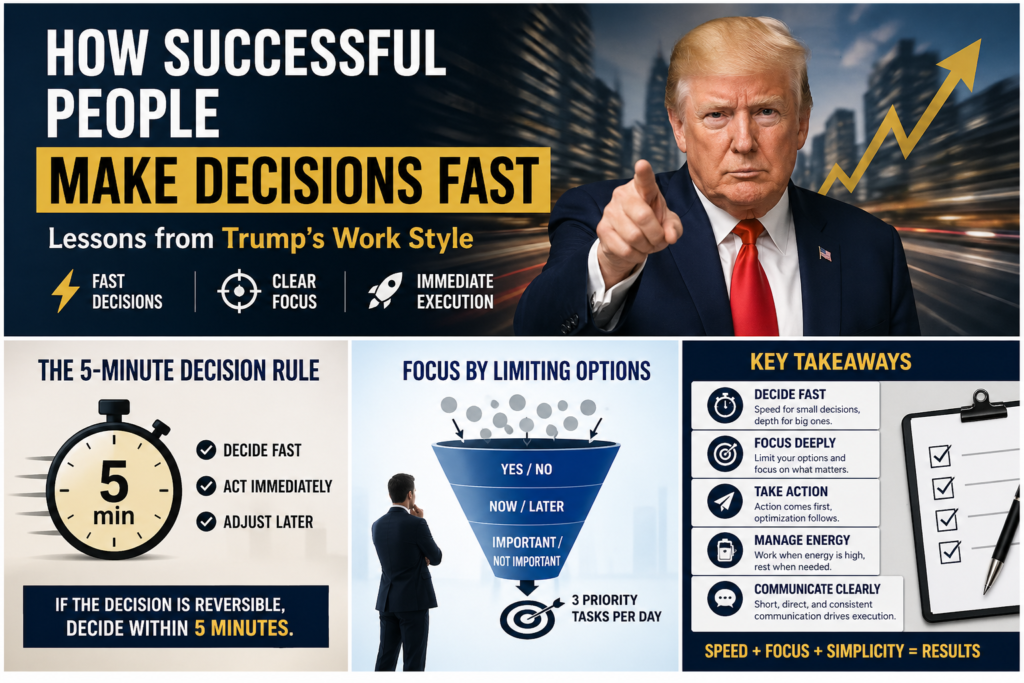
Making decisions quickly is one of the most underrated productivity skills.
Many people struggle not because they lack ability — but because they hesitate, overthink, and delay action.
In high-pressure environments like business or leadership, slow decisions often cost more than wrong ones.
This is why some high-level leaders, including Donald Trump, are known for a very specific pattern:
👉 fast decisions, clear focus, and immediate execution
In this article, we’ll break down what that actually means — and how you can apply it in your daily routine.
Why Fast Decision-Making Matters
Most daily tasks don’t require perfect decisions.
But many people treat them as if they do.
This creates:
Decision fatigue
Delayed execution
Mental overload
High performers avoid this by using a simple rule:
👉 Speed for small decisions, depth for big ones
1. The 5-Minute Decision Rule
One pattern often observed in fast-paced leadership environments is making decisions quickly when the risk is low.
Instead of analyzing endlessly, the focus is:
Decide fast
Act immediately
Adjust later
Real Example
During his time in business and media, Trump was known for making quick, instinct-based decisions in meetings rather than extending discussions unnecessarily.
In many cases, he preferred to move forward with a direction and refine it later, instead of delaying action for more data.
What I applied
I started using this rule:
👉 If the decision is reversible, decide within 5 minutes.
Result
Less hesitation
Faster workflow
More completed tasks
2. Focus by Limiting Options
Another key insight:
👉 Too many choices reduce productivity
Real Example
Throughout his presidency, Trump consistently repeated a small number of key themes in communication, rather than expanding into too many directions.
From a productivity perspective, this reflects a principle:
👉 limit inputs to strengthen focus
What I applied
Instead of long to-do lists:
👉 I now define 3 priority tasks per day
Result
Better focus
Less distraction
More meaningful output
3. Action First, Optimization Later
One common mistake:
👉 Trying to optimize before starting
Real Example
Trump’s business style often emphasized speed of execution over perfect planning, especially in deal-making scenarios where timing mattered more than detailed forecasting.
What I applied
I stopped over-planning and started:
👉 Draft → Execute → Improve
Result
More output
Less delay
Better momentum
4. Energy-Based Productivity
Instead of strict scheduling, high performers often:
Work when energy is high
Rest when focus drops
Real Example
Trump has publicly stated that he operates with a relatively flexible schedule and tends to act quickly when something requires attention, rather than strictly following rigid time blocks.
This reflects a more energy-driven workflow.
What I applied
Deep work during peak hours
Simple tasks during low energy
Result
Higher efficiency
Less burnout
5. Communication as Execution
Fast decision-makers use communication differently.
Instead of long explanations, they:
Keep messages short
Repeat key priorities
Reduce ambiguity
Real Example
Trump frequently used direct communication channels to deliver messages quickly and consistently, often prioritizing speed and clarity over long-form explanation.
From a productivity perspective:
👉 communication becomes part of execution
What I applied
Shorter emails
Clear instructions
Direct messaging
Result
Faster alignment
Less confusion
Where This Approach Can Fail
Speed is powerful — but not always correct.
Risks include:
Poor decisions
Oversimplification
Missing critical details
Balance strategy
👉 Fast decisions → small tasks 👉 Slow thinking → important decisions
What I Learned After Applying This
After testing these ideas, three changes stood out:
1. I stopped overthinking
→ More mental clarity
2. I reduced my task list
→ Better focus
3. I acted faster
→ More results
If you want to turn these decision-making strategies into consistent results, building the right habits is essential.
Final Insight
You don’t need to copy someone’s entire system.
But you can extract what works.
👉 Speed, focus, and simplicity are powerful when applied correctly
DECISION MAKING & PRODUCTIVITY
Recommended Reading
Explore more articles about fast decision-making, mental clarity, focus systems, productivity psychology, and reducing overthinking in daily life.