Introduction
Most productivity advice focuses on motivation, discipline, or time management.
NASA does not.
NASA builds systems where failure is designed out of the process.
When missions involve human life, complex engineering, and zero margin for error,
there is no room for guesswork or inconsistency.
Instead, NASA relies on something far more powerful:
👉 clear objectives, structured systems, and controlled execution
In this article, you’ll learn 5 productivity lessons from NASA missions —
and how to apply them in your daily routine.
Why NASA’s Productivity System Is Different
Before the lessons, understand this:
NASA does not optimize for speed.
NASA optimizes for reliability.
While most people focus on doing more,
NASA focuses on:
- reducing uncertainty
- eliminating errors
- creating repeatable processes
👉 That’s what makes their system powerful.
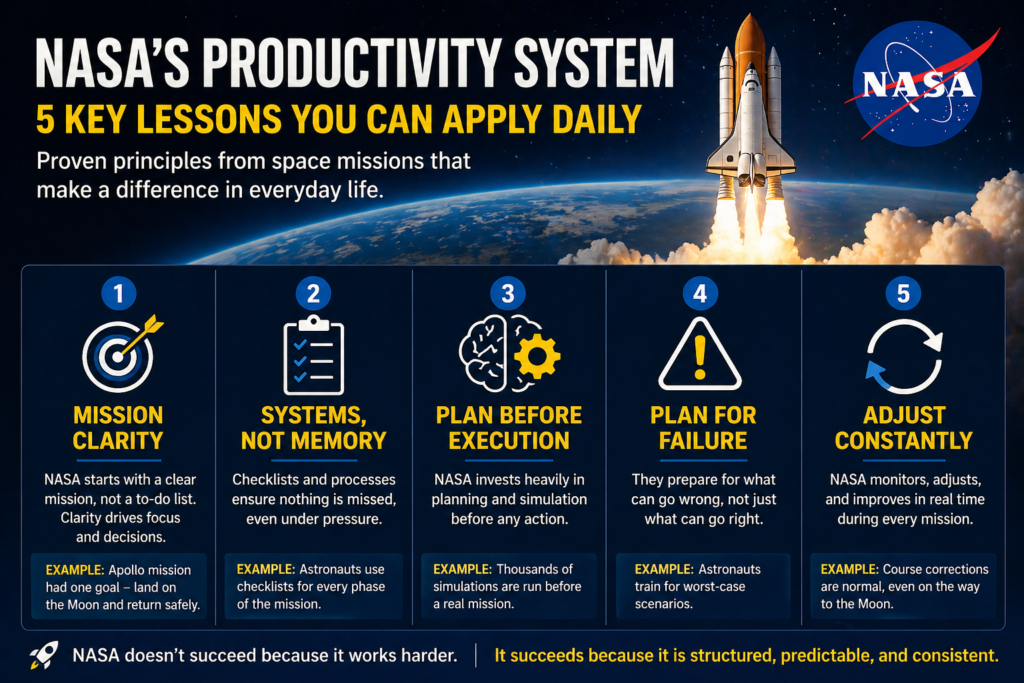
1. Start with Mission Clarity (Not Tasks)
Real Example
During the Apollo program, NASA defined one clear goal:
👉 “Land a man on the Moon and return him safely to Earth.”
No vague objectives. No competing priorities.
Why it works
Clear goals eliminate confusion and decision fatigue.
How to apply
Instead of starting with a to-do list, define:
👉 one mission for the day
Example:
❌ “Be productive”
✔ “Complete 3 priority tasks before 5 PM”
Result
- better focus
- faster execution
- less mental overload
2. Build Systems, Not Memory
Real Example
NASA relies heavily on checklists — even for highly trained astronauts.
Because under pressure:
👉 humans forget
Why it works
Memory is unreliable. Systems are not.
How to apply
Use checklists for:
- daily routine
- work processes
- repetitive tasks
Result
- fewer mistakes
- faster workflow
- reduced cognitive load
3. Separate Thinking from Execution
Real Example
NASA spends extensive time on planning and simulation before execution.
Once a mission starts:
👉 execution follows predefined steps
Why it works
Switching between thinking and doing slows everything down.
How to apply
Split your workflow:
- plan first
- execute later
Avoid mixing both.
Result
- higher efficiency
- clearer decisions
- better output quality
4. Plan for Failure, Not Success
Real Example
NASA trains astronauts using failure simulations.
They prepare for:
- system breakdowns
- unexpected conditions
- communication loss
Because in real missions:
👉 something will go wrong
Why it works
Preparation reduces uncertainty.
How to apply
Before starting a task, ask:
👉 “What could fail?”
Then prepare for it.
Result
- better decisions
- fewer disruptions
- more confidence
5. Adjust Constantly (Execution Is Dynamic)
Real Example
During Apollo 11, the spacecraft required multiple course corrections.
It didn’t follow a perfect path.
It adapted continuously.
Why it works
No plan is perfect.
How to apply
At the end of each day:
- review progress
- identify problems
- adjust strategy
Result
- continuous improvement
- faster learning
- better long-term performance
The Real NASA Productivity Principle
Most people try to work harder.
NASA works differently:
👉 it reduces uncertainty before execution begins
That’s the key.
How I Apply NASA’s Principles in Real Life (Practical Suggestions)
NASA’s approach is powerful, but it only matters if it can be applied in real life.
Here’s how I translated these ideas into a practical daily system.
1. Turning “Mission Clarity” into a Daily System
NASA starts with a mission — not tasks.
So instead of writing a long to-do list, I changed one simple thing:
👉 I define one main mission per day
Example
Instead of:
- Reply to emails
- Write content
- Organize notes
I define:
👉 “Finish and publish one high-quality article”
What changed
- I stopped multitasking
- My focus became sharper
- I completed more meaningful work
2. Designing My Own “Checklist System”
NASA doesn’t rely on memory — and neither should we.
So I created a simple checklist for repetitive work.
Example (writing workflow)
- Topic defined
- Structure created
- Draft completed
- Editing done
- SEO checked
What changed
- Fewer mistakes
- Faster completion
- Less mental fatigue
👉 I no longer “think” about what to do — I just follow the system.
3. Separating Thinking Time from Execution Time
Before, I mixed everything:
- planning
- thinking
- doing
Now I split them.
My structure
- Morning → thinking & planning
- Afternoon → execution
What changed
- Less confusion
- Faster execution
- Better quality work
👉 This is one of the biggest improvements I noticed.
4. Planning for Failure in Daily Work
NASA prepares for failure — not just success.
I started doing the same.
Example
Before publishing a post, I ask:
- What if no one clicks?
- What if it doesn’t rank?
- What if the title is weak?
What I do
- Write 2–3 title variations
- Improve structure before publishing
- Add internal links
Result
- More stable performance
- Less frustration
- Better long-term growth
5. Daily Adjustment System
NASA constantly adjusts during missions.
So I added a simple review system.
Every night (5 minutes)
- What worked today?
- What didn’t?
- What will I change tomorrow?
What changed
- Faster improvement
- Clear direction
- No wasted effort
My Suggestion (If You Want to Apply This)
Don’t try to apply everything at once.
Start with just one:
👉 Define a “daily mission” instead of a to-do list
That alone can change how you work.
Final Personal Insight
What surprised me most is this:
👉 Productivity is not about working harder
It’s about removing uncertainty before you start
That’s what NASA does —
and that’s what actually works.
Conclusion
If you want to improve your productivity:
- define your mission
- build simple systems
- prepare for failure
- adjust constantly
That’s how real execution works.
Recommended Reading
Explore more articles about focus, productivity systems, decision-making, mental clarity, and high-performance habits inspired by NASA-style thinking.
How to Make Decisions Fast
Learn how to reduce overthinking, improve clarity, and make faster decisions under pressure.
FocusWhy I Can’t Focus Anymore
Understand how digital overload and mental distractions quietly destroy concentration and deep work.
AI ProductivityI Used AI to Plan My Daily Routine
Discover how structured systems and AI tools can improve consistency, focus, and daily efficiency.
Time Management10 Things That Waste Your Time Without You Noticing
Identify hidden habits and distractions that silently reduce productivity and mental energy.
External References
- Fast Company: NASA Astronaut Productivity Trick — Former astronaut Mike Massimino explains the “30-second rule” used to recover quickly from mistakes and regain focus.
- How NASA Teams Work — Practical lessons from NASA about systems thinking, delegation, communication, and high-performance teamwork.
- NASA Research on Staying Focused — Research-backed productivity advice inspired by how astronauts maintain concentration during complex missions.
- Deep Work by Cal Newport — A practical framework for improving concentration, reducing distractions, and protecting deep work time.
You May Also Like