When productivity tools don’t create discipline—and what to do about it.
ai habit drift productivity focus consistency problem
Introduction
AI tools promise a simple upgrade: better planning, faster writing, cleaner workflows. Yet many people notice the same pattern after a few weeks:
the system looks organized
the tools are still installed
but the habit is gone
This quiet breakdown has a name:
👉 AI Habit Drift
It’s the gradual loss of consistency despite having powerful tools.
The problem isn’t that AI doesn’t work. It’s that most setups optimize for starting tasks, not sustaining behavior.
This guide explains why AI Habit Drift happens—and how to design a system that holds up over time.
What Is AI Habit Drift?
AI Habit Drift is the gap between tool usage and behavioral consistency.
You might:
generate a daily plan with ChatGPT
track tasks in Notion
auto-schedule blocks in your calendar
…and still fail to follow through.
The drift shows up as:
skipped routines after initial momentum
increasing friction to “get back on track”
reliance on motivation instead of structure
In short:
👉 the system exists, but it no longer drives action
Why It Happens (Even with Good Tools)
1) Tools Optimize for Output, Not Behavior
Most AI tools are built to produce content or organize tasks—not to enforce repetition.
You can generate a perfect plan in seconds. But execution depends on what you do at 9:00 a.m., not what you generated at 8:55.
“We are what we repeatedly do. Excellence, then, is not an act, but a habit.” — commonly attributed to Aristotle
2) Decision Fatigue Creeps Back In
AI reduces big decisions—but often increases small ones:
Which prompt should I use today?
Should I follow yesterday’s plan or regenerate?
Which tool should I open first?
Behavioral research consistently shows that frequent decisions degrade follow-through. When every step requires a choice, consistency breaks.
3) Systems Are Not Anchored to Time
A list is not a routine.
If your system doesn’t specify when something happens, it competes with everything else in your day.
That’s why many AI-driven plans fail after the novelty fades: they lack time anchors.
4) Too Many Tools, Too Little Friction Control
Ironically, more tools often create more friction:
switching between apps
duplicating information
maintaining multiple “sources of truth”
A study on task switching (Rubinstein, Meyer & Evans) found measurable costs in both time and accuracy. When your workflow fragments, consistency becomes expensive.
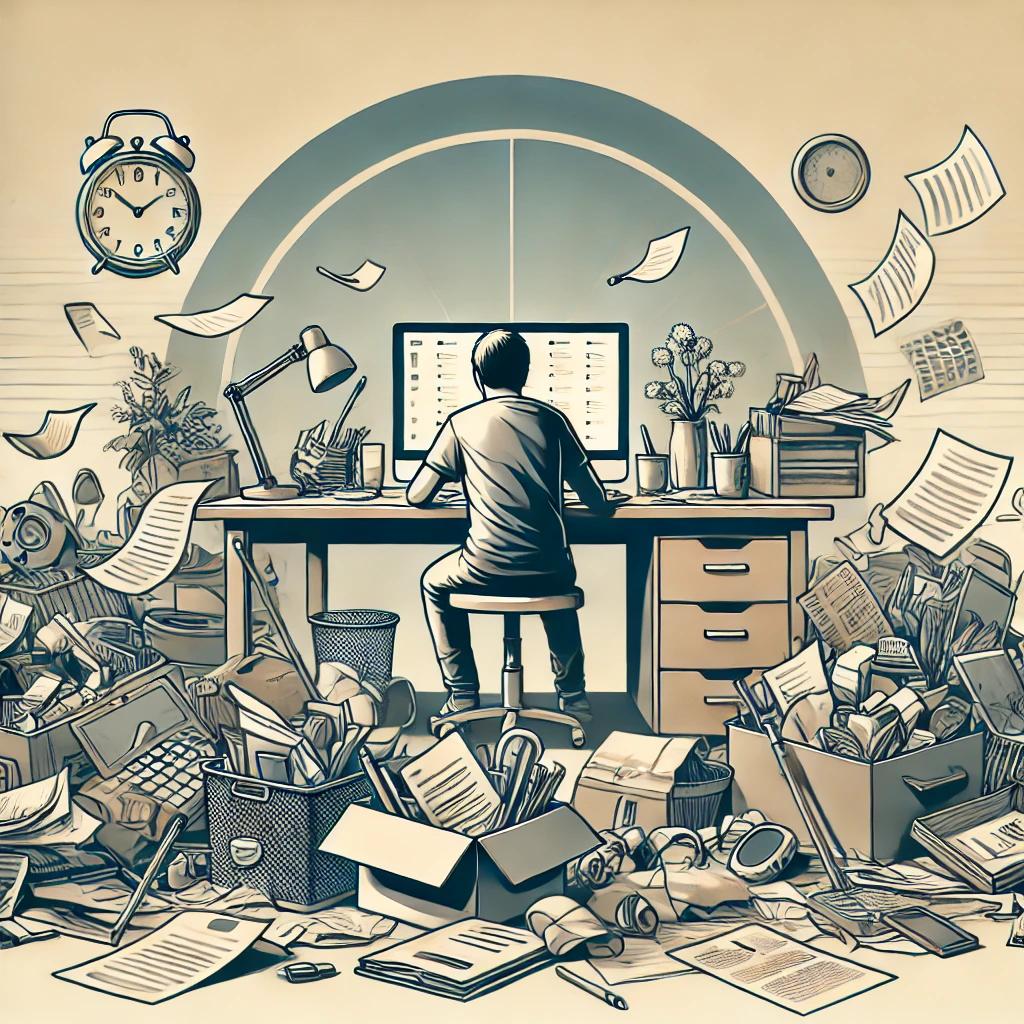
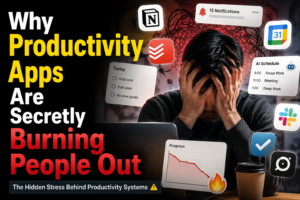
A cluttered workspace showing a person overwhelmed by too many tasks and tools, illustrating how productivity systems can fail without clear structure and focus.
A Real-World Pattern (What Drift Looks Like)
Week 1:
You generate a clean daily plan
You follow it closely
Output increases
Week 3:
You still generate plans
You follow them partially
You skip the first block “just this once”
Week 6:
The system exists
The habit doesn’t
👉 That’s AI Habit Drift.
The Fix: Design for Behavior, Not Just Tools
Principle 1 — Lock a “Start Action” (Not a Full Plan)
Don’t begin your day with a full AI-generated schedule.
Begin with a single, fixed start action:
same time
same place
same task type
Example: 9:00–9:30 → write (no prompts, no planning, just start)
Once the behavior begins, you can use AI to extend it. But the first step must be decision-free.
Principle 2 — Use AI for Preparation, Not Initiation
Let AI do the setup before execution time:
outline tasks the night before
pre-generate tomorrow’s checklist
define the first 2 steps in advance
This removes morning friction.
👉 AI prepares. 👉 You execute.
Principle 3 — Reduce the System to One Flow
Choose a single primary flow:
one planning tool (e.g., Notion or a simple doc)
one execution space
one review loop
Everything else becomes optional.
The more places you can start, the easier it is not to start at all.
Principle 4 — Add Time Anchors (Non-Negotiable Blocks)
A task without time competes with everything.
Define fixed blocks:
9:00–10:00 → deep work
14:00–14:30 → admin
Even if the output varies, the behavior repeats.
Principle 5 — Build a Daily Feedback Loop
Consistency improves when feedback is immediate.
End each day with 3 questions:
What did I actually complete?
Where did I drift?
What will I simplify tomorrow?
This aligns with deliberate practice research (Ericsson): 👉 feedback + adjustment = improvement
A Simple AI Habit System (That Doesn’t Drift)
Night (5 minutes)
Ask AI: “List my top 3 priorities for tomorrow”
Define first action for each
Morning (no thinking)
Start fixed block (no tools yet)
Execute first action
During work
Use AI only when needed (not constantly)
Evening (review)
Adjust tomorrow’s starting point
What Changes When You Fix the Drift
you stop restarting systems every week
you reduce dependence on motivation
you produce consistently, not occasionally
Most importantly:
👉 your system begins to run even when you don’t feel like it
A Short Note on AI Expectations
Recent workplace reports consistently show that AI can save time on tasks—but time saved does not automatically become consistent output.
That gap is behavioral.
AI accelerates execution. It does not replace discipline.
Final Insight
AI Habit Drift is not a failure of tools.
It’s a mismatch between:
how tools are designed
and how habits actually form
If you want consistency:
👉 don’t build a better tool stack 👉 build a better starting point
Conclusion
You don’t need more apps. You need fewer decisions at the moment of action.
fix the start
anchor your time
simplify the system
review daily
Do that, and AI becomes what it should be:
👉 a support system for consistency—not a substitute for it
AI HABITS & CONSISTENCY
Recommended Reading
Explore more articles about AI-driven habits, productivity systems, mental consistency, focus recovery, and how to avoid behavioral drift in daily routines.



Pingback: Why Productivity Tools Are Making You Less Productive
Pingback: Fix Your Productivity System with AI (Stop Relying on Tools)
Pingback: AI Decision Fatigue: Why You Feel Mentally Tired