How does Jerome Powell make high-stakes decisions? Learn the real decision-making principles behind Fed policy and what most people misunderstand.
How Jerome Powell makes decisions under uncertainty using data, risk management, and controlled strategy. A simple framework for decision-making under uncertainty: define risks, evaluate outcomes, plan for downside, and avoid emotional reactions.
Why Everyone Is Suddenly Talking About Jerome Powell
If you’ve searched “Jerome Powell” recently, you’ve probably seen headlines about interest rates, inflation, or the Federal Reserve.
But most articles focus on what he said.
Very few explain something more important:
👉 How he makes decisions when the outcome is uncertain.
And that’s the part that actually matters.
What Makes Jerome Powell’s Decisions So Difficult
Every decision the Federal Reserve makes involves trade-offs.
Raise rates too fast:
inflation slows
but economic growth suffers
Lower rates too early:
growth increases
but inflation may return
👉 There is no perfect answer.
Only better or worse decisions under uncertainty.
The Real Skill: Decision-Making Under Uncertainty
Searches like “Fed decision making” or “interest rate decisions” are rising for a reason.
People want certainty.
But Powell operates in a system where certainty doesn’t exist.
What this means in practice:
data is incomplete
outcomes are delayed
consequences are global
👉 This is the definition of high-stakes decision-making.
Why Most People Misunderstand Powell
Here’s the mistake.
People judge decisions based on outcomes.
👉 Not based on the quality of the decision itself.
Example:
If inflation drops → “Good decision”
If markets fall → “Bad decision”
But this is flawed thinking.
Because:
👉 a good decision can still lead to a bad outcome
The Psychology Behind This Mistake
Behavioral research shows a consistent bias:
👉 humans evaluate decisions using results, not reasoning
This is known as outcome bias.
What outcome bias looks like:
judging based on hindsight
ignoring uncertainty at the time
overestimating predictability
How Powell Actually Approaches Decisions
While no public figure reveals everything, consistent patterns show:
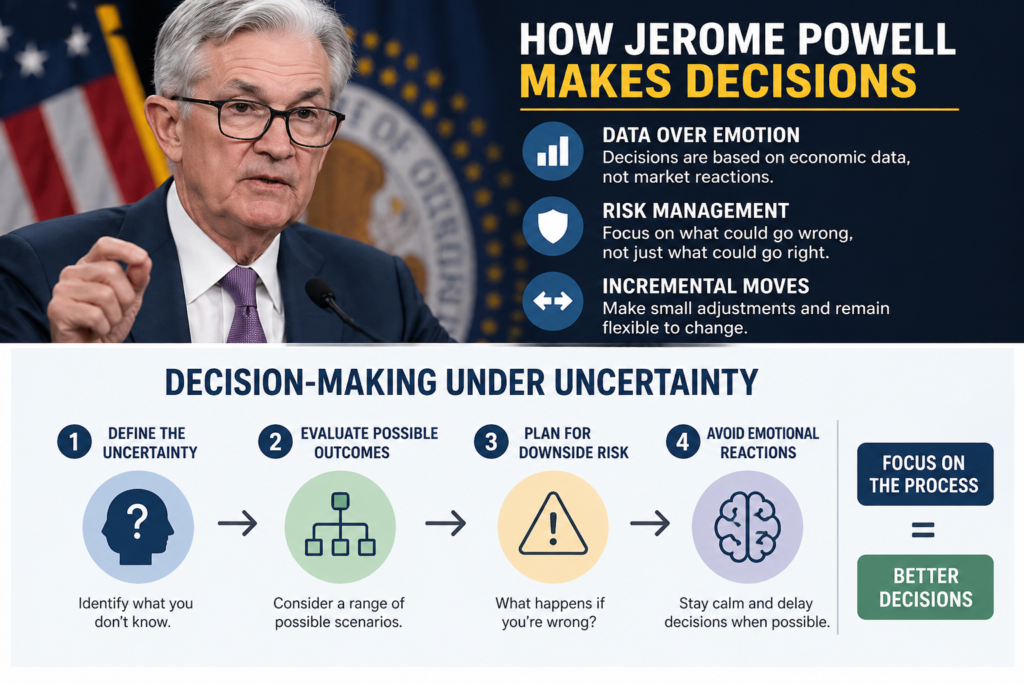
✔ 1. Data Over Emotion
Decisions are based on:
inflation trends
employment data
financial stability indicators
Not market reactions.
✔ 2. Risk Management Thinking
Instead of asking:
“Will this work?”
The real question is:
👉 “What happens if we’re wrong?”
✔ 3. Incremental Moves
Rather than drastic changes:
small adjustments
continuous evaluation
flexibility to pivot
Why This Matters for You
This isn’t just about the Fed.
The same thinking applies to:
investing
business decisions
career choices
Most people:
react quickly
follow headlines
chase short-term outcomes
Better decision-makers:
think in probabilities
accept uncertainty
focus on process over outcome
A Simple Framework You Can Use
If you want to make better decisions, use this:
Step 1: Define the uncertainty
What do you not know?
Step 2: Evaluate possible outcomes
Not just the most likely one.
Step 3: Plan for downside risk
What if you’re wrong?
Step 4: Avoid emotional reactions
Delay decisions when possible.
Real-World Example (Why This Thinking Works)
Look at market reactions to Fed announcements.
Often:
Powell speaks → markets drop
days later → markets recover
Why?
👉 Initial reactions are emotional. 👉 Long-term movements reflect fundamentals.
What Most Articles Miss
Most coverage answers:
What did Powell say?
What will rates be?
But the more valuable question is:
👉 How are decisions made when there is no clear answer?
Why This Topic Gets Search Traffic
People searching:
“Jerome Powell”
“Fed rate decisions”
“interest rate outlook”
are really asking:
👉 “What should I do?”
That’s why articles that explain thinking, not just news, perform better long-term.
Final Insight
Jerome Powell’s job isn’t to be right.
👉 It’s to make the best possible decision with limited information.
And that’s exactly the challenge most people face every day.
LEADERSHIP & DECISION MAKING
Recommended Reading
Explore more articles about high-pressure decision-making, leadership psychology, economic uncertainty, focus under stress, and how disciplined thinking shapes long-term outcomes.
Jerome Powell’s Final Fed Press Conference
— Powell emphasized data-driven decision-making, caution under uncertainty, and resisting political pressure while managing inflation and employment risks.
Reuters: Powell on Economic Resilience
— Reuters coverage of Powell’s leadership approach during inflation pressure, geopolitical uncertainty, and divided Fed opinions.
Axios: Powell’s Final Fed Decision
— Analysis of Powell’s calm but cautious leadership style during one of the Fed’s most internally divided periods in decades.
Why Jerome Powell Stayed at the Fed
— Coverage of Powell’s decision to remain at the Federal Reserve Board and his defense of institutional independence.