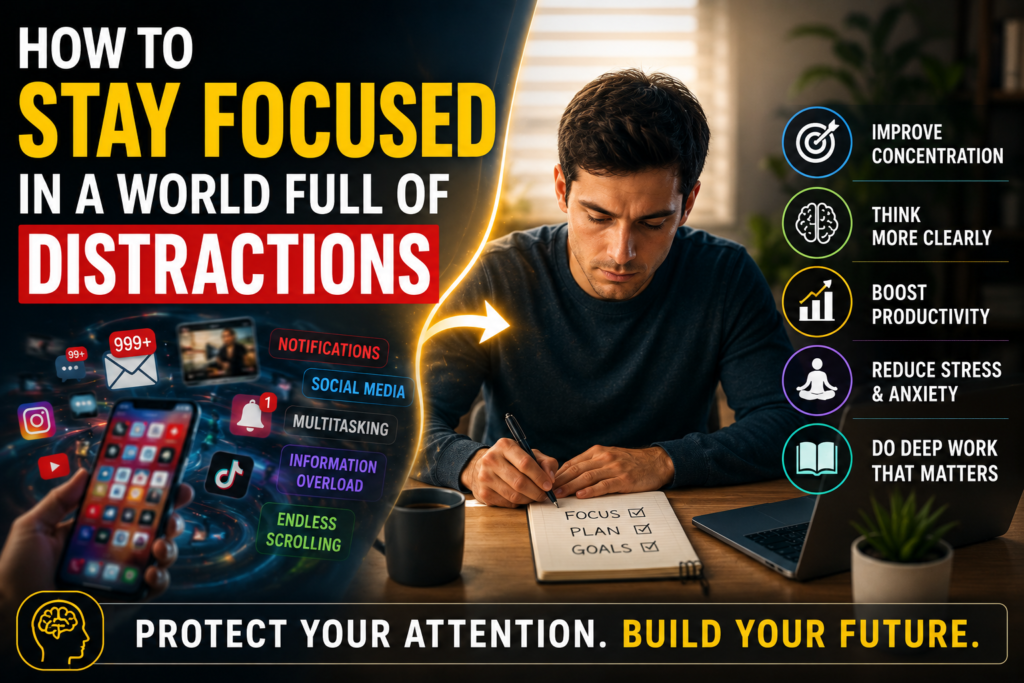
Modern distractions are constantly competing for your attention. Protecting your focus may become one of the most valuable skills in the digital age.
How to Stay Focused in a World Full of Distractions
Modern life constantly fights for your attention.
Notifications interrupt your thoughts. Social media pulls you into endless scrolling. Short-form content trains the brain to expect constant stimulation.
Even when people want to focus, many feel mentally scattered within minutes.
For millions of people, concentration no longer feels natural.
It feels exhausting.
The problem is not simply a lack of discipline.
The modern world is designed around distraction.
Technology companies compete aggressively for human attention because attention has become one of the most valuable resources in the digital economy.
That means staying focused today requires more than motivation.
It requires protecting your brain from nonstop cognitive overload.
Why Focus Feels Harder Than Ever
Human attention evolved in environments very different from modern digital life.
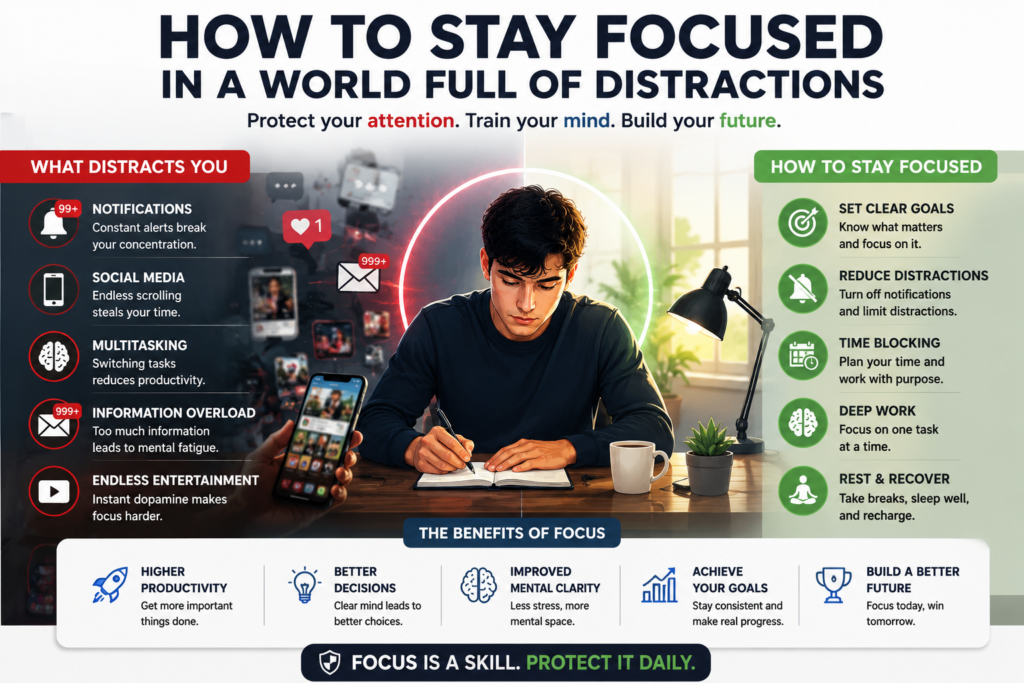
Today, most people experience:
Endless notifications
Constant multitasking
AI-generated information overload
Social media stimulation
Continuous interruptions
Rapid context switching
The brain struggles when it receives too much information too quickly.
Researchers studying cognitive overload have repeatedly found that excessive stimulation reduces concentration, decision quality, and mental clarity.
In Deep Work, author Cal Newport argues that modern distraction is destroying the ability to think deeply.
Deep focus is becoming increasingly rare.
And that rarity makes it more valuable than ever.
The Attention Economy Is Designed to Distract You
Most digital platforms make money from engagement.
The longer users remain online, the more profitable those users become.
As a result, algorithms are carefully optimized to maximize:
Scroll time
Emotional reactions
Notification engagement
Content consumption
Habit formation
This creates an environment where distraction is not accidental.
It is engineered.
Social media feeds, short-form videos, infinite scrolling, and personalized recommendations all compete aggressively for cognitive attention.
Your brain is constantly being pulled away from sustained focus.
Dopamine and the Modern Focus Problem
Many distraction systems operate through dopamine-driven reward loops.
Dopamine is associated with:
Motivation
Reward anticipation
Novelty-seeking behavior
Every time people check their phones, refresh feeds, or open apps, the brain anticipates possible rewards:
New messages
Viral content
Notifications
Entertainment
Social validation
This creates powerful behavioral habits.
Over time, the brain becomes conditioned to seek constant novelty.
As a result, slower activities begin to feel mentally uncomfortable.
This is one reason many people struggle to:
Read books deeply
Study without checking devices
Work uninterrupted
Stay mentally present
The brain gradually adapts to distraction.
Why Multitasking Quietly Destroys Focus
Many people believe multitasking improves productivity.
Research consistently suggests the opposite.
The brain does not truly focus on multiple complex tasks simultaneously.
Instead, it rapidly switches between them.
Every switch creates a small cognitive cost.
Over time, excessive task switching increases:
Mental fatigue
Attention fragmentation
Reduced memory retention
Lower productivity
Cognitive exhaustion
This is why many people feel mentally drained after constantly switching between emails, messages, tabs, and apps all day.
The brain loses depth when attention becomes fragmented.
Why Your Environment Matters More Than Motivation
Focus is heavily influenced by environment.
People often blame themselves for distraction while ignoring the systems surrounding them.
But environmental cues strongly affect attention.
For example:
Visible phones increase distraction
Notifications interrupt cognitive flow
Cluttered spaces increase mental noise
Open tabs encourage task switching
Researchers in behavioral psychology consistently find that behavior becomes easier when environments support it.
This means focus improves dramatically when distractions are reduced before work even begins.
AI and Information Overload Are Making Focus Worse
AI tools improve productivity in many ways.
But they also increase the amount of information humans process every day.
People now receive:
AI-generated summaries
Constant recommendations
Personalized feeds
Faster information cycles
Endless content generation
The brain struggles when recovery time disappears.
Many people now experience:
Brain fog
Attention fatigue
Mental overstimulation
Productivity burnout
Reduced patience
The nervous system becomes overloaded from continuous cognitive input.
Why Silence Feels Uncomfortable Now
Many people can no longer sit quietly without stimulation.
Moments of boredom often trigger automatic phone checking.
This happens because the brain becomes accustomed to continuous dopamine stimulation.
Historically, boredom helped humans:
Reflect
Process emotions
Think creatively
Recover mentally
Build concentration
Today, boredom is interrupted almost instantly by digital input.
Without quiet mental space, attention weakens over time.
Stress and Anxiety Also Damage Concentration
Chronic stress significantly affects focus.
When cortisol levels remain elevated, the brain prioritizes survival-focused thinking instead of deep concentration.
Modern stress often comes from:
Information overload
Productivity pressure
Financial anxiety
Social comparison
Constant connectivity
The nervous system rarely fully relaxes.
As a result, mental clarity becomes harder to maintain.
This is one reason many people feel mentally exhausted despite not doing physically demanding work.
How to Rebuild Focus in a Distracted World
Focus is not just a talent.
It is a trainable cognitive skill.
Like physical fitness, concentration strengthens when practiced consistently.
Several habits are especially effective for rebuilding attention.
1. Reduce Notifications Aggressively
Notifications constantly break cognitive flow.
Even brief interruptions reduce concentration significantly.
Turning off unnecessary alerts immediately improves mental stability.
Many high performers intentionally create low-interruption environments because attention recovery takes longer than most people realize.
2. Practice Single-Task Focus
Deep concentration requires sustained attention.
Try focusing on one task at a time without switching tabs, checking messages, or opening social media.
Even short periods of uninterrupted work help retrain the brain for deeper concentration.
3. Create Screen-Free Recovery Time
The brain needs periods without stimulation.
Walking outside, sitting quietly, reading offline, or spending time away from screens helps the nervous system recover.
Mental clarity improves when cognitive overload decreases.
4. Protect Sleep Quality
Sleep heavily affects:
Memory
Focus
Emotional regulation
Mental energy
Poor sleep weakens concentration dramatically.
Late-night scrolling and excessive screen exposure often make focus problems worse the following day.
5. Allow Boredom Sometimes
Boredom is not always negative.
It gives the brain space to process thoughts, recover attention, and rebuild concentration.
Many creative insights emerge during periods of low stimulation.
The brain needs silence more than modern culture admits.
Why Focus Is Becoming a Competitive Advantage
As distraction increases globally, sustained focus becomes increasingly rare.
People who can think deeply now possess a major advantage in:
Learning
Creativity
Problem-solving
Productivity
Emotional regulation
In a world filled with endless stimulation, attention itself becomes valuable.
Focus may become one of the most important cognitive skills of the modern era.
Modern distractions constantly compete for your attention. Building focus requires reducing digital overload, protecting mental energy, and creating space for deep work.
Final Thoughts
Staying focused today is difficult because modern systems are designed to compete for your attention constantly.
The problem is not simply personal weakness.
The digital world rewards distraction, speed, novelty, and endless stimulation.
But the brain still requires:
Recovery
Silence
Deep concentration
Mental rest
Focus improves when people intentionally protect attention instead of constantly exposing it to interruption.
Because in a distracted world, attention is no longer automatic.
It is something people must actively defend.
FOCUS & DIGITAL DISTRACTIONS
Recommended Reading
Explore more articles about focus, attention span, brain fog, digital distractions, deep work, and how to protect your mental clarity in a noisy world.