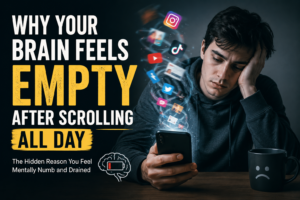
The Hidden Cost of Living in a Constantly Distracted World
You open your laptop to finish one task.
A few seconds later, your phone vibrates.
Then a notification appears on your screen. Someone sent a message. An email arrives. A short video catches your attention. Suddenly, twenty minutes disappear without you realizing it.
For many people, this has become normal life.
And that is exactly why so many people now search questions like:
“Why is my attention span getting worse?”
“Why can’t I focus anymore?”
“How do I improve my attention span?”
“Why do I get distracted so easily?”
The truth is uncomfortable:
Modern digital environments are actively training the brain to lose focus.
This is not simply about discipline or laziness. It is about how technology, dopamine, stress, and information overload are reshaping human attention.
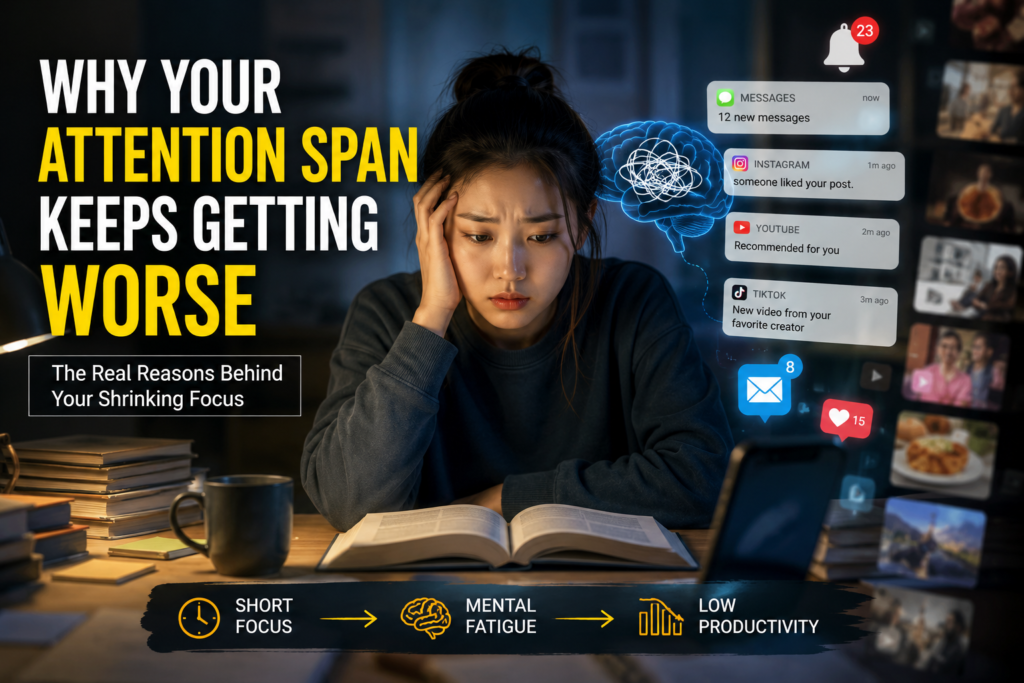
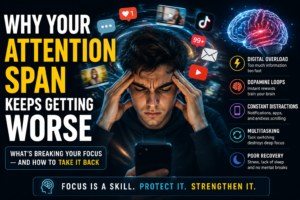
Why Your Attention Span Keeps Getting Worse
Attention span is your brain’s ability to stay engaged with one task without constantly seeking new stimulation.
The problem is that modern life rewards interruption.
Every day, your brain processes:
notifications
short-form videos
emails
social media
advertisements
endless scrolling
multitasking
Instead of staying focused deeply on one thing, the brain constantly switches between tiny bursts of stimulation.
Over time, concentration becomes fragmented.
This is one reason why many people now struggle to:
finish books
study for long periods
watch long videos
complete deep work
stay mentally present
Even activities that once felt easy now feel mentally exhausting.
Social Media Is Rewiring Human Attention
One of the biggest causes of shrinking attention span is short-form content.
Platforms like TikTok, Instagram Reels, and YouTube Shorts are designed around rapid dopamine rewards.
Every swipe creates:
novelty
unpredictability
emotional stimulation
instant feedback
This creates what psychologists often call a “variable reward loop.”
Your brain never knows what the next swipe will deliver, which makes the experience addictive.
Books like Dopamine Nation explain how repeated overstimulation changes reward sensitivity and increases compulsive behavior.
At the same time, the brain slowly becomes less comfortable with slower, quieter activities.
That means:
reading feels harder
silence feels uncomfortable
deep focus feels mentally painful
The brain begins expecting constant stimulation.
Why Notifications Destroy Focus Faster Than You Think
Notifications are not harmless interruptions.
Every notification forces the brain to shift attention.
Researchers studying “attention residue” found that even brief interruptions reduce cognitive performance and make it harder to return to deep focus.
This is why many people feel mentally drained despite “not doing much.”
Their brain never stays in one cognitive state long enough to fully engage.
The average smartphone user now checks their phone dozens — sometimes hundreds — of times per day.
Many of those checks happen automatically.
Without conscious thought.
The Rise of Digital Overload
Modern life exposes people to more information in one day than previous generations processed in weeks.
News alerts. Emails. Group chats. Social media updates. Streaming platforms. Algorithm-driven feeds.
Your brain is constantly filtering signals.
This creates cognitive overload.
And cognitive overload reduces:
concentration
memory
mental clarity
emotional regulation
Books like Stolen Focus explore how constant distraction is affecting modern attention spans at a societal level.
The issue is not intelligence.
It is overstimulation.
Why You Can’t Focus Anymore
Many people believe they have suddenly become less disciplined.
But in reality, attention works similarly to physical fitness.
The brain adapts to whatever it practices most often.
If your daily environment trains:
rapid scrolling
multitasking
constant switching
endless novelty
Then sustained focus becomes weaker over time.
The brain learns speed instead of depth.
This is why many people feel uncomfortable when they try to:
read quietly
study deeply
work without music or notifications
sit without stimulation
The nervous system becomes dependent on constant input.
Multitasking Is Quietly Damaging Your Brain
Multitasking feels productive.
But neuroscience research repeatedly shows that multitasking reduces efficiency and increases mental fatigue.
When the brain constantly switches between tasks, it consumes more cognitive energy.
That leads to:
lower productivity
more mistakes
mental exhaustion
shorter attention span
This is one reason why many high performers now prioritize:
deep work
monotasking
distraction-free environments
instead of constant connectivity.
The Link Between Dopamine and Attention Span
Dopamine is often misunderstood.
It is not simply the “pleasure chemical.”
Dopamine is heavily connected to motivation, anticipation, and reward-seeking behavior.
Short-form content floods the brain with fast dopamine spikes.
But over time, ordinary tasks begin feeling less stimulating by comparison.
This creates a dangerous cycle:
normal work feels boring
scrolling feels easier
focus becomes harder
attention span weakens further
Eventually, many people begin feeling mentally restless all the time.
Even during rest.
Why Mental Fatigue Makes Attention Worse
Sleep deprivation, stress, and burnout also reduce attention span dramatically.
According to reports discussed by organizations like the American Psychological Association, chronic stress directly affects concentration, memory, and decision-making ability.
When the brain is overwhelmed, it seeks easier forms of stimulation.
That is why mentally exhausted people often end up:
scrolling more
procrastinating more
switching tasks more often
Even when they genuinely want to focus.
How to Improve Your Attention Span Again
The good news is that attention can recover.
But improving attention span requires reducing overstimulation first.
Here are strategies that actually help.
1. Reduce Notification Frequency
Turn off unnecessary notifications.
Especially:
social media alerts
shopping notifications
news alerts
recommendation notifications
Every interruption weakens sustained focus.
2. Create “Low-Stimulation” Time
Your brain needs moments without constant input.
Try:
walking without headphones
reading physical books
quiet mornings
phone-free meals
screen-free evenings
At first, this may feel uncomfortable.
That discomfort is often a sign that the brain has become overstimulated.
3. Stop Consuming Only Short-Form Content
Short videos train rapid attention switching.
Balance them with:
long-form reading
podcasts
deep conversations
focused work sessions
Attention improves through practice.
4. Practice Single-Tasking
Do one thing at a time.
Not:
five tabs
multiple screens
constant checking
Deep concentration strengthens attention over time.
5. Protect Your Sleep
Poor sleep dramatically reduces focus.
Blue light exposure and nighttime scrolling are strongly linked to cognitive fatigue and reduced attention control.
This is one reason why doomscrolling often creates worse focus the next day.
Why This Problem Is Bigger Than Productivity
Attention is connected to quality of life.
Without attention:
relationships weaken
creativity suffers
learning slows
emotional stability decreases
The modern attention economy profits from distraction.
Which means protecting focus is no longer just a productivity skill.
It is becoming a survival skill.
Final Thoughts
Your attention span is not disappearing because you are lazy.
It is adapting to an environment built around interruption.
The good news is that the brain remains flexible.
Focus can improve. Mental clarity can return. Attention can recover.
But only if you intentionally reduce the noise competing for your mind every day.
SMART SOLUTIONS
Related Posts
Explore more articles about focus, digital distractions, dopamine, and modern productivity.