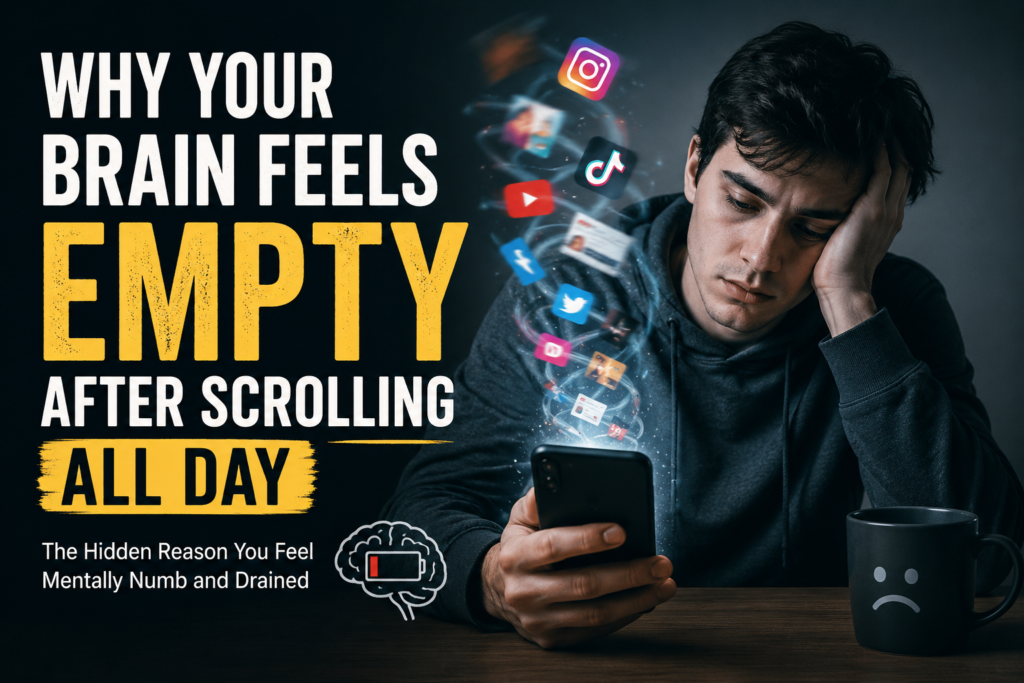
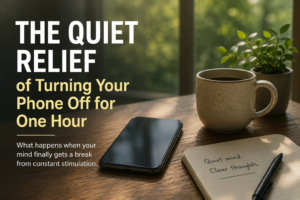
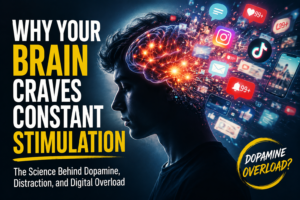
Endless scrolling may be quietly draining your focus, emotions, and mental energy more than you realize.
Why Your Brain Feels Empty After Scrolling All Day
The Strange Feeling Nobody Talks About
You put your phone down after scrolling for an hour.
Maybe it was TikTok. Instagram Reels. YouTube Shorts. Reddit. News headlines. AI feeds. X.
And then it hits you.
Not stress. Not sadness. Not even tiredness.
Just… emptiness.
Your brain feels numb. Your thoughts feel slower. You want stimulation, but nothing feels satisfying anymore.
A few months ago, I noticed this happening almost every night. I would finish work, open my phone “for five minutes,” and suddenly realize an hour had disappeared. The strange part wasn’t the wasted time. It was the emotional flatness afterward.
I wasn’t relaxed.
I wasn’t entertained.
I just felt mentally hollow.
It turns out there’s a real psychological reason for this feeling — and researchers are becoming increasingly concerned about it.
Your Brain Was Never Designed for Infinite Information
Modern scrolling platforms exploit one of the brain’s oldest survival systems:
Variable reward dopamine loops
This concept became famous through behavioral psychology research by B. F. Skinner.
The human brain becomes highly engaged when rewards are unpredictable.
That’s exactly what scrolling apps provide.
One boring post
One emotional story
One funny clip
One shocking headline
One outrage-inducing comment
Your brain keeps pulling the lever because the next piece of content might feel rewarding.
Researchers from Harvard Medical School and other institutions have repeatedly connected social media overuse with dopamine-driven compulsive behavior patterns similar to gambling systems.
The problem is not just stimulation.
It’s overstimulation without recovery.
Why Endless Scrolling Makes Your Brain Feel Emotionally Empty
Most people assume scrolling is “rest.”
Neurologically, it often behaves more like cognitive overload.
Your attention system becomes fragmented
According to research published in journals like Nature Communications and Computers in Human Behavior, rapid context switching weakens sustained attention capacity over time.
Your brain constantly jumps between:
emotional content
political outrage
humor
advertisements
productivity advice
celebrity drama
tragedy
AI-generated media
The nervous system never settles.
After enough stimulation, your brain begins protecting itself by emotionally flattening the experience.
That “empty” feeling is often a form of mental exhaustion.
The Hidden Cost of Doomscrolling
The term “doomscrolling” exploded during the pandemic, but the behavior didn’t disappear afterward.
It evolved.
Today, many people unconsciously scroll not because they enjoy it — but because silence feels uncomfortable.
That’s a major shift.
In his book Stolen Focus, Johann Hari argues that modern digital environments are systematically damaging humanity’s ability to sustain deep attention.
One line from the book became especially popular online:
“Your attention didn’t collapse. It was stolen.”
That resonates because people genuinely feel different now.
Many describe symptoms like:
mental fog
emotional numbness
reduced motivation
inability to focus
constant low-level anxiety
feeling “empty” after being online too long
And increasingly, neuroscientists believe these experiences are connected.
Your Brain Craves Recovery, Not More Content
One of the biggest misconceptions about scrolling is this:
More stimulation does not equal more recovery.
Real cognitive recovery usually comes from:
silence
walking
boredom
deep conversation
reading
sleep
focused work
reflection
physical movement
But infinite scrolling removes nearly all of those states.
Instead of recovering your brain, you keep feeding it fragmented novelty.
Over time, this can create what psychologists call attentional fatigue.
Why Social Media Feels Worse Than It Used To
Many users say the internet feels “heavier” now.
That’s not imaginary.
Algorithms increasingly prioritize:
emotional intensity
outrage
fear
hyper-stimulation
controversy
addictive retention patterns
In other words:
The platforms are becoming better at holding your attention — even if the experience leaves you emotionally drained afterward.
According to reports discussed by The Wall Street Journal and internal platform investigations leaked over recent years, engagement systems often amplify emotionally extreme content because it keeps users active longer.
Your nervous system pays the price.
I Realized My Brain Never Had Silence Anymore
One thing I personally noticed was how uncomfortable quiet moments became.
Waiting in line? Phone.
Eating alone? Phone.
Before sleeping? Phone.
Waking up? Phone.
Eventually, my brain stopped tolerating stillness.
That was the moment I realized the issue wasn’t “productivity.”
It was dependency on constant stimulation.
When I reduced short-form content for even a few days, something surprising happened:
my thoughts became clearer
reading felt easier
conversations felt more engaging
time felt slower again
my mind felt less emotionally flat
Not perfect. Just… calmer.
That experience changed how I think about attention completely.
The Dangerous Illusion of “Mental Rest”
Scrolling feels passive, which tricks people into believing it’s restorative.
But passive consumption can still exhaust the brain.
Especially when the content is:
emotionally intense
rapidly changing
algorithmically optimized
socially comparative
fear-inducing
outrage-driven
Your brain keeps processing all of it.
Even when you feel “checked out.”
How to Stop Feeling Mentally Empty After Scrolling
You do not need to quit the internet.
But your brain probably needs boundaries.
1. Reduce short-form content first
Short-form feeds create the fastest attention fragmentation.
2. Reintroduce boredom
Walk without headphones. Sit quietly. Let your brain recover.
3. Consume slower media
Books, podcasts, long-form articles, and deep conversations help rebuild sustained attention.
4. Stop using your phone immediately after waking up
Morning scrolling overloads your attention system before the day even begins.
5. Create “input-free” time
Your nervous system needs moments without stimulation.
Even 20 minutes matters.
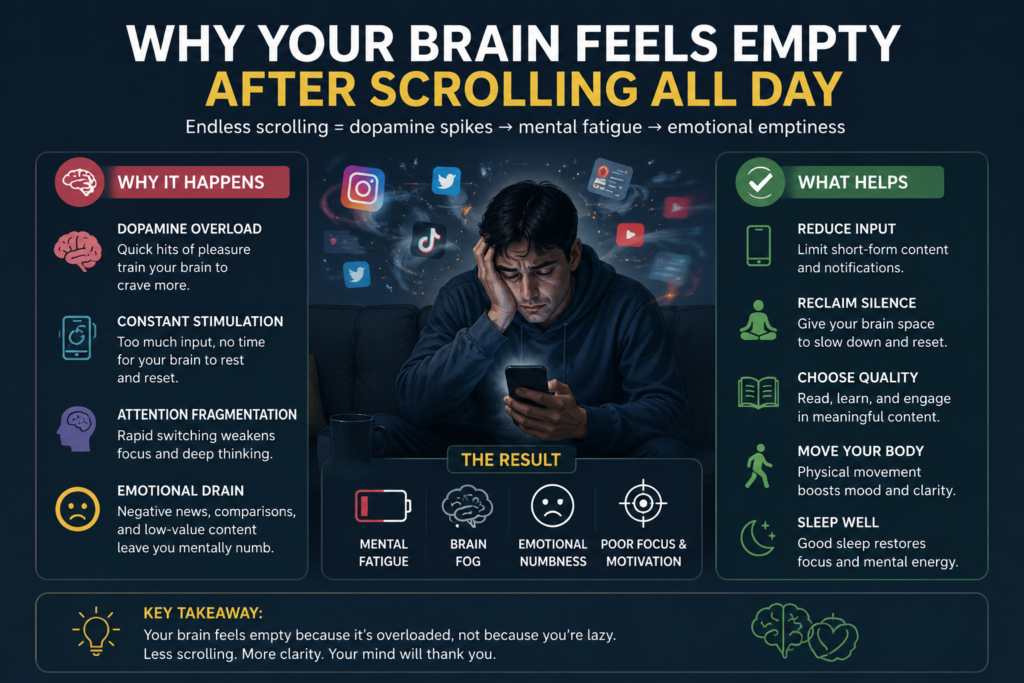
A visually detailed infographic illustrating the psychological effects of doomscrolling and constant social media stimulation. The image explains how dopamine overload, attention fragmentation, emotional exhaustion, and digital overstimulation contribute to brain fog and mental fatigue. It also provides practical recovery strategies such as reducing screen time, improving sleep, embracing silence, and limiting short-form content to restore focus and emotional balance.
Final Thoughts
If your brain feels empty after scrolling all day, you are not lazy, broken, or weak.
Your nervous system is reacting exactly the way modern attention platforms are designed to influence it.
The real danger is not just distraction.
It’s the slow loss of mental stillness.
And once stillness disappears, focus, creativity, emotional depth, and even motivation often disappear with it.
The good news is that attention can recover.
But recovery usually starts the moment the scrolling stops.
READ NEXT
Related Posts
If scrolling leaves your brain feeling empty, these articles can help you understand attention, dopamine, focus, and digital overload more deeply.