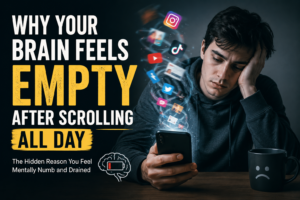
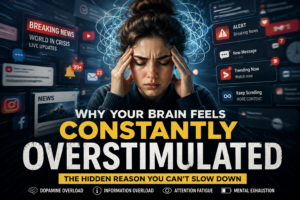
The Quiet Relief of Turning Your Phone Off for One Hour
Last Thursday, I walked into a coffee shop without my phone for the first time in months.
Not intentionally.
I had left it charging on the kitchen counter by accident.
About halfway through my walk, I reached into my pocket and felt nothing there. My first reaction honestly wasn’t calmness.
It was panic.
I remember standing near a crosswalk thinking:
“What if someone needs me?”
Which sounds dramatic now, but the feeling felt real in that moment.
For the next fifteen minutes, my brain kept trying to “check” something that didn’t exist:
notifications
headlines
messages
email
weather
anything
Then something strange happened.
The mental noise slowly started fading.
Not completely. Just enough for me to notice how loud my mind normally feels.
And honestly, I hadn’t realized how exhausted I was until things became quiet for a while.
Modern Life Rarely Leaves The Brain Alone
A normal day now includes more stimulation than people used to process in entire weeks.
Phones vibrate constantly. News updates never stop. Social media feeds refresh endlessly. AI tools generate more information every hour. Even silence gets filled with podcasts, short videos, or background scrolling.
The brain almost never experiences uninterrupted stillness anymore.
Researchers discussed by the American Psychological Association have repeatedly linked chronic digital overload with stress, attention fatigue, and emotional exhaustion.
And honestly, that feels obvious once you start paying attention to your own habits.
Many people wake up and absorb:
text messages
bad news
financial anxiety
work notifications
social comparison
before they even fully wake up emotionally.
The nervous system barely gets a quiet starting point anymore.
I Didn’t Notice How Automatic My Phone Habits Had Become
That afternoon in the café, I caught myself reaching for my phone at least six or seven times even though I already knew it wasn’t there.
The weird part was realizing I wasn’t trying to contact anyone.
My brain simply couldn’t tolerate small empty moments anymore.
Waiting for coffee? Check phone.
Sitting alone for thirty seconds? Check phone.
Hearing silence? Check phone.
At one point, I looked around the café and realized almost everyone else was doing the same thing.
Nobody looked relaxed.
Everyone looked busy protecting themselves from boredom.
The Attention Economy Was Built Around Preventing Silence
This is something people rarely talk about honestly.
Most modern apps are not designed to help people feel calm.
They are designed to keep attention active.
Former Google design ethicist Tristan Harris has spoken extensively about how digital platforms compete aggressively for human attention using psychological triggers like unpredictability, urgency, and social validation.
That explains why phones feel emotionally “sticky.”
The brain starts associating stillness with discomfort.
And after enough repetition, silence itself begins feeling unfamiliar.
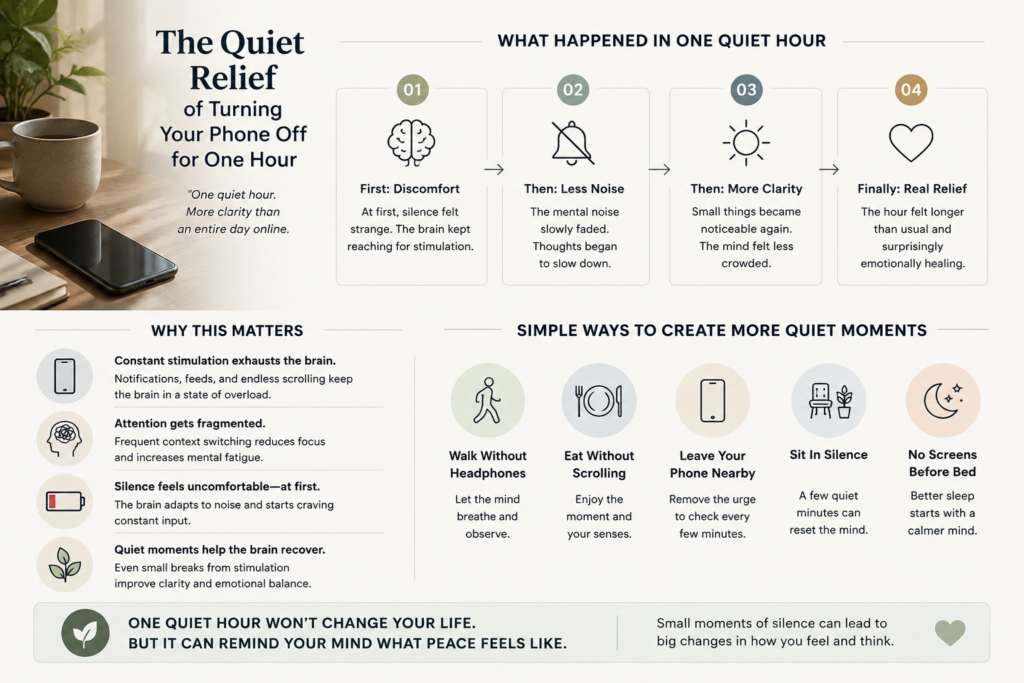
One Quiet Hour Felt Longer Than An Entire Evening Online
Later that night, I tried something intentionally.
I turned my phone off for one hour.
No music. No YouTube. No scrolling. No “just checking one thing.”
At first, the silence felt uncomfortable.
I could actually feel my brain searching for stimulation.
But eventually, something slowed down.
I started noticing tiny details again:
the sound of rain outside
the hum of the refrigerator
how mentally crowded my thoughts normally feel
how fast my attention jumps during ordinary days
The strange part is that the hour felt emotionally longer than entire evenings spent online.
Not because time slowed down.
Because my attention finally stopped splitting into dozens of directions.
Constant Scrolling Quietly Fragments Attention
The problem isn’t simply screen time.
It’s mental fragmentation.
Psychologists sometimes describe this as attentional residue — the brain partially remaining attached to previous information even after shifting tasks.
Modern digital life constantly forces the mind to switch between:
headlines
notifications
messages
videos
emotional reactions
unfinished thoughts
over and over again.
And eventually, people stop noticing how mentally crowded they feel because the overstimulation becomes normal.
Author Cal Newport argued in Digital Minimalism that many technologies now function less like tools and more like environments competing continuously for human attention.
I think that distinction matters more than people realize.
Calmness Feels Rare Because The Brain Adapted To Noise
One thing I’ve started noticing recently is that many people are not actually resting anymore.
They’re consuming softer forms of stimulation.
Scrolling while lying in bed. Watching videos while eating. Listening to podcasts while walking. Checking notifications during conversations.
The brain rarely experiences complete stillness.
And maybe that’s why quiet moments now feel surprisingly emotional.
Not because silence is extraordinary.
Because uninterrupted attention became rare.
The Goal Isn’t To Reject Technology
I don’t think phones are evil.
Honestly, I still use mine too much.
The point isn’t becoming some perfectly disciplined digital minimalist living in the woods.
The point is simply noticing what constant stimulation is doing to the nervous system.
For me, that one quiet hour revealed something uncomfortable:
I had slowly forgotten what mental spaciousness felt like.
And I don’t think I’m alone in that.
Small Moments Of Quiet Matter More Than People Think
Since then, I’ve started experimenting with tiny moments of intentional silence:
walking without headphones
eating without scrolling
leaving my phone in another room
sitting outside without consuming content
Nothing dramatic.
But emotionally, the difference feels surprisingly real.
The brain seems to recover slowly when it finally stops reacting to everything all the time.
And honestly, I think many people are more overstimulated than they realize simply because modern life made nonstop input feel normal.
Constant notifications and endless scrolling quietly overwhelm the brain. Even one quiet hour without a phone can help reduce mental noise, improve focus, and restore a sense of calm.
Final Thoughts
Turning my phone off for one hour didn’t transform my life.
But it briefly made my mind feel less crowded.
And lately, that feeling seems harder and harder to find.
Modern digital life trains people to constantly react:
refresh
check
consume
respond
scroll
without pause.
But maybe the human brain was never designed to process this much stimulation continuously.
And maybe that’s why even one quiet hour without a phone can feel unexpectedly relieving now.
Related Reading: Digital Detox, Focus, and Mental Clarity
If one quiet hour without your phone felt surprisingly calming, these related articles explore doomscrolling, overstimulation, attention span, and the modern struggle to feel mentally clear.