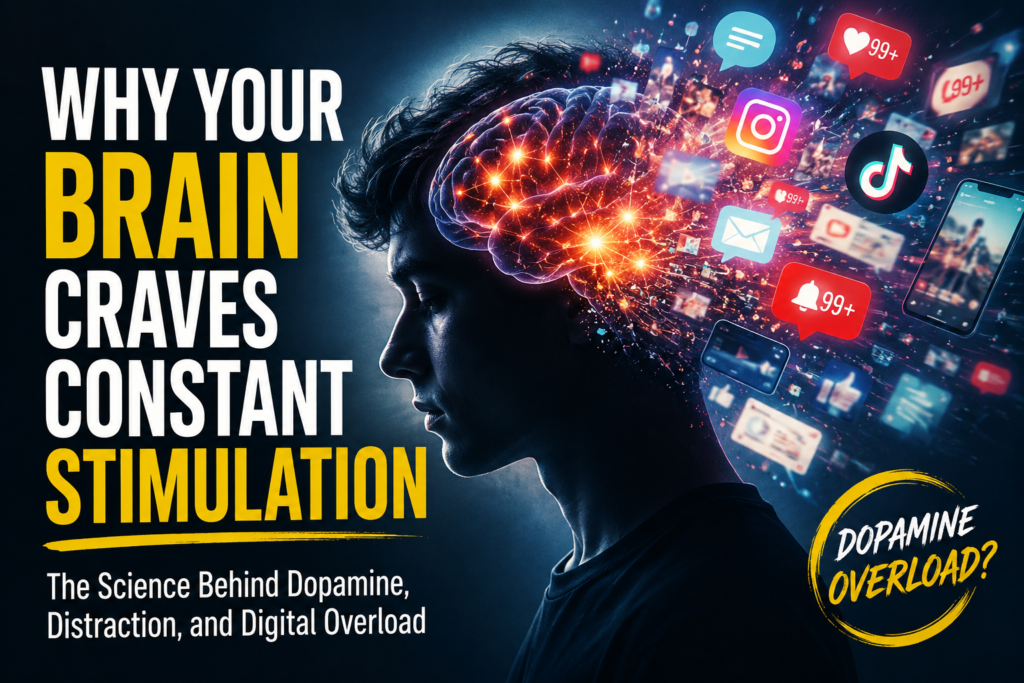
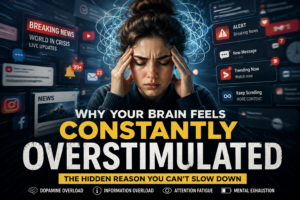
A visually striking illustration showing a human brain overwhelmed by constant digital stimulation, social media notifications, dopamine overload, and endless scrolling. The image represents modern attention span problems, mental exhaustion, cognitive overload, and the psychological effects of technology addiction in the AI era.
Why Your Brain Craves Constant Stimulation
Modern life feels louder than ever.
You open your phone for “just one minute,” and suddenly you’ve checked five apps, watched twelve short videos, replied to two messages, and forgotten what you originally wanted to do.
Then something strange happens.
Silence starts to feel uncomfortable. A slow day feels unbearable. Even resting feels mentally exhausting.
If that sounds familiar, you’re not lazy. Your brain may simply be overstimulated.
And millions of people are quietly experiencing the same thing.
The Real Reason Your Brain Can’t Relax Anymore
A few years ago, I noticed something disturbing.
I couldn’t sit through a movie without checking my phone. Reading books felt harder. Even during quiet moments, my brain kept searching for “something else.”
More stimulation. More novelty. More dopamine.
At first, I blamed stress.
But the deeper issue was something psychologists and neuroscientists have been warning about for years:
the human brain was never designed for constant stimulation.
Today, we consume more information in one day than previous generations consumed in weeks. Notifications, TikTok videos, endless scrolling, AI tools, YouTube Shorts, and algorithm-driven feeds have fundamentally changed how attention works.
And our brains are struggling to adapt.
What Dopamine Actually Does to Your Brain
Many people misunderstand dopamine.
Dopamine is not simply the “pleasure chemical.” Neuroscientists increasingly describe it as a motivation and anticipation system.
In The Molecule of More, psychiatrist Daniel Z. Lieberman explains that dopamine is deeply connected to wanting, seeking, and chasing rewards — not necessarily enjoying them.
That distinction matters.
Because modern apps are designed to keep your brain chasing the next reward:
the next video
the next notification
the next message
the next recommendation
the next dopamine spike
This creates what researchers call a variable reward loop — the same psychological mechanism used in slot machines.
Social media platforms, short-form content, and even productivity apps increasingly exploit this system.
And over time, your baseline attention changes.
Why Everything Starts Feeling Boring
One of the biggest signs of dopamine overstimulation is this:
normal life starts feeling emotionally “flat.”
Simple activities lose their appeal:
reading
walking
conversations
studying
deep work
quiet thinking
Your brain becomes conditioned to high-speed stimulation.
A 2023 report from researchers studying digital media habits found that excessive short-form content consumption was associated with reduced sustained attention and increased mental fatigue.
That explains why many people say things like:
“I can’t focus anymore.”
“My brain feels tired all the time.”
“Nothing feels exciting unless it’s fast.”
The issue is not intelligence.
It’s adaptation.
Your brain adapts to the environment you repeatedly expose it to.
The Attention Economy Is Training Your Brain
Former Google design ethicist Tristan Harris has repeatedly warned that modern technology platforms compete aggressively for human attention.
Because attention is profitable.
The longer you scroll:
the more ads you see
the more data platforms collect
the more emotionally reactive you become
In other words:
your distraction is part of the business model.
This is why modern apps rarely encourage stopping.
Historically, many breakthroughs came from long periods of uninterrupted thought.
But modern digital environments rarely allow that state anymore.
That’s why more people feel mentally overloaded despite having more convenience than ever before.
Final Thoughts
Your brain is not broken.
It’s adapting to an environment filled with constant stimulation.
The problem is that modern technology rewards:
speed
novelty
reaction
instant gratification
while deep focus requires:
slowness
silence
patience
repetition
And those qualities are becoming increasingly rare.
The good news is this:
attention can recover.
But recovery usually starts the moment you stop feeding your brain endless stimulation.
DOPAMINE OVERLOAD & DIGITAL STIMULATION
Recommended Reading
Explore more articles about dopamine overload, attention span decline, digital overstimulation, doomscrolling, and the hidden psychological effects of modern technology.