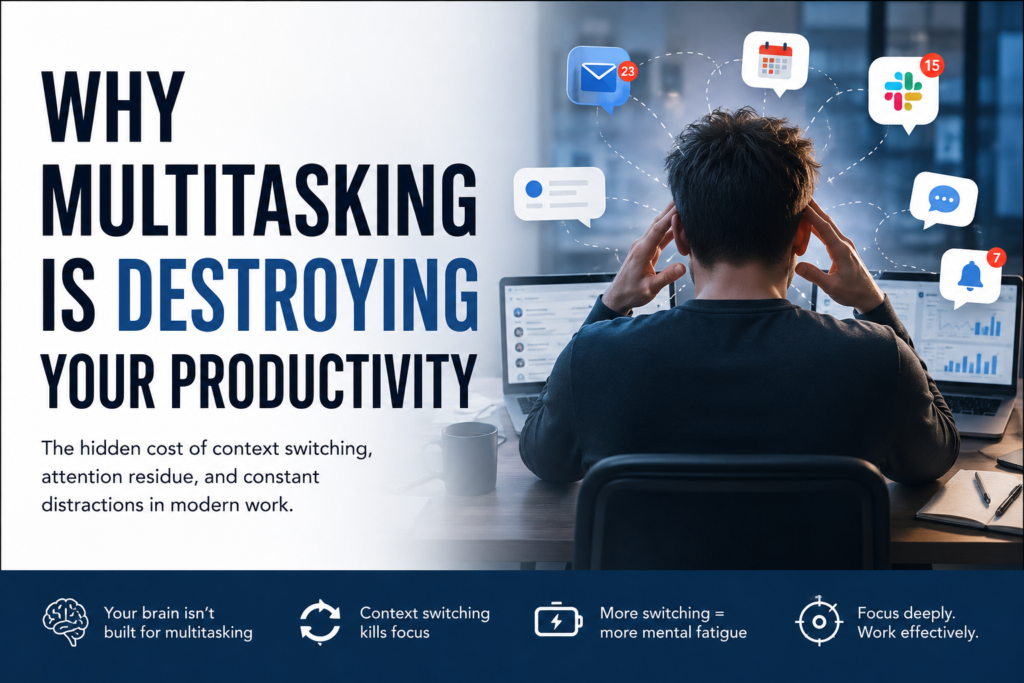
Reply quickly. Switch faster. Handle multiple things at once. Stay constantly available.
For years, multitasking has been treated almost like a professional skill.
People proudly describe themselves as “good multitaskers.” Job descriptions often celebrate employees who can “manage multiple priorities simultaneously.”
But neuroscience and productivity research increasingly suggest something uncomfortable:
most multitasking is not making people more productive.
It is making them slower, more distracted, more mentally exhausted, and far less effective than they realize.
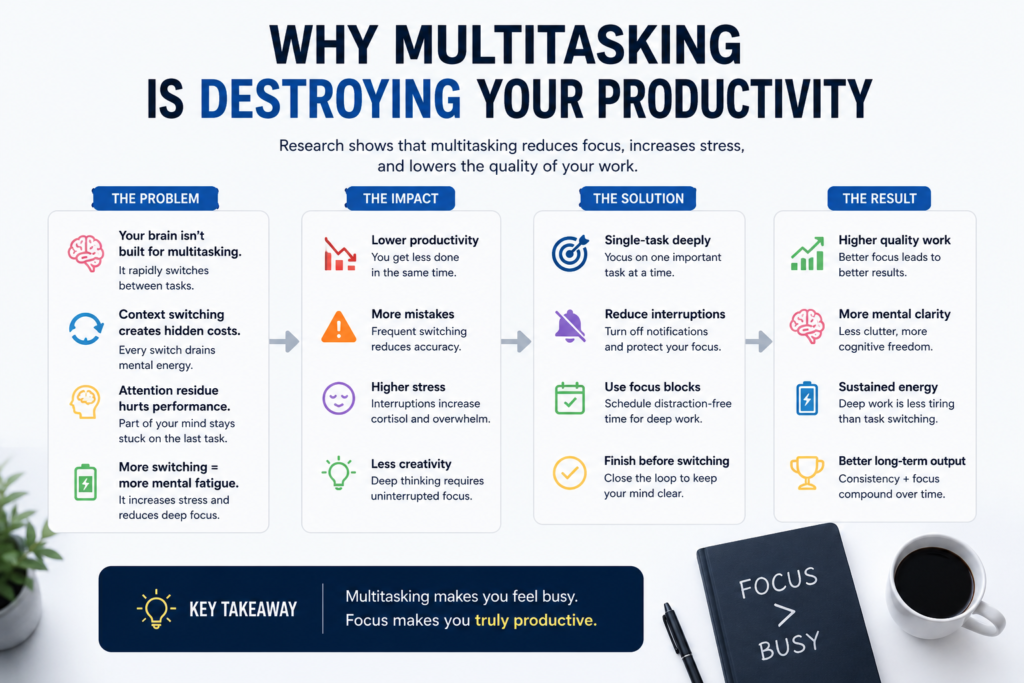
The problem is that the human brain is not actually designed to perform multiple cognitively demanding tasks simultaneously.
Instead, what most people call multitasking is actually rapid task-switching.
And every switch comes with a hidden cognitive cost.
Your Brain Is Not Truly Multitasking
One of the biggest misconceptions about productivity is the idea that the brain can fully process multiple complex tasks at once.
Research from the American Psychological Association explains that humans typically do not perform true multitasking with attention-heavy work. Instead, the brain rapidly switches attention between tasks.
That distinction matters.
Because every time your attention switches, your brain must:
stop one mental process,
reload another,
rebuild context,
recover focus.
This process consumes cognitive energy.
And over time, those small interruptions compound into significant productivity loss.
Most people underestimate how damaging these interruptions become when repeated dozens or hundreds of times per day.
Researchers describe this phenomenon as:
context switching
Context switching occurs whenever your brain shifts from one task to another before fully completing the original activity.
Software development research has repeatedly shown that task interruptions and frequent switching significantly reduce concentration and increase cognitive load.
In other words:
the brain pays a recovery cost every time attention moves.
The “Attention Residue” Problem
One of the most important ideas in productivity research is something called:
attention residue
The concept was introduced by researcher Sophie Leroy, whose studies found that when people switch tasks, part of their attention remains stuck on the previous task.
Even if you physically move on, your mind often does not.
Part of your cognitive bandwidth stays attached to unfinished work.
That residue reduces:
concentration,
creativity,
memory performance,
decision quality.
This is one reason multitasking often creates the illusion of productivity while quietly reducing actual output.
Why Multitasking Feels Productive
If multitasking is so harmful, why do people continue doing it?
Because it feels productive.
Modern digital environments reward responsiveness.
Every notification creates a tiny sense of urgency.
Every reply creates a feeling of completion.
Every app switch gives the brain a small dopamine reward tied to novelty and stimulation.
This creates a dangerous loop:
more switching,
more stimulation,
less deep focus,
lower-quality work.
Research on digital distraction increasingly shows that fragmented attention creates mental fatigue even when people believe they are “getting more done.”
Multitasking Quietly Increases Stress
Multitasking does not only reduce productivity.
It also increases stress.
Studies referenced by workplace researchers have shown that repeated interruptions elevate feelings of:
frustration,
pressure,
workload stress,
mental fatigue.
Stanford-related findings also suggest that constant switching can increase cortisol levels associated with stress responses.
This helps explain why many people finish modern workdays feeling mentally exhausted despite struggling to identify what they actually accomplished.
Their brains spent the day constantly reorienting.
Why Modern Technology Makes Multitasking Worse
The modern workplace is optimized for interruption.
Most employees now operate inside environments filled with:
messaging platforms,
browser tabs,
shared documents,
alerts,
collaborative tools,
smartphones.
Technology increased communication speed.
But it also dramatically increased attention fragmentation.
A worker may switch between:
Slack,
email,
meetings,
spreadsheets,
dashboards,
AI tools,
project management apps,
hundreds of times per day.
Some reports estimate digital workers toggle between apps over 1,000 times daily.
The human brain evolved for focused attention.
Not constant context fragmentation.
Why Deep Work Is Becoming Rare
One hidden consequence of multitasking is the disappearance of deep work.
Deep work refers to uninterrupted periods of focused cognitive effort.
This is where:
complex thinking,
creativity,
strategic insight,
high-quality problem solving
usually happen.
But multitasking destroys the conditions required for deep work.
Even small interruptions can reset cognitive momentum.
That is why many people spend entire days “working” while producing surprisingly little meaningful output.
They are busy.
But not cognitively engaged long enough to produce deep results.
The Productivity Myth of “Doing More”
Multitasking often creates visible activity.
But visible activity is not the same as meaningful productivity.
Checking email while attending a meeting may look efficient.
Switching between five browser tabs may feel fast.
But cognitive research consistently shows that rapid switching reduces efficiency and increases error rates.
In many cases, the brain performs better when tasks are completed sequentially rather than simultaneously.
The problem is that modern work culture often rewards visible responsiveness instead of focused execution.
Ideas often emerge after prolonged focus, not rapid interruption.
When attention is constantly fragmented, the brain struggles to:
maintain conceptual depth,
connect complex ideas,
retain working memory,
sustain cognitive flow.
This is one reason writers, engineers, researchers, and designers often protect uninterrupted work blocks aggressively.
High-level thinking requires continuity.
Multitasking destroys continuity.
Why People Feel More Mentally Tired Today
Many people assume their exhaustion comes from working too much.
But often, the deeper problem is:
cognitive fragmentation,
unfinished tasks,
constant switching,
digital overload.
Modern workers rarely allow their attention to settle fully into one thing.
The brain stays trapped in partial engagement.
Over time, this creates chronic mental fatigue.
Research increasingly suggests that multitasking overloads working memory and reduces attentional control over time.
That fatigue accumulates quietly.
The Rise of Single-Tasking
As research on multitasking grows, many productivity experts are shifting toward:
single-tasking
Single-tasking simply means giving full attention to one cognitively demanding task at a time.
This approach often:
improves output quality,
reduces stress,
increases completion rates,
restores focus,
improves cognitive endurance.
Psychologists interviewed by Real Simple recently noted that reducing multitasking may help improve attention span, emotional regulation, and overall work quality.
The brain performs best when attention remains stable long enough to build momentum.
How to Reduce Multitasking in Daily Life
Most people cannot eliminate interruptions completely.
But they can reduce unnecessary switching.
Some practical strategies include:
disabling nonessential notifications,
batching email responses,
using fewer apps simultaneously,
scheduling focused work blocks,
finishing small tasks before opening new ones,
separating communication time from deep work time.
Even modest reductions in context switching can improve mental clarity significantly.
Why Modern Productivity Systems Fail
Many productivity systems fail because they focus on organization rather than attention protection.
Apps, tools, dashboards, task managers — none of them matter if attention remains fragmented all day.
The real challenge of modern productivity is not information management.
It is attention management.
And multitasking quietly destroys attention.
Final Thoughts
Multitasking became a symbol of modern efficiency.
But research increasingly suggests it may be one of the biggest hidden productivity problems of digital life.
The brain performs best when attention stays stable, focused, and uninterrupted long enough to think deeply.
The result is a culture where people feel busy all day — while struggling to produce meaningful work.
The future of productivity may not belong to people who do more things at once.
It may belong to people who protect their attention long enough to do one thing well.
FAQ Section
Is multitasking actually bad for productivity?
Research suggests that multitasking often reduces efficiency because the brain repeatedly switches attention between tasks instead of processing them simultaneously.
What is context switching?
Context switching is the mental process of shifting attention from one task to another, forcing the brain to reload information and rebuild focus.
What is attention residue?
Attention residue refers to the lingering cognitive attachment to a previous task after switching to a new one, reducing focus and performance.
Why does multitasking feel productive?
Multitasking creates the feeling of activity and responsiveness, but research suggests it often lowers work quality and increases mental fatigue.
FOCUS & MULTITASKING
Recommended Reading
Explore more articles about task switching, cognitive overload, attention fragmentation, deep work, and why multitasking quietly destroys productivity and mental clarity.
How Multitasking Affects Productivity
— Research summary showing that multitasking reduces comprehension, attention span, and overall cognitive performance.