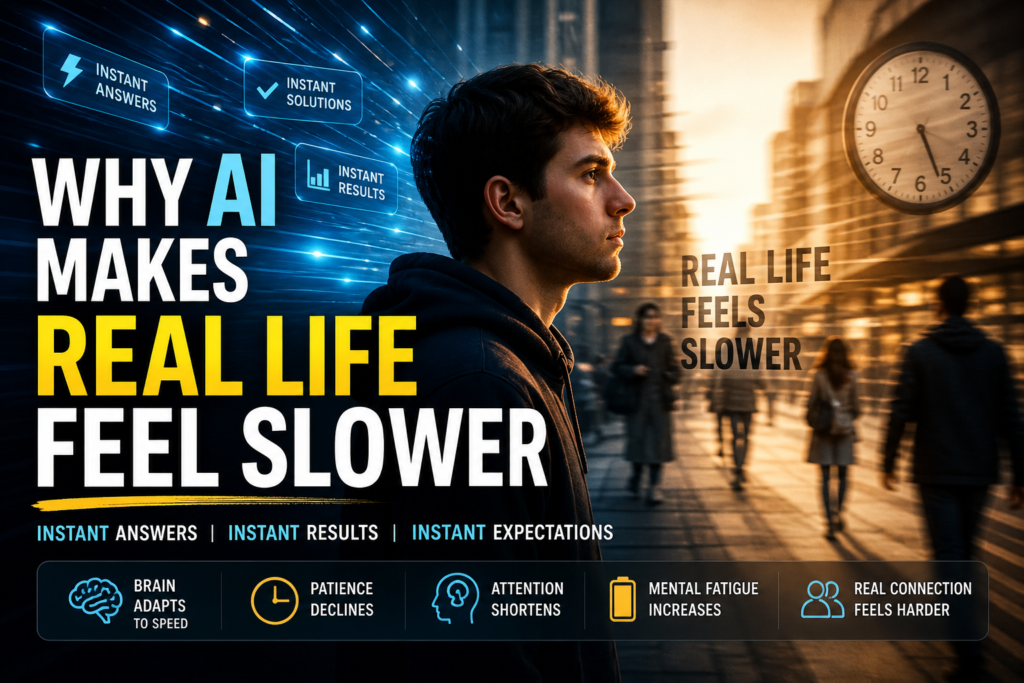
AI delivers instant answers and instant gratification so quickly that normal life, conversations, and waiting now feel psychologically slower.
Why AI Makes Real Life Feel Slower
A strange thing started happening to me recently.
After spending hours using AI tools every day, normal life began to feel… slow.
Not peaceful slow. Frustrating slow.
Waiting for people to reply to messages felt longer than before. Conversations sometimes felt less efficient. Even searching for information manually suddenly felt exhausting.
At first, I thought I was just becoming impatient.
But the more I talked with others, the more I realized many people were experiencing something similar.
AI gives instant answers, instant summaries, instant validation, and instant productivity.
And slowly, the human brain begins adapting to that speed.
The problem is this:
real life does not move at AI speed.
And that gap may quietly be changing the way humans experience patience, attention, boredom, and even relationships.
The Human Brain Adapts Faster Than We Realize
One of the most important things to understand about the brain is neuroplasticity.
The brain constantly adapts to repeated environments.
If your environment becomes faster, more stimulating, and more responsive, your expectations gradually change too.
AI systems create an unusually high-speed feedback environment:
instant answers
immediate summaries
zero waiting
endless information
instant creativity assistance
instant problem solving
Compared to that, normal life suddenly feels slower.
Because normal life contains:
uncertainty
pauses
delays
misunderstandings
emotional complexity
waiting
Things humans historically considered normal now feel mentally inefficient.
Why AI Speed Feels So Psychologically Powerful
Psychologists have long studied how immediate rewards shape human behavior.
The faster the reward, the stronger the behavioral reinforcement.
AI compresses the time between:
curiosity
action
reward
almost to zero.
You ask a question. The answer appears instantly.
That instant feedback loop is psychologically powerful because it activates dopamine-driven anticipation and reward systems.
In The Molecule of More, psychiatrist Daniel Z. Lieberman explains that dopamine is strongly linked to anticipation and reward-seeking behavior.
AI accelerates both.
The brain quickly becomes accustomed to immediate cognitive rewards.
And once that happens, slower processes begin feeling emotionally frustrating.
Real Conversations Operate Differently
Human interaction was never designed for instant optimization.
Real conversations involve:
pauses
silence
emotional nuance
uncertainty
misunderstanding
thinking time
AI removes much of that friction.
That sounds helpful at first.
But over time, it may subtly reshape expectations around communication itself.
I noticed this personally during normal conversations with friends.
Sometimes I caught myself mentally expecting:
faster responses
clearer explanations
more structured thinking
almost like I was unconsciously expecting human conversations to behave like AI systems.
That realization honestly felt uncomfortable.
Because humans are not supposed to communicate like algorithms.
The Rise of Instant Cognitive Gratification
Modern technology already shortened attention spans through:
social media
short-form videos
notifications
endless scrolling
AI may intensify this even further.
Why?
Because AI does not simply entertain the brain.
It accelerates cognition itself.
Tasks that once required:
research
patience
reflection
deep thinking
now happen instantly.
This creates what some psychologists describe as cognitive acceleration.
The brain begins adapting to immediate mental resolution.
And delayed processes suddenly feel emotionally difficult.
Why Waiting Feels Harder After Using AI
This is one of the biggest behavioral shifts I’ve noticed personally.
Waiting used to feel normal.
Now:
slow websites feel unbearable
delayed replies feel irritating
long videos feel exhausting
deep reading feels harder
slow brainstorming feels frustrating
Not because the world became slower.
But because AI changed the brain’s reference point for speed.
And once expectations shift, patience often decreases.
AI and the Decline of Boredom Tolerance
Boredom once played an important psychological role.
Quiet moments allowed the brain to:
reflect
process emotions
think creatively
recover attention
But AI dramatically reduces mental downtime.
Now the brain can instantly:
generate ideas
answer questions
solve problems
entertain itself
receive stimulation
without interruption.
The result?
Many people are slowly losing tolerance for cognitive stillness.
And boredom starts feeling uncomfortable much faster.
Why Slow Thinking Still Matters
In Thinking, Fast and Slow, Nobel Prize-winning psychologist Daniel Kahneman explains that humans rely on two cognitive systems:
fast thinking
slow thinking
Fast thinking is immediate and automatic.
Slow thinking requires:
reflection
patience
analysis
deeper reasoning
Modern AI heavily rewards fast cognitive behavior.
But some of the most important human abilities still depend on slow thinking:
wisdom
creativity
emotional understanding
long-term decision making
meaningful relationships
The danger is not simply becoming faster.
It’s losing comfort with slowness entirely.
The Attention Economy Never Stops Accelerating
Former Google design ethicist Tristan Harris has repeatedly warned that modern platforms compete aggressively for human attention.
AI pushes this acceleration even further.
Because AI does not just reduce waiting.
It reduces friction itself.
And friction is deeply connected to patience, reflection, and emotional regulation.
The less friction people experience digitally, the harder normal human processes may begin to feel.
The Emotional Side Effects Nobody Talks About
One surprising consequence of AI acceleration is emotional fatigue.
Constant high-speed stimulation can create:
impatience
restlessness
mental exhaustion
reduced focus
frustration tolerance decline
Even when productivity technically improves.
This may explain why many people feel:
mentally overwhelmed
emotionally overstimulated
unable to relax
uncomfortable with silence
constantly cognitively “on”
despite using tools designed to make life easier.
My Personal Wake-Up Call
One night, I noticed myself becoming irritated while waiting for a friend to finish explaining something.
The conversation wasn’t actually slow.
My brain had simply become used to AI-speed interaction.
That realization genuinely bothered me.
Because real human connection requires:
patience
pauses
listening
emotional unpredictability
And those are exactly the things AI removes.
Since then, I’ve started intentionally slowing parts of my life down:
walking without headphones
reading long-form books again
brainstorming without AI assistance
allowing boredom occasionally
resisting instant-answer habits
And honestly, the difference became noticeable surprisingly quickly.
How to Protect Your Attention in the AI Era
AI is not the enemy.
It’s an incredibly useful tool.
But human psychology still needs balance.
A few habits genuinely help:
reducing constant AI dependency
practicing slow thinking
tolerating boredom again
creating quiet moments
reading deeply without multitasking
having uninterrupted conversations
The brain adapts to whatever environment it experiences repeatedly.
That includes speed.
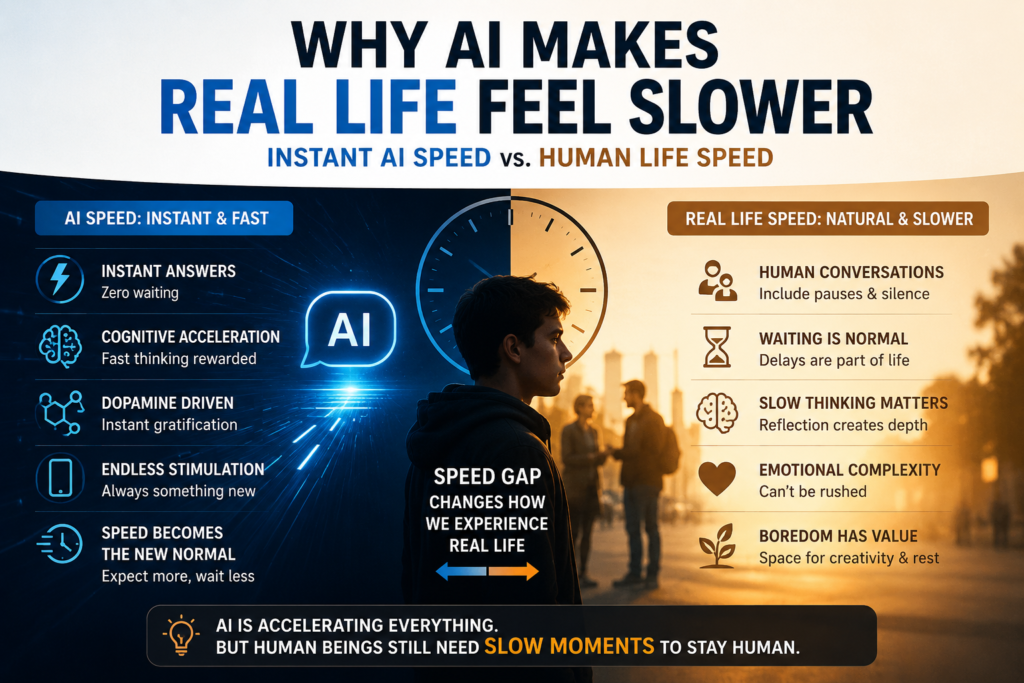
A visually clean infographic explaining how instant AI speed is changing human patience, attention, and perception of time. The image contrasts fast AI-driven digital stimulation with slower real-life experiences, highlighting dopamine overload, cognitive acceleration, reduced boredom tolerance, slow thinking, emotional complexity, and the growing psychological gap between AI speed and human life.
Final Thoughts
AI is changing more than productivity.
It may be quietly changing:
patience
attention
boredom tolerance
communication expectations
emotional pacing
Real life has not actually become slower.
But AI has dramatically accelerated the speed of cognitive reward.
And once the brain adapts to instant answers, normal human experiences can start feeling unusually slow.
The challenge moving forward may not simply be learning how to use AI effectively.
It may be learning how to remain psychologically human while using it.
AI SPEED, PATIENCE & SLOW THINKING
Recommended Reading
Explore more articles about AI speed, instant gratification, human patience, slow thinking, attention overload, and how artificial intelligence is quietly changing everyday behavior.
Nobel Prize — Daniel Kahneman
— Background on Daniel Kahneman, whose work on human judgment and decision-making helps explain fast thinking and slow thinking.
Center for Humane Technology
— Resources about persuasive technology, attention capture, digital wellbeing, and how modern platforms shape human behavior.