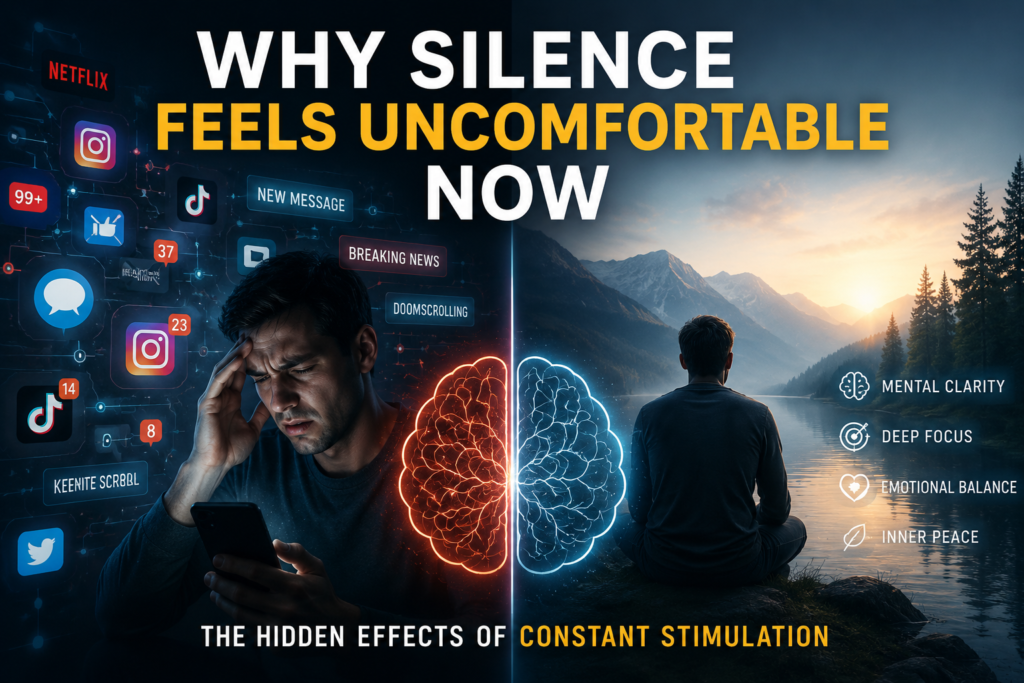
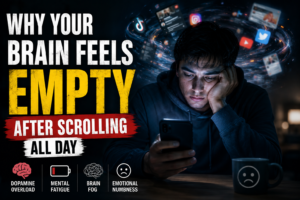
A cinematic digital illustration showing the psychological contrast between constant digital stimulation and mental silence. One side represents dopamine overload, endless scrolling, social media addiction, and mental exhaustion, while the other symbolizes deep focus, emotional balance, inner peace, and mental clarity in a quiet environment.
Why Silence Feels Uncomfortable Now
Modern life has become incredibly loud.
Even when we are physically alone, our minds are rarely quiet. Notifications vibrate constantly. Videos autoplay endlessly. Podcasts fill empty moments. Music follows us everywhere. Silence has slowly disappeared from daily life.
And something strange has happened because of it:
many people no longer feel comfortable being alone with their own thoughts.
I noticed this in my own life a few months ago.
I was driving without music for the first time in a while, and within minutes I instinctively reached for my phone. Not because I needed anything important — but because the silence itself felt uncomfortable.
That realization stayed with me.
Why does quiet suddenly feel so difficult?
The answer may reveal something important about modern attention, dopamine, overstimulation, and the way technology is quietly reshaping the human brain.
The Modern Brain Is Addicted to Noise
For most of human history, silence was normal.
People walked without headphones. Waited without scrolling. Sat alone without consuming endless streams of content.
Today, silence often feels unnatural.
Many people immediately fill quiet moments with:
TikTok
YouTube Shorts
podcasts
music
social media
notifications
background TV
AI conversations
Not because they truly need stimulation — but because the brain has adapted to constant input.
Psychologists sometimes describe this as stimulation dependency.
The brain becomes so accustomed to novelty and dopamine-driven activity that low-stimulation environments begin to feel emotionally uncomfortable.
Why Silence Feels Mentally Uncomfortable
Silence itself is not dangerous.
But silence removes distraction.
And that’s exactly why many people avoid it.
When external stimulation disappears, internal thoughts become louder:
stress
anxiety
uncertainty
emotional discomfort
overthinking
loneliness
Research published in Science famously found that many participants preferred giving themselves mild electric shocks rather than sitting alone quietly with their thoughts for several minutes.
That study shocked many psychologists at the time.
But today, it feels strangely believable.
Modern brains are deeply conditioned to avoid mental stillness.
Dopamine and the Fear of Quiet
Dopamine plays a major role here.
In The Molecule of More, psychiatrist Daniel Z. Lieberman explains that dopamine is heavily linked to anticipation, novelty, and reward-seeking behavior.
Modern technology constantly activates this system:
refreshing feeds
new messages
algorithmic recommendations
endless scrolling
short-form videos
Each interaction provides tiny bursts of stimulation.
Over time, the brain starts expecting constant novelty.
And silence suddenly feels “empty.”
Not because silence changed — but because the brain’s stimulation threshold changed.
The Attention Economy Profits From Your Discomfort
Former Google design ethicist Tristan Harris has repeatedly warned that modern apps compete aggressively for human attention.
Because attention generates revenue.
The longer users stay engaged:
the more ads they see
the more data companies collect
the more profitable platforms become
This creates an environment where technology is intentionally designed to eliminate silence.
In many ways, silence has become the enemy of modern platforms.
Why Constant Noise Creates Mental Exhaustion
One surprising consequence of overstimulation is emotional fatigue.
People often feel:
mentally tired
emotionally numb
unable to focus
restless during quiet moments
uncomfortable without stimulation
Even when they’ve done very little physically.
Researchers studying cognitive overload have found that constant context switching increases mental fatigue dramatically.
Modern life rarely gives the brain true recovery time.
You move constantly between:
emails
Slack messages
Instagram
news
AI tools
YouTube
text messages
productivity apps
The brain remains in a semi-alert state almost all day.
And eventually, silence starts feeling unfamiliar.
Why Boredom Is Actually Important
This may sound strange, but boredom serves an important psychological function.
Moments of low stimulation help the brain:
recover attention
process emotions
strengthen creativity
improve memory consolidation
restore mental clarity
In Stolen Focus, journalist Johann Hari argues that constant interruption fragments human attention and weakens deep thinking.
Historically, many creative breakthroughs happened during quiet moments:
walking
resting
staring out windows
solitude
silence
But modern life leaves very little room for those mental states.
My Personal Wake-Up Call
One weekend, I decided to spend a few hours without background noise.
No podcasts. No scrolling. No music.
At first, it felt uncomfortable.
My brain kept searching for stimulation almost automatically. I reached for my phone repeatedly without even realizing it.
But after a while, something changed.
My thoughts slowed down.
I felt calmer. More mentally clear. Less restless.
It made me realize how rarely the modern brain truly rests anymore.
And honestly, that realization was uncomfortable.
Signs Your Brain May Be Overstimulated
You may be experiencing stimulation overload if:
silence feels awkward
you constantly check your phone
you always need background noise
long-form reading feels difficult
boredom feels unbearable
you struggle to sit quietly
your brain feels mentally noisy
you feel tired but keep consuming content
These patterns are becoming increasingly common in the AI era.
Because stimulation is now infinite.
Algorithms never stop feeding novelty.
How to Become Comfortable With Silence Again
The solution is not deleting all technology.
But the brain does need periods of reduced stimulation.
Here’s what genuinely helped me:
1. Walk Without Headphones
This felt surprisingly difficult at first.
But it helped retrain my attention span.
2. Stop Filling Every Empty Moment
Waiting in line doesn’t always need scrolling.
Small moments of boredom matter.
3. Reduce Short-Form Content
Short videos dramatically increase novelty-seeking behavior.
4. Create Quiet Mornings
Avoid checking your phone immediately after waking up.
Your nervous system notices the difference.
5. Let Your Brain Slow Down
Silence often feels uncomfortable before it feels peaceful.
That transition matters.
The Hidden Psychological Cost of Constant Noise
The biggest danger may not simply be distraction.
It may be losing the ability to:
think deeply
tolerate stillness
process emotions
reflect clearly
feel mentally present
Modern technology has made stimulation effortless.
But human attention was never designed for nonstop input.
And that may explain why so many people feel mentally exhausted despite constantly consuming entertainment.
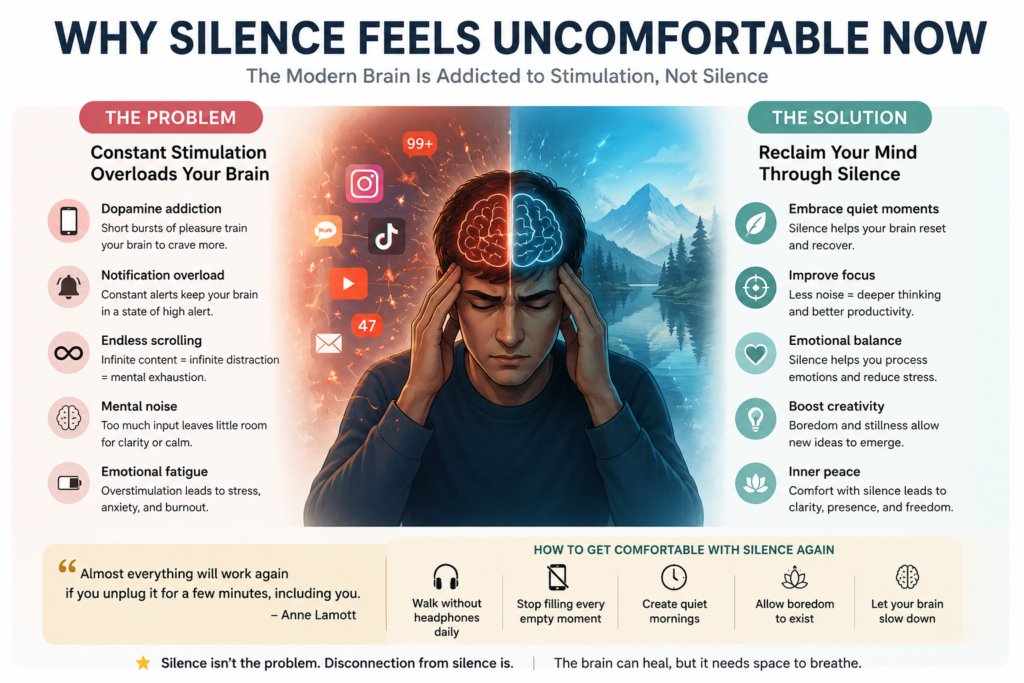
A clean and visually organized infographic explaining why silence feels uncomfortable in modern life. The image highlights dopamine overload, constant digital stimulation, social media addiction, mental exhaustion, reduced attention span, and the benefits of silence such as deep focus, emotional balance, mental clarity, and cognitive recovery.
Final Thoughts
Silence has not become worse.
Our brains have simply become less familiar with it.
Modern life rewards:
speed
novelty
stimulation
instant gratification
But mental clarity often requires:
quiet
slowness
stillness
uninterrupted thought
And those things are becoming increasingly rare.
The good news is this:
the brain can adapt back.
But recovery often begins the moment we stop trying to escape silence.
SILENCE, FOCUS & DIGITAL OVERLOAD
Recommended Reading
Explore more articles about silence anxiety, overstimulation, attention span decline, mental noise, dopamine overload, and how modern technology changes the way we focus.