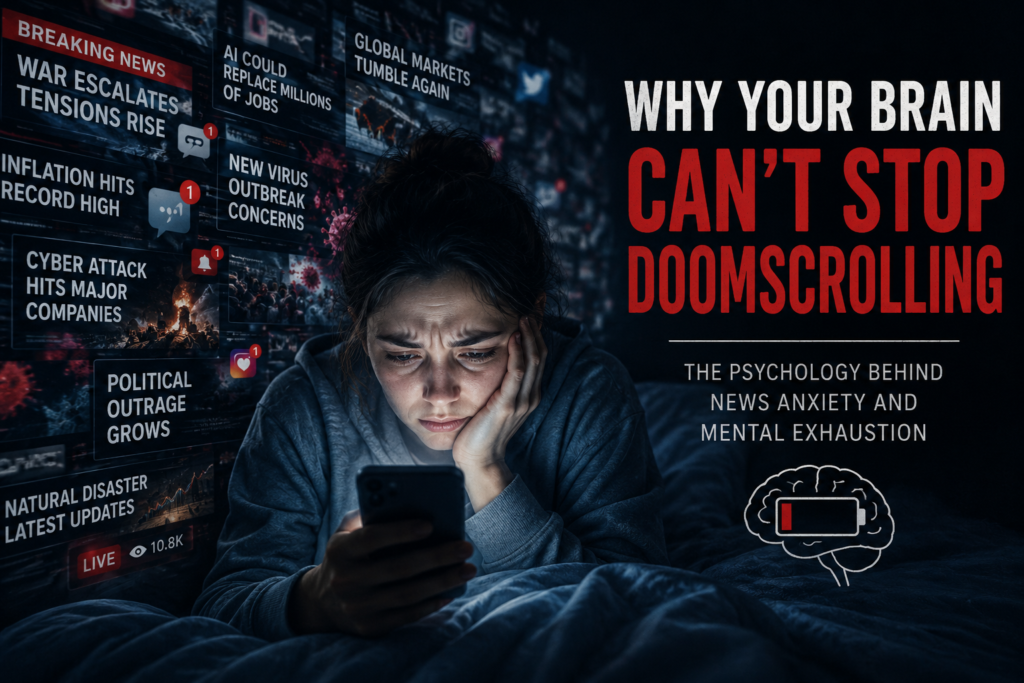
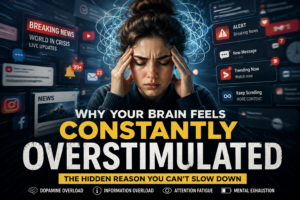
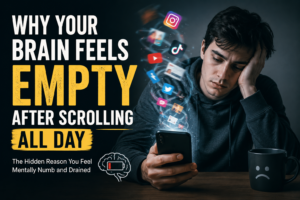
Modern apps and nonstop breaking news create dopamine-driven scrolling loops that leave the brain anxious, overstimulated, and mentally exhausted.
Why Your Brain Can’t Stop Doomscrolling
It usually starts innocently.
You check one headline before bed. Then another. Then a social media post. Then a video explaining the situation. Suddenly, forty minutes disappear — and your brain feels more anxious, exhausted, and mentally overloaded than before.
I realized this was happening to me almost every night.
Even when I knew scrolling was making me feel worse, I still kept doing it.
That’s the strange thing about doomscrolling:
most people know it hurts their mental health, but they still can’t stop.
And modern technology is specifically designed to make that behavior incredibly difficult to resist.
What Is Doomscrolling?
Doomscrolling describes the habit of continuously consuming negative news or emotionally distressing content online.
It often involves:
social media feeds
breaking news
political outrage
disaster updates
fear-based content
anxiety-driven information loops
The behavior became especially common during the pandemic, but psychologists now believe it reflects a much larger issue in the digital age.
Modern platforms reward emotional attention.
And fear captures attention extremely well.
Why the Brain Keeps Returning to Negative News
One of the biggest reasons doomscrolling feels addictive is something psychologists call negativity bias.
The human brain naturally prioritizes threats over neutral information.
From an evolutionary perspective, this made survival easier.
Paying attention to danger helped humans stay alive.
The problem is that modern digital environments constantly exploit this instinct.
Algorithms know that emotionally intense content generates:
more clicks
longer watch time
stronger engagement
more comments
more shares
Fear spreads fast online because fear keeps people watching.
Doomscrolling Activates Dopamine Loops
Many people assume doomscrolling is only about anxiety.
But dopamine plays a major role too.
In The Molecule of More, psychiatrist Daniel Z. Lieberman explains that dopamine is deeply connected to anticipation and reward-seeking behavior.
Doomscrolling creates a powerful psychological loop:
uncertainty
anticipation
new information
emotional reaction
temporary relief
repeat
Each refresh creates the possibility of discovering something important, shocking, or emotionally stimulating.
That uncertainty keeps the brain engaged.
Even when the experience itself feels mentally exhausting.
Why Doomscrolling Feels Impossible to Stop
Modern apps are designed to remove stopping points.
Social media platforms use:
infinite scroll
autoplay
personalized recommendations
emotional engagement algorithms
nonstop notifications
The brain never receives a natural signal to stop consuming information.
Former Google design ethicist Tristan Harris has repeatedly warned that many digital platforms are engineered specifically to capture and hold human attention.
And emotionally charged content performs best.
Which means fear becomes profitable.
Why Negative News Feels Emotionally Addictive
This part surprised me personally.
Sometimes I noticed myself checking stressful news repeatedly even when nothing useful came from it.
Why?
Because emotionally intense information creates stimulation.
The brain becomes trapped between:
anxiety
curiosity
fear
anticipation
emotional activation
This combination is psychologically powerful.
Researchers studying emotional arousal have found that highly stimulating content is much harder for the brain to disengage from.
Especially during periods of stress or uncertainty.
The Mental Exhaustion Nobody Talks About
Doomscrolling creates a unique type of fatigue.
Not physical exhaustion.
Mental exhaustion.
After long periods of consuming emotionally intense information, many people experience:
brain fog
anxiety
emotional numbness
reduced focus
irritability
overstimulation
sleep disruption
I personally noticed this most strongly at night.
The more news I consumed before sleeping, the harder it became for my brain to feel calm afterward.
Even when I wasn’t directly affected by the events themselves.
Why Social Media Makes Doomscrolling Worse
Traditional news once had limits.
Newspapers ended. TV broadcasts stopped. Information cycles slowed down.
Social media removed those boundaries entirely.
Now negative information is:
personalized
emotionally optimized
algorithmically amplified
available 24/7
And AI recommendation systems intensify this even further.
Platforms continuously learn which topics trigger emotional reactions and feed similar content back to users.
This creates endless emotional feedback loops.
Why the AI Era Feels Mentally Overwhelming
Artificial intelligence accelerated information speed dramatically.
Today, people experience:
nonstop updates
viral fear cycles
instant outrage
algorithmic amplification
emotional overload
faster than ever before.
AI systems are exceptionally good at optimizing engagement.
One night, I caught myself scrolling through negative headlines for nearly an hour without even realizing it.
I wasn’t learning anything meaningful anymore.
I was simply emotionally trapped in the loop.
What bothered me most was how automatic it felt.
My brain kept searching for:
one more update
one more explanation
one more headline
even though the experience was clearly making me feel worse.
That realization changed how I use social media completely.
How to Stop Doomscrolling Without Deleting Everything
The solution is not avoiding information entirely.
But the brain does need boundaries.
A few habits genuinely helped me:
turning off breaking news alerts
avoiding social media before sleep
limiting emotionally manipulative content
reading fewer but higher-quality sources
taking intentional breaks from news cycles
replacing scrolling with quiet activities
The difference became noticeable surprisingly quickly.
Why Silence Feels So Uncomfortable After Doomscrolling
One thing I realized after reducing doomscrolling was how uncomfortable silence initially felt.
Without constant stimulation, the brain suddenly notices:
anxiety
restlessness
boredom
emotional discomfort
That reaction matters.
Because modern digital environments train the brain to avoid stillness constantly.
And doomscrolling becomes one of the easiest ways to escape quiet thinking.
The Attention Economy Profits From Your Anxiety
In Stolen Focus, author Johann Hari explains how modern digital systems aggressively compete for human attention.
The business model depends on engagement.
And unfortunately:
fear
outrage
uncertainty
emotional stimulation
perform extremely well online.
This means the internet increasingly rewards psychological activation over mental clarity.
The result is a culture where many people feel mentally overwhelmed almost all the time.
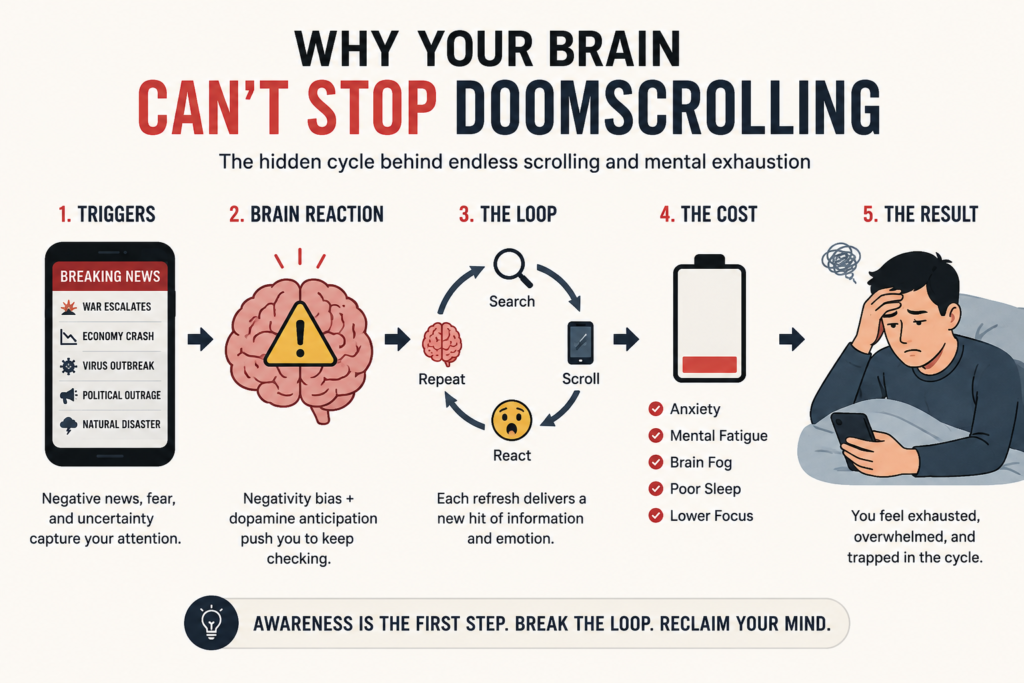
A clean infographic explaining the psychology behind doomscrolling and why the brain struggles to stop consuming negative news online. The image visualizes the cycle of fear-based headlines, dopamine anticipation, endless scrolling, emotional reactions, anxiety, mental fatigue, brain fog, poor sleep, and attention overload caused by modern digital media and nonstop information exposure.
Final Thoughts
Your brain is not weak for struggling with doomscrolling.
Modern digital systems are specifically designed to keep attention emotionally engaged.
Doomscrolling combines:
fear
uncertainty
dopamine anticipation
emotional stimulation
nonstop information
into one powerful behavioral loop.
And the human brain was never designed to process endless global anxiety twenty-four hours a day.
Staying informed matters.
But protecting mental clarity matters too.
Because sometimes the healthiest thing you can do for your brain is stop scrolling long enough to let it breathe again.
DOOMSCROLLING, NEWS ANXIETY & DIGITAL OVERLOAD
Recommended Reading
Explore more articles about doomscrolling, news anxiety, dopamine overload, attention fatigue, digital overstimulation, and how modern technology quietly affects mental clarity.