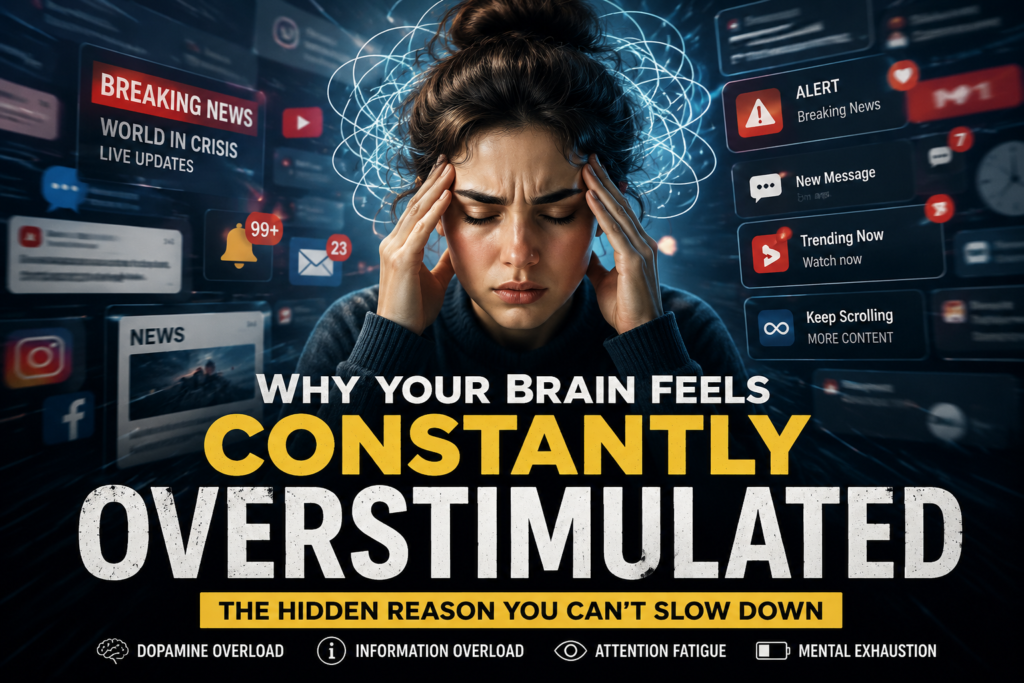
Modern digital life floods the brain with nonstop stimulation, dopamine overload, attention fatigue, and emotional exhaustion that make true mental rest increasingly difficult.
Why Your Brain Feels Constantly Overstimulated
Some days, it feels impossible to fully relax.
Even when nothing dramatic is happening, the brain still feels:
mentally noisy
emotionally overloaded
restless
distracted
unable to slow down
I started noticing this in small moments.
Watching a movie without checking my phone suddenly felt difficult. Silence felt uncomfortable. Even short periods without stimulation felt strangely frustrating.
At first, I assumed I was simply tired.
But over time, I realized something deeper was happening.
Modern life constantly overstimulates the human brain — and most people barely notice how much it affects their nervous system until mental exhaustion becomes impossible to ignore.
What Does an Overstimulated Brain Feel Like?
Mental overstimulation does not always look dramatic.
Sometimes it appears as:
constant mental noise
difficulty focusing
emotional fatigue
irritability
brain fog
anxiety
restlessness
inability to relax
overstimulation from screens
exhaustion after scrolling online
Many people describe it as feeling “mentally full” all the time.
The brain rarely experiences true quiet anymore.
Why Modern Life Overstimulates the Brain
The human nervous system evolved in relatively slow environments.
Historically, the brain processed:
local conversations
nearby social interactions
limited information
occasional threats
Modern digital life changed that completely.
Now the average brain constantly processes:
notifications
breaking news
social media feeds
AI conversations
short-form videos
emails
advertisements
emotional headlines
endless recommendations
all within hours.
The nervous system never fully recovers from the stimulation cycle.
Dopamine Overload Is Quietly Rewiring Attention
One major reason overstimulation feels so powerful is dopamine.
Dopamine is often misunderstood as a “happiness chemical.”
But researchers increasingly describe dopamine as a system connected to:
anticipation
motivation
novelty
reward-seeking
In The Molecule of More, psychiatrist Daniel Z. Lieberman explains how dopamine pushes the brain toward continuous stimulation and future rewards.
Modern technology constantly activates this system.
Every:
refresh
notification
recommendation
short video
headline
AI response
creates another small anticipation loop.
Over time, the brain adapts to high levels of stimulation and begins struggling with slower environments.
Why Silence Feels So Uncomfortable Now
This was one of the strangest things I noticed personally.
The quieter my environment became, the more restless my brain felt.
Many people experience this without realizing why.
Constant digital stimulation trains the nervous system to expect continuous input.
When silence appears, the brain suddenly notices:
boredom
anxiety
uncomfortable thoughts
emotional discomfort
Instead of feeling peaceful, stillness can feel mentally irritating.
That reaction itself is often a sign of overstimulation.
Neuroscientists increasingly connect this type of rapid attention switching with:
reduced concentration
mental fatigue
cognitive overload
lower boredom tolerance
The brain never remains in one mental state long enough to fully recover.
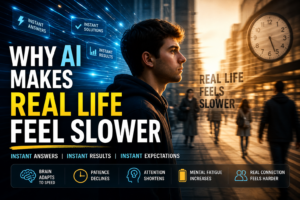
Why AI Makes Overstimulation Worse
Artificial intelligence accelerated information speed dramatically.
AI systems now provide:
instant answers
instant entertainment
instant creativity
instant summaries
instant stimulation
This changes the brain’s expectation for cognitive speed.
I noticed this personally after spending long hours using AI tools daily.
Normal activities suddenly felt:
slower
less stimulating
mentally harder to sustain
The problem is not AI itself.
The problem is that the human nervous system still needs recovery time from constant cognitive activation.
The Attention Economy Profits From Overstimulation
Modern digital platforms compete aggressively for human attention.
Former Google design ethicist Tristan Harris has repeatedly warned that many platforms are designed specifically to maximize engagement.
The systems reward:
emotional intensity
novelty
outrage
stimulation
speed
because stimulation keeps users interacting longer.
Unfortunately, the human brain pays the psychological cost.
Why Overstimulation Creates Brain Fog
One surprising effect of overstimulation is cognitive exhaustion.
The brain eventually becomes overwhelmed by:
nonstop information
emotional processing
constant switching
digital multitasking
stimulation overload
The result often feels like:
reduced clarity
low focus
mental fatigue
emotional numbness
lack of motivation
Ironically, many people respond by consuming even more stimulation.
And the cycle continues.
My Personal Wake-Up Call
I realized how overstimulated my brain had become during a simple walk outside.
I instinctively reached for my phone every few minutes.
Not because I needed anything.
My brain simply struggled with unstimulated moments.
That realization honestly bothered me.
I had become so accustomed to constant digital input that normal silence started feeling incomplete.
Since then, I’ve intentionally reduced:
endless scrolling
background noise
nonstop notifications
constant multitasking
excessive short-form content
And the difference became noticeable surprisingly quickly.
How to Calm an Overstimulated Brain
The nervous system needs recovery periods.
Without recovery, overstimulation slowly becomes the brain’s default state.
A few habits genuinely helped me:
walking without headphones
reducing notification overload
spending time away from screens
reading long-form books again
limiting short-form video consumption
allowing boredom occasionally
practicing deeper focus without multitasking
At first, slowing down felt uncomfortable.
Then it started feeling peaceful again.
Why Boredom Is Actually Important
Modern culture treats boredom like a problem.
But psychologists increasingly believe boredom serves an important role in:
creativity
emotional processing
reflection
nervous system recovery
deeper thinking
Constant stimulation removes those recovery spaces completely.
The brain never fully settles.
And eventually, mental exhaustion becomes chronic.
The Nervous System Was Never Designed for Constant Input
In Stolen Focus, author Johann Hari explains how modern digital systems aggressively fragment human attention.
The brain evolved for slower, more stable environments.
Not endless information streams operating twenty-four hours a day.
Today, many people are not simply tired.
They are neurologically overloaded.
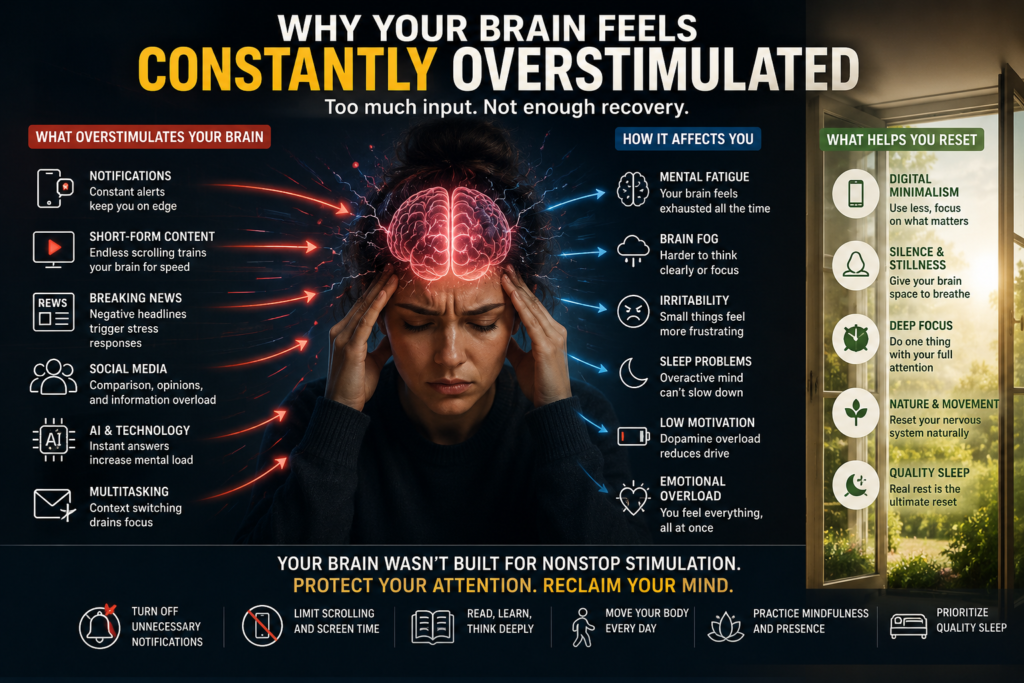
A visually clean infographic explaining why modern brains feel constantly overstimulated from nonstop notifications, social media, AI-driven speed, information overload, multitasking, and dopamine-based digital habits. The image highlights symptoms like mental fatigue, brain fog, emotional exhaustion, poor focus, and sleep disruption while showing how slowing down, reducing input, and creating silence can help the brain recover.
Final Thoughts
If your brain feels constantly overstimulated, you are not imagining it.
Modern digital environments expose the nervous system to:
nonstop information
emotional stimulation
constant novelty
algorithmic engagement
AI acceleration
endless attention switching
all without enough recovery time.
The brain adapts to whatever environment it experiences repeatedly.
And today’s environment is louder, faster, and more stimulating than anything humans evolved to handle.
Sometimes the healthiest thing you can do for your mind is not finding more stimulation.
It’s allowing your brain enough quiet to finally recover again.
OVERSTIMULATED BRAIN & DIGITAL FATIGUE
Recommended Reading
Explore more articles about overstimulation, dopamine overload, attention fatigue, doomscrolling, silence discomfort, and how modern technology quietly affects mental clarity.