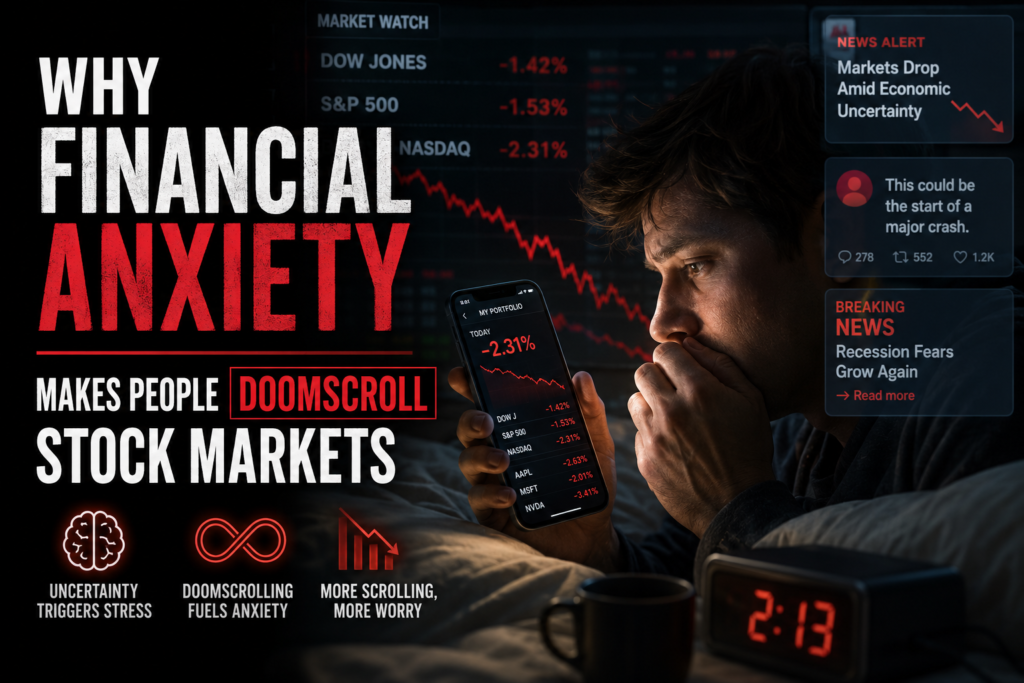
Financial anxiety is pushing more people to constantly check stock market apps, economic news, and recession headlines. The more uncertain the economy feels, the harder it becomes to stop doomscrolling.
Why Financial Anxiety Makes People Doomscroll Stock Markets
At 2:13 AM last month, I checked Nasdaq futures while lying in bed in the dark.
I wasn’t trading. I wasn’t about to buy anything. And honestly, I already knew checking the market again wouldn’t help me sleep.
But I opened the app anyway.
Dow futures were red. Twitter was full of recession threads. Someone on Reddit was predicting another crash. Another person was calling it “the beginning of the AI bubble collapse.”
So I kept scrolling.
Five minutes became forty.
The strange part? I’m starting to realize millions of people are quietly doing the exact same thing now.
Not because they love finance.
Because uncertainty has become emotionally addictive.
Why People Doomscroll Stock Markets During Economic Uncertainty
The term “doomscrolling” exploded during the pandemic, describing the compulsive habit of consuming endless negative news online.
But financial doomscrolling feels slightly different.
It’s more personal.
When stock markets become unstable, people suddenly monitor:
Dow Jones futures
Bitcoin prices
inflation reports
Federal Reserve news
recession predictions
AI stock bubbles
layoffs in tech
almost obsessively.
Even people with small investments now refresh market apps constantly.
Why?
Because uncertainty creates psychological tension the human brain struggles to tolerate.
Researchers at Harvard University found that uncertainty activates stress responses similar to physical threats. In many cases, people experience “not knowing” as emotionally harder than receiving bad news itself.
That explains why so many people repeatedly check financial news even when it makes them feel worse.
The brain keeps thinking:
“Maybe the next update will finally make things feel safe again.”
It almost never does.
I Didn’t Realize Financial Anxiety Was Affecting Me
For years, I barely checked markets during the day.
Now I catch myself opening stock apps automatically while waiting in line for coffee.
One morning recently, I checked:
the S&P 500 premarket
Treasury yields
Bitcoin
AI stock news
Jerome Powell headlines
before brushing my teeth.
That honestly bothered me.
Not because investing is bad.
But because I realized I wasn’t searching for information anymore.
I was searching for emotional reassurance.
And I think a lot of people are doing this without fully noticing it.
Why Smart People Get Trapped in Financial Doomscrolling
One of the biggest myths about doomscrolling is that it only affects inexperienced investors.
Actually, intelligent and analytical people often fall into it even harder.
Why?
Because smart people usually believe:
“More information leads to better decisions.”
That sounds logical. But modern markets don’t behave like calm environments anymore.
Researchers from Stanford University found that excessive information exposure increases cognitive fatigue and weakens decision quality over time.
At some point, information stops helping.
It starts flooding the brain instead.
And social media makes this dramatically worse.
Financial News Is Now Designed To Trigger Emotion
Twenty years ago, investors checked the news once or twice daily.
Now financial anxiety follows people everywhere.
Open YouTube: “Market Crash Incoming.”
Open Twitter: “AI Bubble About To Burst.”
Open TikTok: “Three Stocks To Survive Economic Collapse.”
The algorithms reward fear because fear keeps people engaged.
And honestly? The market itself sometimes feels less stressful than the endless reactions surrounding it.
That’s the exhausting part.
The modern financial internet turns uncertainty into entertainment.
The Brain Was Never Built For Real-Time Markets
Human beings evolved slowly.
Financial markets do not.
Today your brain absorbs:
live charts
AI-driven predictions
breaking economic news
global instability
recession warnings
layoffs
interest rate fears
before breakfast.
That level of constant stimulation is historically abnormal.
In Thinking, Fast and Slow, Daniel Kahneman explained how uncertainty pushes the brain into reactive thinking patterns.
The human brain becomes hyper-alert during unclear situations.
That survival mechanism once protected humans from danger.
Now it makes people refresh stock apps 17 times a day.
Warren Buffett Quietly Warned About This Years Ago
Warren Buffett once said:
“The stock market is designed to transfer money from the active to the patient.”
That quote feels almost uncomfortable in today’s culture.
Because modern investing rewards constant stimulation:
alerts
notifications
hot takes
prediction threads
viral panic
But historically, many successful investors avoided emotional overconsumption of financial news entirely.
Charlie Munger repeatedly criticized what he called “noise-driven behavior.”
And honestly, the older I get, the more I understand what he meant.
Sometimes nonstop financial content creates the illusion of control while quietly destroying emotional clarity.
Financial Anxiety Is No Longer Just About Money
This is the part people rarely talk about.
Most financial doomscrolling isn’t really about investing anymore.
And the platforms reward exactly those emotions because emotional reactions generate engagement.
Calm analysis rarely goes viral.
Panic does.
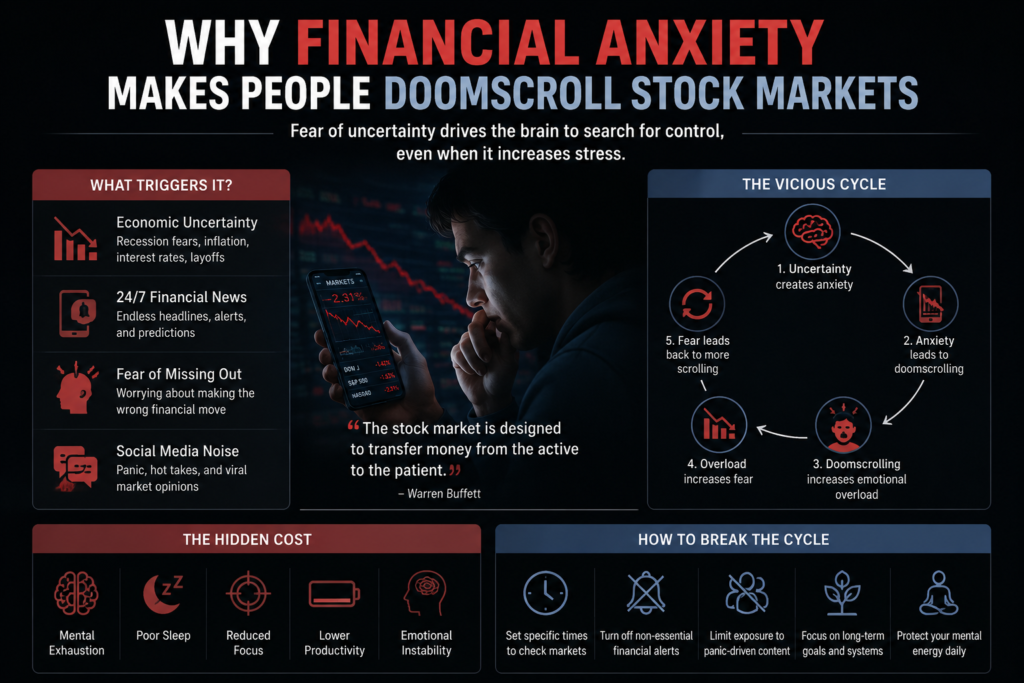
That creates a brutal cycle:
uncertainty increases anxiety
anxiety increases scrolling
scrolling increases emotional overload
overload increases fear
fear creates more scrolling
That loop is what makes financial doomscrolling feel addictive.
The Hidden Cost Nobody Talks About
The real danger isn’t just bad investing decisions.
It’s mental exhaustion.
Constant financial monitoring quietly damages:
focus
sleep
attention span
emotional regulation
productivity
I started noticing this personally during periods of high market volatility.
On days I checked markets constantly, my concentration became fragmented.
Even when I stopped scrolling, part of my brain still felt “financially alert.”
Like background stress never fully turned off.
That feeling is becoming incredibly common now.
Especially among younger professionals constantly exposed to financial content online.
So How Do You Stop Financial Doomscrolling?
Not by pretending the economy doesn’t matter.
But by understanding what your brain is actually searching for.
Most people aren’t really searching for information anymore.
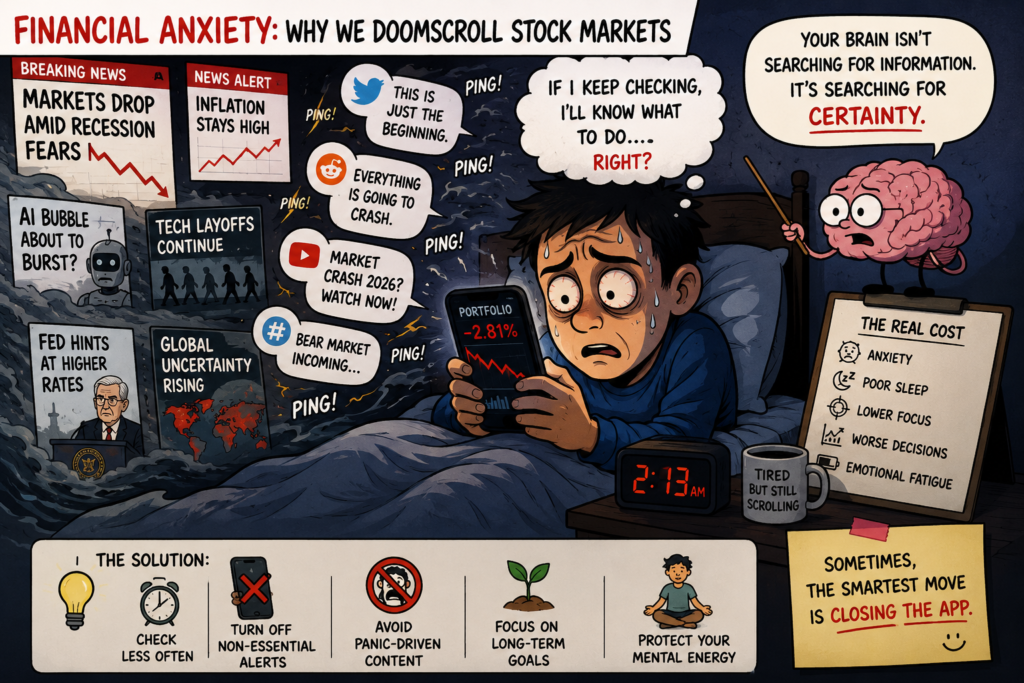
They’re searching for certainty.
And unfortunately, modern financial media profits from keeping people uncertain.
The biggest thing that helped me personally was setting boundaries:
checking markets only at specific times
deleting finance apps from my home screen
avoiding panic-based creators
reading slower long-form analysis instead of emotional feeds
Ironically, the less often I checked markets, the calmer and clearer my decisions became.
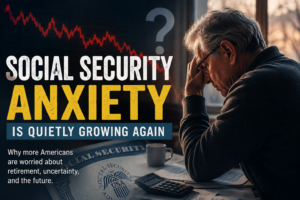
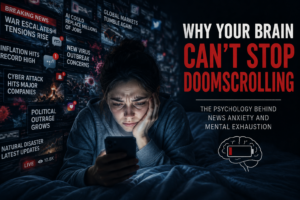
Constant exposure to stock market news, recession fears, and economic uncertainty is quietly increasing financial anxiety for millions of people. Doomscrolling financial content may feel productive in the moment, but it often amplifies stress, emotional fatigue, and information overload instead of providing real control.As financial anxiety grows, more people are trapped in a cycle of constantly checking stock prices, recession headlines, and market predictions. This satirical illustration highlights how doomscrolling financial news can quietly increase stress, emotional exhaustion, and the fear of uncertainty in modern life.
Final Thoughts
Financial anxiety is quietly becoming one of the defining psychological pressures of modern life.
And the strange part is: the more connected people become to information, the more emotionally unstable many of them feel.
Stock market doomscrolling isn’t just about investing.
It’s about uncertainty. Control. Fear. Identity. And the uncomfortable feeling that the future keeps changing faster than humans can emotionally process.
Maybe that’s why people keep refreshing financial apps late at night.
Not because it helps.
Because for a few seconds, it feels like doing something.
Even when it isn’t.
Related Reading: Financial Anxiety, Focus, and Information Overload
If stock market news makes you feel mentally exhausted, these related articles will help you understand how anxiety, information overload, and modern digital habits affect focus and decision-making.