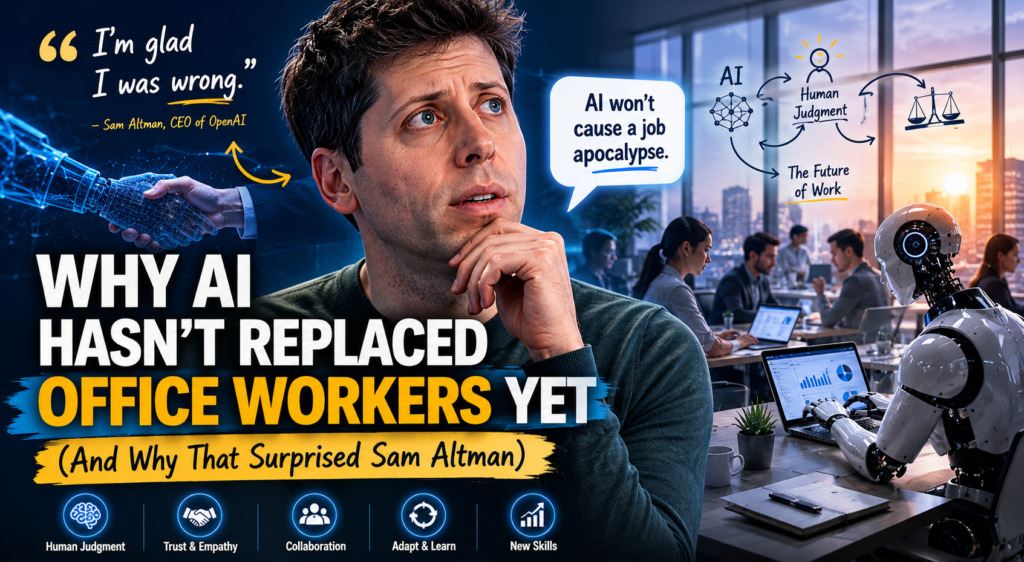
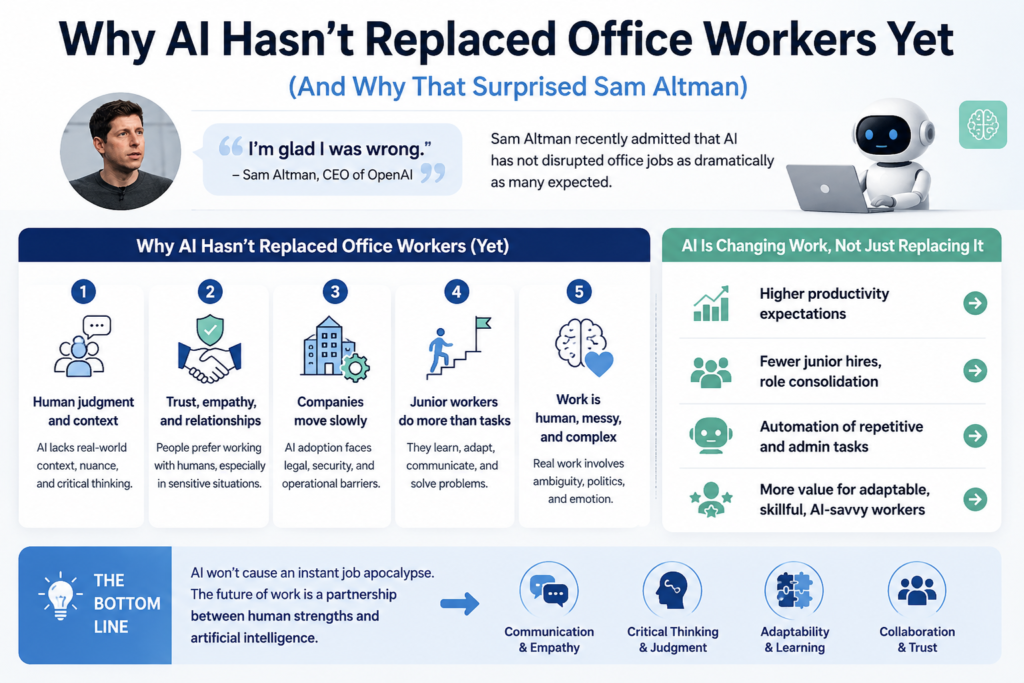
Sam Altman recently admitted that AI has not disrupted office jobs as dramatically as many expected. Human judgment, trust, and communication still matter more than automation alone.
Why AI Hasn’t Replaced Office Workers Yet (And Why That Surprised Sam Altman)
For the last two years, people have been asking the same terrifying question:
“Will AI replace office workers?”
When ChatGPT exploded into mainstream culture, the internet filled with predictions about the collapse of white-collar jobs. Junior analysts. Copywriters. Customer support teams. Recruiters. Even software engineers suddenly felt vulnerable.
At one point, it genuinely felt like artificial intelligence would automate half of office life.
But something strange happened.
It didn’t.
And recently, even Sam Altman admitted that reality has been more complicated than expected.
During a public appearance in Australia, Altman said he was “glad to be wrong” about how severely AI would disrupt office employment. While AI capabilities advanced rapidly, the large-scale economic shock many feared simply hasn’t arrived yet.
That statement matters.
Because it reveals something deeper about work, technology, and human psychology that Silicon Valley may have underestimated from the beginning.
The AI Panic Wasn’t Irrational
To be fair, the fear made sense.
AI suddenly became capable of:
writing reports
generating emails
summarizing meetings
creating presentations
answering customer questions
generating code
analyzing spreadsheets
From the outside, office jobs looked dangerously automatable.
In 2023, Goldman Sachs estimated that generative AI could affect up to 300 million jobs globally. Major consulting firms published alarming forecasts about workforce disruption across finance, marketing, legal services, and administration.
Social media amplified the fear even more.
Every week, someone posted:
“AI just replaced an entire department.”
And honestly, even I believed it at first.
I Thought AI Would Replace More People Too
When I first started using AI tools daily, the productivity boost felt almost unreal.
I could summarize documents in seconds. Generate outlines instantly. Draft emails faster than ever before.
For a while, I genuinely wondered:
“Why would companies still hire junior office workers?”
But after months of actually working with AI, I noticed something important.
The tool was powerful…
…but humans still spent enormous amounts of time:
checking accuracy
fixing tone
understanding context
making judgment calls
communicating emotionally
coordinating between people
The work itself didn’t disappear.
Instead, the shape of work changed.
That distinction is critical.
Why Office Jobs Turned Out To Be Harder To Replace
The biggest misunderstanding about office work is that it’s mostly repetitive.
In reality, most office environments are chaotic human systems.
Researchers from MIT and Harvard University have repeatedly shown that workplace productivity depends heavily on:
trust
social coordination
emotional communication
contextual judgment
informal collaboration
These things sound abstract until you try removing humans from the process entirely.
That’s when companies discovered a frustrating truth:
AI is excellent at generating information. Humans are still better at navigating messy reality.
The Human Side of Work Matters More Than Tech People Expected
One reason AI hasn’t replaced office workers yet is surprisingly simple:
People still prefer dealing with people.
This is especially true in:
customer communication
management
negotiations
leadership
team collaboration
Even perfectly written AI responses can feel emotionally empty.
Psychologist Daniel Kahneman spent decades studying how humans make decisions under uncertainty. His work showed that people rarely operate through pure logic alone.
Human interaction contains:
tone
trust
timing
empathy
status signals
emotional nuance
AI can imitate these patterns.
But imitation and human presence are not the same thing.
At least not yet.
Companies Also Move Much Slower Than AI
Another reason job collapse hasn’t happened?
Organizations are slow.
Very slow.
A McKinsey study found that many businesses struggle to fully integrate AI because of:
security concerns
legal risks
inaccurate outputs
accountability issues
employee resistance
unclear workflows
This creates a major gap between:
what AI can technically do and
what companies are realistically willing to automate
On Twitter and YouTube, AI progress looks instantaneous.
Inside corporations, implementation often moves painfully slowly.
Junior Workers Secretly Do More Than People Realize
One prediction that hasn’t fully materialized is the destruction of entry-level office jobs.
Why?
Because junior employees don’t just complete tasks.
They absorb culture.
They learn systems. Build relationships. Coordinate information. Notice operational problems. Support communication flow.
These invisible functions rarely appear in productivity metrics.
But they matter enormously in real organizations.
Ironically, many managers only realized this after trying to automate too aggressively.
AI Is Still Changing Work — Just Not In The Way People Expected
This doesn’t mean workers are completely safe.
AI is absolutely restructuring the workplace.
But the shift is more subtle than “robots taking all jobs.”
Instead, companies are increasingly:
hiring fewer junior employees
expecting higher productivity
consolidating roles
automating repetitive admin work
rewarding workers who use AI effectively
That changes career dynamics dramatically.
The future may not be:
“AI replaces everyone.”
It may look more like:
“One worker now does the work of three.”
Economically, that still creates enormous pressure.
The Psychological Impact Is Already Here
Oddly enough, one of the biggest AI effects isn’t unemployment.
It’s anxiety.
A Microsoft Work Trend report found that employees increasingly feel overwhelmed by constant digital acceleration and rising productivity expectations.
I’ve noticed this personally too.
Even when AI saves time, people often feel:
more mentally exhausted
more replaceable
more pressured to optimize constantly
more afraid of falling behind
This creates a strange paradox:
AI reduces effort in some tasks… while simultaneously increasing psychological pressure overall.
That may become one of the defining workplace problems of the next decade.
Silicon Valley May Have Underestimated Human Complexity
For years, many tech leaders viewed work as a collection of tasks.
If a task could be automated, the worker seemed replaceable.
But real-world organizations aren’t spreadsheets.
They’re social systems.
People don’t just exchange information at work. They exchange:
trust
reassurance
status
emotion
responsibility
accountability
And those human layers are far harder to automate than writing an email.
Even Sam Altman now appears more cautious about predicting immediate labor collapse.
That alone says a lot.
So Who Actually Wins In An AI Economy?
The workers becoming more valuable are usually not the fastest typists or the most repetitive workers anymore.
Instead, the advantage increasingly belongs to people who can:
adapt quickly
think critically
communicate clearly
combine AI with human judgment
manage ambiguity
solve unstructured problems
Ironically, the more AI improves, the more uniquely human skills begin to matter.
Not less.
AI may be transforming office work faster than expected, but human judgment, trust, communication, and adaptability still remain difficult to replace. Sam Altman recently admitted that the “AI job apocalypse” many feared has not happened — at least not yet.
Final Thoughts
AI hasn’t replaced office workers yet because work was never just about output.
It was always about people.
About coordination. Trust. Context. Emotional intelligence. Decision-making under uncertainty.
The internet often frames AI as a battle between humans and machines.
But reality looks more complicated.
At least for now, the future of work seems less like total replacement…
…and more like an uncomfortable partnership between human judgment and artificial intelligence.
The companies — and workers — who understand that balance first will probably survive the transition best.
Related Reading: Understand AI, Work, and Mental Overload
If you found this article useful, these related posts will help you understand how AI is changing work, productivity, and the way our brains handle modern information.