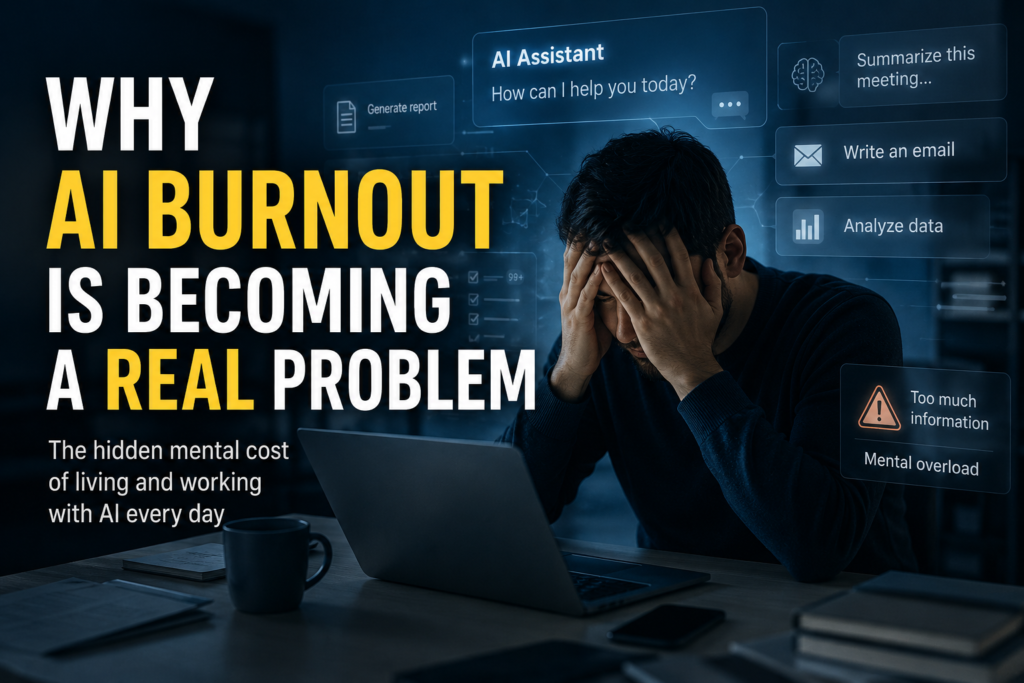
AI burnout is emerging as constant automation, digital overload, and nonstop optimization quietly exhaust attention and mental energy.
Artificial intelligence was supposed to make work easier.
In many ways, it has.
AI tools can now summarize meetings, generate reports, answer emails, organize schedules, create presentations, and automate repetitive tasks in seconds. Productivity has accelerated faster than many experts predicted.
But something unexpected is starting to happen alongside that progress.
People are becoming mentally exhausted by AI itself.
What began as a productivity revolution is quietly turning into a new form of cognitive overload.
And researchers, psychologists, workplace experts, and even major technology companies are beginning to notice the same pattern:
AI burnout is becoming real.
What Is AI Burnout?
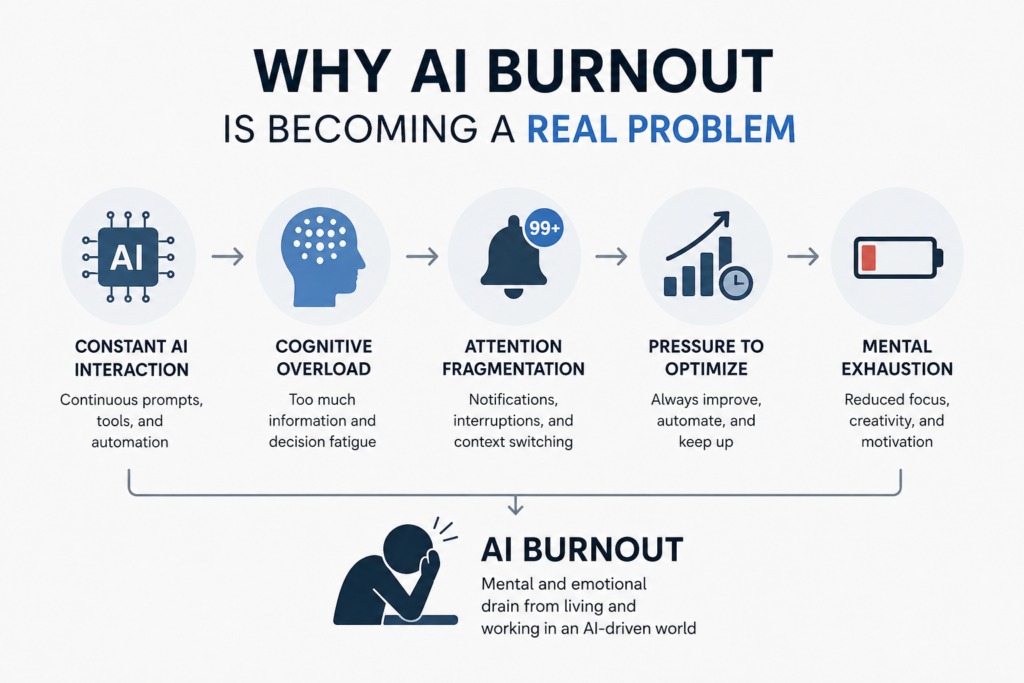
AI burnout is the mental exhaustion caused by constant interaction with AI-driven systems, automated workflows, and continuous digital decision-making.
Unlike traditional workplace burnout, AI burnout often feels strangely invisible at first.
People are not necessarily exhausted from physical work.
They are exhausted from:
Constant prompts
Endless optimization
Continuous notifications
AI-generated choices
Rapid information overload
Context switching between tools
Mental pressure to “keep up” with AI
The result is a type of cognitive fatigue that builds slowly over time.
Many people describe it as:
“My brain feels full all the time.”
The Productivity Trap Nobody Expected
AI promises efficiency.
But efficiency can create a dangerous psychological trap.
Historically, whenever technology increases productivity, expectations also increase.
This phenomenon has happened repeatedly:
Email accelerated communication — then increased response pressure
Smartphones improved connectivity — then created constant availability
Social media improved access to information — then overloaded attention
AI may be accelerating the same cycle.
Instead of reducing workload, many workers now feel pressure to:
Produce faster
Respond instantly
Learn new AI systems constantly
Automate everything
Stay “competitive” with AI-enhanced workers
The result is a strange contradiction:
People are saving time while simultaneously feeling more mentally overwhelmed.
Why AI Feels Mentally Exhausting
One major reason AI burnout happens is cognitive overload.
The human brain was not designed to process endless streams of information without recovery.
Researchers studying attention and decision fatigue have consistently found that excessive choices and rapid task switching reduce mental performance over time.
AI dramatically increases both.
Every day, users are now expected to evaluate:
AI-generated suggestions
Multiple outputs
Automated recommendations
Competing tools
Constant updates
Instead of eliminating decisions, AI sometimes multiplies them.
This creates what psychologists call decision fatigue — the gradual decline in mental energy after repeated cognitive effort.
The Hidden Cost of Constant Optimization
AI culture increasingly promotes optimization as a lifestyle.
People are constantly told to:
Optimize productivity
Optimize workflows
Optimize schedules
Optimize learning
Optimize focus
Optimize business systems
At first, this feels empowering.
But eventually, endless optimization becomes mentally exhausting.
Psychologists have long warned that humans struggle when life becomes excessively performance-driven.
In The Burnout Society, philosopher Byung-Chul Han argued that modern people increasingly suffer not from external oppression, but from internal pressure to maximize themselves constantly.
AI intensifies that pressure dramatically.
Now people are not only competing with other humans.
They are competing against machine-level efficiency.
AI Burnout Is Already Appearing in Workplaces
Large companies are already noticing signs of AI fatigue among employees.
Workers often report:
Mental exhaustion from monitoring AI systems
Anxiety about keeping up with automation
Information overload from AI-generated content
Reduced attention span
Pressure to continuously adapt
Some organizations initially believed AI would reduce stress.
Instead, many teams now experience a new kind of mental fragmentation caused by managing too many intelligent systems simultaneously.
This issue has become especially common in:
Marketing
Software development
Customer support
Content creation
Research-heavy jobs
Knowledge work
Ironically, the more digital the work becomes, the more cognitive pressure workers often experience.
Why AI Burnout Feels Different From Traditional Burnout
Traditional burnout often comes from overwork.
AI burnout often comes from overstimulation.
That distinction matters.
Many people experiencing AI fatigue are not necessarily working longer hours.
Instead, they are exposed to:
Faster information cycles
Continuous digital interaction
AI-generated noise
Endless notifications
Reduced mental recovery time
This creates constant low-level cognitive stress.
Over time, the brain struggles to fully disconnect.
The Attention Economy Is Making It Worse
AI systems are increasingly competing for attention.
This is not accidental.
The modern digital economy rewards platforms that keep users engaged for longer periods of time.
AI tools amplify this dynamic because they feel highly responsive, personalized, and rewarding.
Every instant answer creates a small psychological reward.
Over time, users become conditioned to expect:
Immediate clarity
Constant stimulation
Continuous assistance
Frictionless decision-making
But the human brain still needs periods of boredom, reflection, and silence to recover properly.
Without recovery, mental fatigue accumulates faster.
Why Younger Workers May Face the Biggest Risk
Younger generations entering the workforce may experience AI burnout more intensely than older workers.
Unlike previous generations, many younger workers are entering careers where:
AI systems are always present
Digital multitasking is normal
Constant connectivity is expected
Productivity tracking is continuous
Automation pressure never fully stops
This creates a work environment with very little cognitive downtime.
Some researchers worry this could reshape long-term attention patterns and emotional resilience.
AI Burnout May Quietly Reduce Creativity
One of the least discussed consequences of AI burnout is reduced creativity.
Creativity requires:
Mental space
Reflection
Slow thinking
Curiosity
Deep focus
But AI-driven environments increasingly reward speed instead.
When people constantly optimize for efficiency, they often lose time for experimentation and original thinking.
This may eventually become one of the biggest hidden costs of hyper-optimized AI workflows.
The Dangerous Illusion of Infinite Capacity
AI creates the illusion that humans should always be capable of doing more.
More tasks. More output. More optimization. More responsiveness.
But human cognitive limits still exist.
The brain cannot operate at machine speed indefinitely.
Ignoring those limits creates long-term exhaustion.
This is why many experts believe future productivity conversations will increasingly focus on:
Mental sustainability
Cognitive recovery
Digital boundaries
Healthy AI usage habits
—not just efficiency alone.
Why This Problem Will Grow Faster Than People Expect
AI adoption is accelerating rapidly.
But society still has very few norms around healthy AI usage.
Most people are still experimenting in real time.
That means the psychological effects often become visible only after habits are already deeply formed.
This happened with:
Smartphones
Social media
Remote work
Continuous notifications
AI may simply be the next stage of the same behavioral shift.
Only faster.
AI burnout happens when constant digital stimulation, automation, and productivity pressure overwhelm mental energy and attention.
Final Thoughts
AI is not inherently harmful.
In many cases, it genuinely improves productivity and reduces repetitive work.
But humans were never designed for nonstop optimization, continuous stimulation, and permanent digital acceleration.
The more AI systems remove friction from work, the more important mental recovery becomes.
Because the future challenge may not be whether AI can work faster than humans.
It may be whether humans can mentally keep up with the pace AI creates.
AI BURNOUT & MENTAL OVERLOAD
Recommended Reading
Explore more articles about AI burnout, cognitive overload, productivity systems, digital behavior, and the hidden psychological effects of modern technology.