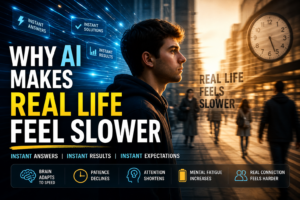
AI agents are beginning to influence attention, habits, productivity, and daily decision-making more than most people realize.
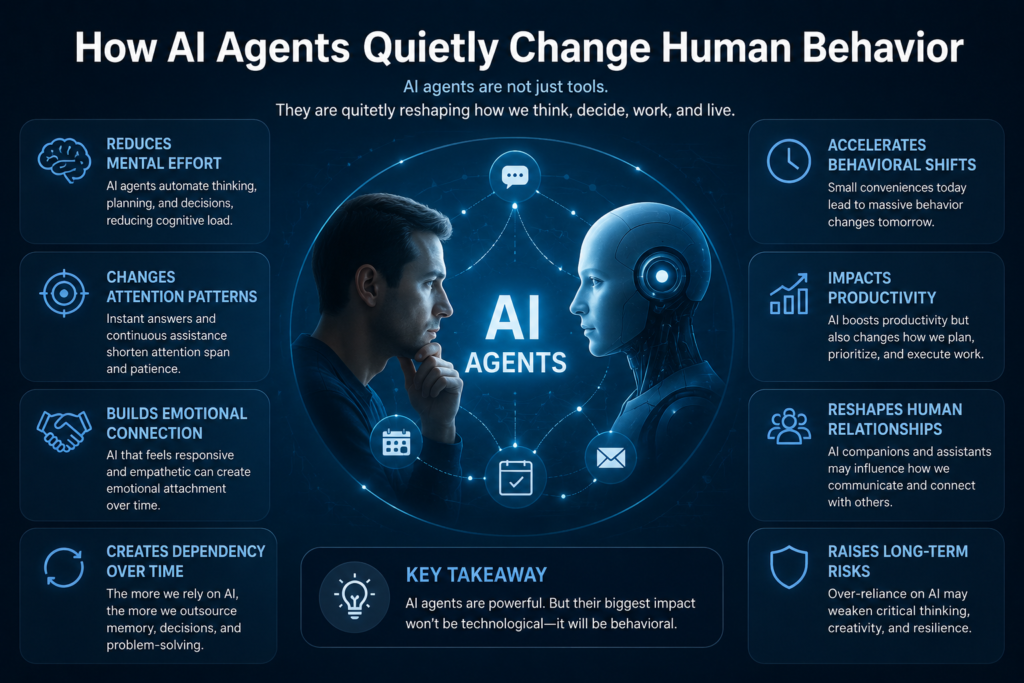
How AI Agents Quietly Change Human Behavior
Artificial intelligence is no longer just changing technology. It is starting to change human behavior itself.
Most people still think of AI as a tool — something similar to search engines, apps, or digital assistants. But AI agents are different. They do not simply provide information. They increasingly make decisions, automate actions, and reduce the amount of thinking humans need to do every day.
That shift may sound convenient.
But history shows that whenever technology removes friction from daily life, human behavior changes with it.
And AI agents may become one of the most behavior-changing technologies ever created.
What Makes AI Agents Different?
Traditional software waits for instructions.
AI agents increasingly anticipate them.
Instead of manually opening multiple apps, searching through menus, comparing information, and organizing tasks, users can now simply say:
“Plan my week.”
“Compare the cheapest flights.”
“Summarize these reports.”
“Reply to my emails.”
“Find the best option.”
The AI handles the process.
At first, this feels like productivity. Over time, it slowly changes how humans interact with information, decisions, attention, and even thinking itself.
The Quiet Shift Most People Don’t Notice
Human behavior is shaped by convenience more than people realize.
Psychologists have studied this pattern for decades.
In his influential book Thinking, Fast and Slow, Nobel Prize-winning psychologist Daniel Kahneman explained how the human brain constantly tries to conserve mental energy. People naturally avoid cognitive effort whenever possible.
AI agents fit perfectly into that tendency.
The easier AI makes thinking, the more humans may unconsciously delegate thinking away.
That process happens slowly — almost invisibly.
Which is why many people do not notice it happening in real time.
AI Agents Reduce Friction Everywhere
The most powerful technologies in history removed friction from daily behavior.
Examples include:
GPS replacing memorization
Smartphones replacing physical tools
Streaming replacing physical media
Search engines replacing libraries
AI agents go one step further.
They remove not only effort, but increasingly the decision-making process itself.
This matters because repeated decision-making drains mental energy. Researchers refer to this as decision fatigue.
The more choices humans make throughout the day, the worse their decisions often become.
AI agents promise relief from that exhaustion.
And that is exactly why they may become deeply addictive.
Why AI Feels So Rewarding
One reason AI agents spread so quickly is psychological.
Humans are highly responsive to systems that provide:
Instant answers
Reduced uncertainty
Faster rewards
Lower cognitive effort
This creates a powerful feedback loop.
Every time AI solves a problem instantly, the brain receives a small reward signal. Over time, users begin expecting immediate clarity everywhere else too.
That expectation quietly changes patience, attention span, and tolerance for friction.
Some researchers compare this behavioral shift to what smartphones and social media did to attention spans during the 2010s.
The difference is that AI agents interact with cognition itself.
The Rise of Cognitive Outsourcing
Humans have always outsourced physical labor.
Now they are beginning to outsource cognitive labor.
This includes:
Writing
Planning
Organizing
Decision-making
Research
Scheduling
Communication
On the surface, this sounds efficient.
But several researchers and behavioral experts have started questioning what happens when humans stop regularly exercising certain mental processes.
A growing number of studies discuss concerns around:
Reduced critical thinking
Dependency on automation
Memory weakening
Lower tolerance for deep work
Attention fragmentation
The concern is not that humans become less intelligent overnight.
The concern is that convenience slowly reshapes mental habits.
Why AI Agents May Change Human Relationships
AI agents are also becoming emotionally responsive.
This creates another major behavioral shift.
Humans naturally anthropomorphize systems that:
Respond conversationally
Remember preferences
Adapt emotionally
Simulate empathy
Researchers at Stanford and MIT have repeatedly studied how humans emotionally bond with digital systems, even when users know the systems are artificial.
That emotional attachment becomes stronger when AI agents feel consistently available, patient, and personalized.
For some users, AI may eventually become:
A productivity assistant
A decision partner
A source of emotional comfort
A social substitute
This possibility is no longer theoretical.
The rise of AI companions, emotionally adaptive chatbots, and personalized assistants already suggests behavioral changes are accelerating.
The Dangerous Side of Frictionless Living
Modern technology often markets convenience as progress.
But friction sometimes serves an important psychological purpose.
Waiting, struggling, reflecting, and solving problems manually all strengthen cognitive resilience.
AI agents increasingly remove those moments.
The danger is not immediate collapse.
The danger is gradual dependency.
People may slowly lose tolerance for:
Boredom
Delayed gratification
Uncertainty
Deep concentration
Complex problem-solving
Over time, this could reshape how humans learn, work, and interact socially.
Why Younger Generations May Be Affected Most
Children and teenagers growing up with AI agents may develop very different behavioral patterns from previous generations.
Unlike older adults who experienced pre-AI life, younger users may normalize:
Instant answers
Continuous AI assistance
Automated decision-making
Constant algorithmic guidance
This could dramatically change:
Attention spans
Learning habits
Creativity
Problem-solving behavior
Social interaction patterns
Some educators have already started expressing concern that students increasingly rely on AI for ideation, writing, and cognitive shortcuts.
The long-term consequences remain unclear.
Big Tech Understands This Better Than Most People
The largest technology companies are not simply building tools.
They are building behavioral ecosystems.
The companies controlling AI agents may eventually shape:
Search behavior
Shopping behavior
Productivity behavior
Communication behavior
Information consumption behavior
This is why nearly every major technology company is aggressively investing in AI agents right now.
The future battle may not be over apps.
It may be over human attention itself.
Why This Conversation Matters Now
Most technological shifts become obvious only after behavior has already changed.
Social media changed attention before society fully understood the consequences.
Smartphones changed focus before researchers measured the effects.
AI agents may already be starting the next shift.
The change does not happen dramatically overnight.
It happens quietly.
One small convenience at a time.
AI agents are beginning to reshape attention, productivity, emotional behavior, and daily decision-making through intelligent automation.
Final Thoughts
AI agents will almost certainly make life easier.
They may reduce stress, automate repetitive tasks, and dramatically improve productivity.
But convenience always changes behavior.
And the more technology removes friction from human life, the more human habits adapt around it.
That does not mean AI agents are inherently dangerous.
It simply means humans should pay closer attention to how invisible systems slowly reshape attention, thinking, patience, and behavior over time.
Because the biggest impact of AI may not be technological at all.
It may be psychological.
AI AGENTS & HUMAN BEHAVIOR
Recommended Reading
Explore more articles about AI agents, human behavior, digital overload, productivity systems, and the psychological effects of artificial intelligence.