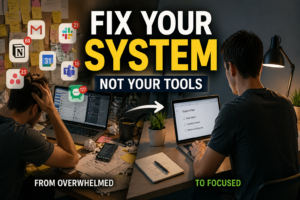
A person overwhelmed by multiple productivity tools and notifications, showing how too many apps can reduce focus instead of improving efficiency.
Introduction
Most people don’t notice when their productivity system starts to fail.
At first, everything feels perfect.
You install a new tool, organize your tasks, and build what looks like a clean system. For a few days, it works.
Then something changes.
You skip one task. You delay another. And slowly, the system you trusted becomes something you avoid.
Nothing is broken. But nothing works either.
👉 This is where most productivity systems fail.
The Problem Nobody Talks About
We live in a time where productivity tools are everywhere.
From AI assistants to advanced SaaS platforms, everything is designed to help you:
plan better
organize faster
automate tasks
But despite all of this, many people still struggle with the same problems:
inconsistency
lack of focus
unfinished work
This isn’t a coincidence.
👉 It’s a pattern.
And it happens for a reason.
Why Productivity Tools Fail Most People
1. Tools Help You Plan — Not Act
Most tools are designed for planning.
They help you:
create tasks
structure projects
visualize progress
But they don’t solve the most important moment:
👉 starting the work
Without a clear starting point, everything stays as intention—not action.
2. Too Many Options Slow You Down
Modern tools give you flexibility:
multiple views
customizable systems
endless ways to organize
But every option creates a decision.
And decisions drain energy.
Over time, this leads to:
hesitation
delay
avoidance
👉 What looks like productivity is often just structured procrastination.
3. Your System Is Not Designed for Consistency
Most people build systems around motivation.
But motivation changes.
Consistency doesn’t come from:
better tools
better ideas
It comes from:
👉 repeatable structure
If your system changes every day, your behavior will too.
4. AI Makes Planning Easier — Not Execution
AI tools can now:
generate plans instantly
organize information
suggest workflows
But they don’t remove the hardest part:
👉 actually doing the work
You can have the perfect system on screen and still not follow it.
That’s why many people experience what feels like a slow breakdown of their system over time—something often described as “habit drift.”
What Actually Works Instead
If tools don’t solve the problem, what does?
The answer is simpler than most people expect.
1. Start With One Fixed Action
Instead of building a complex system, define:
👉 one action 👉 at one fixed time
Example:
9:00 AM → start focused work
No thinking. No planning. Just start.
2. Anchor Your Work to Time
Lists create options. Time creates action.
When work is tied to a specific time, it becomes:
automatic
predictable
repeatable
👉 That’s where consistency begins.
3. Simplify Your System
Most people don’t need more tools. They need fewer decisions.
Choose:
one main tool
one workflow
one daily structure
Everything else becomes secondary.
4. Build a Daily Feedback Loop
At the end of the day, ask:
What did I actually complete?
Where did I hesitate?
What can I simplify tomorrow?
This creates awareness—and awareness drives change.
A Real-World Pattern
If you look at people who maintain long-term consistency, you’ll notice something interesting:
They don’t rely on tools alone.
They rely on:
structure
repetition
simplicity
This pattern shows up across different fields:
athletes
professionals
long-term performers
Even in leadership.
For example, the way long-term consistency is built in real careers can be seen in leadership paths like John Ternus at Apple—where progress wasn’t driven by sudden breakthroughs, but by sustained execution over time.
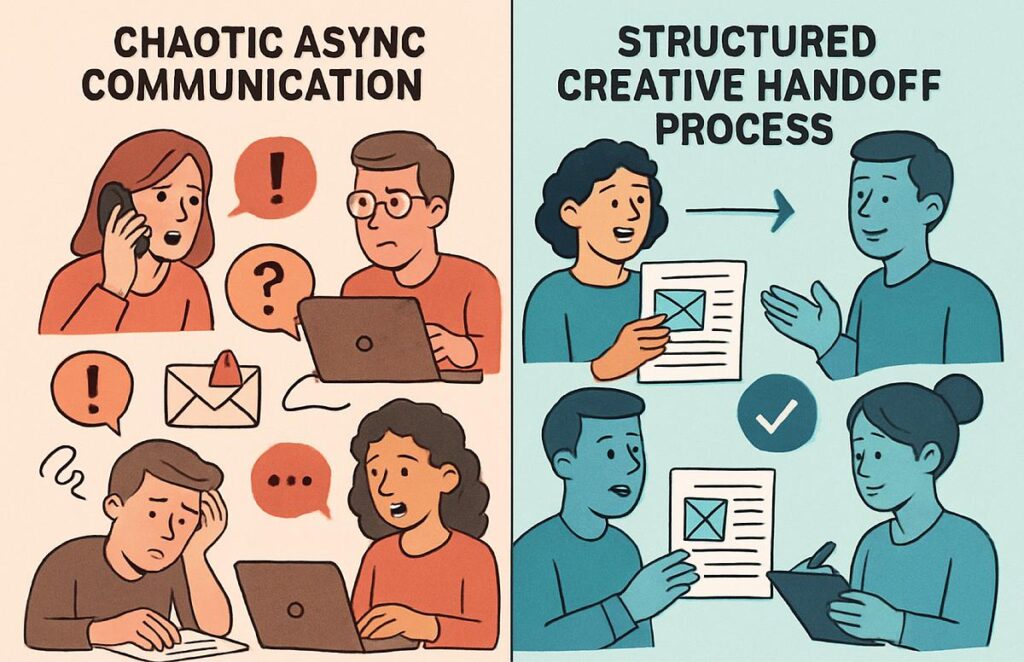
A comparison between chaotic communication and a structured workflow, illustrating how unorganized tools and constant interruptions reduce productivity, while clear systems improve focus and execution.
The Shift That Matters
Right now, productivity is changing.
It’s no longer about:
having the best tools
using the latest AI
It’s about:
👉 building systems that are easy to follow
Because in the end:
tools support
systems drive
behavior decides
Conclusion
If your productivity system isn’t working, don’t replace it immediately.
Instead:
remove complexity
define a clear starting point
anchor it to time
repeat daily
Over time, this approach creates something tools alone cannot:
👉 consistency
And in the long run:
👉 consistency is what actually produces results
PRODUCTIVITY SYSTEMS & FOCUS
Recommended Reading
Explore more articles about productivity systems, focus recovery, mental overload, habit consistency, and why many modern productivity tools fail in real life.
WIRED: How Slack Ruined Work
— A detailed look at how constant notifications and digital communication tools damage deep focus and productivity.
Research Paper: Why Digital Tools Fail
— Research discussing how lack of discipline, feature overload, and distractions reduce the effectiveness of productivity apps.
Atomic Habits by James Clear
— A practical framework focused on sustainable systems, habit consistency, and behavior change instead of tool dependency.



Pingback: Why Smart People Make Bad Decisions (Sri Lanka Monks Case)