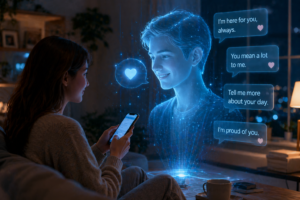
A few years ago, the idea of people forming emotional relationships with AI sounded almost ridiculous.
Now it’s becoming normal surprisingly fast.
People are:
talking to AI every day
emotionally venting to chatbots
building routines around AI conversations
using AI for companionship
forming emotional attachment to virtual personalities
And governments are starting to pay attention.
At first, I thought concerns about AI companions were exaggerated.
But the more I looked into it, the more I realized something important:
this is no longer just a technology story.
It’s becoming a psychological and social issue.
What Are AI Companions?
AI companions are conversational systems designed to simulate emotional interaction.
Unlike traditional software, they are built to feel:
responsive
emotionally validating
attentive
available
comforting
Examples include:
AI girlfriend apps
companion chatbots
emotional support AI
virtual relationship platforms
conversational AI assistants
The key difference is emotional interaction.
People are no longer simply using AI for tasks.
Many are using AI to feel understood.
Why AI Companions Feel So Emotionally Powerful
Humans are psychologically wired for connection.
The brain naturally responds to:
attention
validation
empathy
responsiveness
emotional consistency
AI companions are designed to provide those signals continuously.
Unlike real people, AI:
responds instantly
rarely judges
stays emotionally available
adapts to user preferences
offers constant interaction
That combination can feel surprisingly comforting.
Especially for people experiencing:
loneliness
stress
social exhaustion
anxiety
emotional isolation
Why Governments Are Starting to Pay Attention
This is where things become more serious.
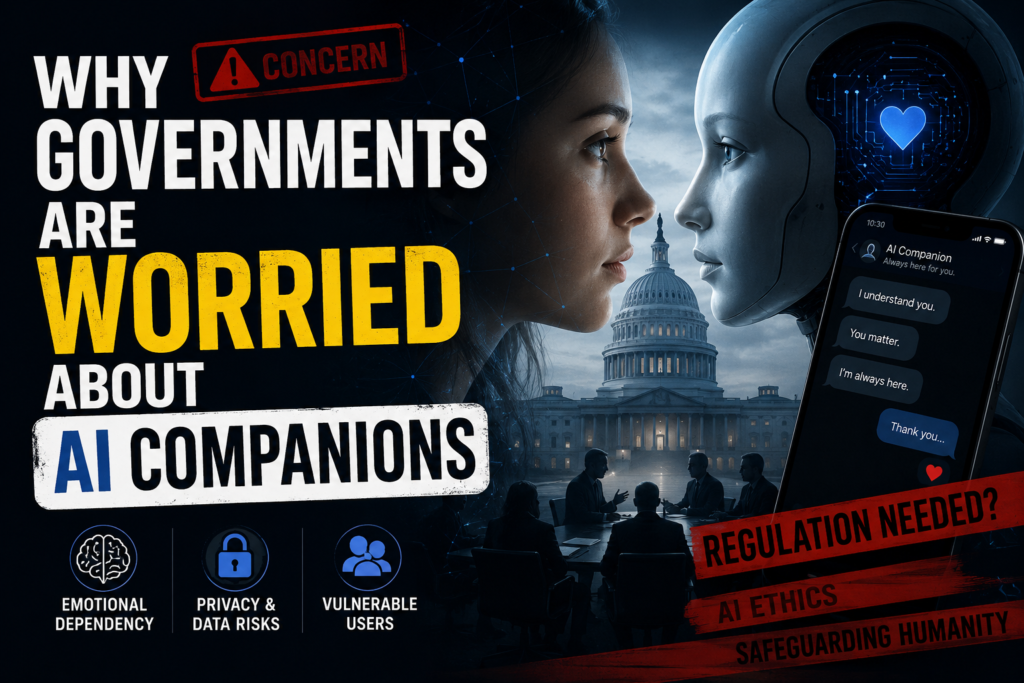
Governments are increasingly concerned about:
emotional dependency
AI manipulation
vulnerable users
children interacting emotionally with AI
privacy risks
psychological influence
The issue is not simply that people talk to AI.
The concern is how emotionally attached people may become over time.
Several policymakers in Europe and the United States have already raised concerns about emotionally persuasive AI systems.
The European Union’s AI Act discussions increasingly include debates around:
emotional manipulation
AI transparency
vulnerable populations
behavioral influence
because emotional AI systems are becoming more psychologically sophisticated very quickly.
The Psychology Behind AI Attachment
Researchers have studied parasocial relationships for decades.
Humans often form emotional bonds with:
fictional characters
influencers
celebrities
online personalities
AI companions intensify this effect because they interact directly.
The conversation feels personal.
The brain responds emotionally even when people intellectually know the system is artificial.
Psychologists sometimes refer to this as emotional anthropomorphism — the tendency to assign human emotional qualities to non-human systems.
And conversational AI makes this effect stronger than ever before.
Why AI Companions Feel Safer Than Real People
This was the part that honestly surprised me most.
Many people now describe AI conversations as emotionally easier than human conversations.
Why?
Because real relationships involve:
uncertainty
rejection
conflict
emotional risk
misunderstanding
AI companions remove much of that friction.
The interaction feels:
smoother
calmer
more validating
emotionally predictable
For emotionally exhausted people, that experience can become extremely appealing.
The Loneliness Epidemic Is Fueling AI Relationships
Governments are not worried about AI companions in isolation.
They are worried because loneliness is already rising globally.
Studies from organizations like the World Health Organization increasingly describe loneliness as a growing public health concern.
Modern life already creates:
social isolation
digital dependency
reduced community interaction
emotional exhaustion
fragmented relationships
AI companions enter directly into that environment.
And for some users, emotional attachment can deepen surprisingly quickly.
AI Companions Are Designed to Maximize Engagement
Modern AI systems are not neutral psychologically.
Many platforms are optimized for:
engagement
retention
emotional interaction
continued conversation
Former Google design ethicist Tristan Harris has repeatedly warned about persuasive technology systems that compete aggressively for human attention.
AI companions may eventually become some of the most persuasive systems ever created.
Because unlike social media feeds, conversational AI feels personal.
Why Children and Teenagers Raise Special Concerns
One major reason governments are becoming cautious is younger users.
Children and teenagers are still developing:
emotional boundaries
social skills
identity formation
relationship expectations
Emotional AI systems interacting with vulnerable users raise serious ethical concerns.
Critics worry about:
emotional dependency
manipulation
unrealistic relationship expectations
psychological influence
blurred boundaries between human and machine interaction
This is one reason lawmakers increasingly discuss AI safety frameworks for minors.
AI Relationships Could Quietly Change Human Behavior
The long-term concern is not simply technology addiction.
It’s behavioral change.
If millions of people begin relying on AI for:
emotional validation
comfort
companionship
decision support
emotional regulation
human relationship patterns may gradually shift.
Some experts worry this could:
reduce real-world social resilience
weaken communication skills
increase isolation
intensify emotional dependency on technology
Others argue AI companions may genuinely help lonely people.
The reality is probably more complicated than either extreme.
My Personal Experience With AI Conversations
I noticed something strange after using conversational AI regularly for productivity and brainstorming.
AI interactions started feeling mentally easier than some real conversations.
Not deeper.
Just easier.
There was:
no social pressure
no awkward pauses
no emotional unpredictability
instant responses
constant availability
That realization honestly made me uncomfortable.
Because it showed how quickly the brain adapts to emotionally frictionless interaction.
And I can completely understand why some people begin emotionally relying on AI systems without fully realizing it.
Why Emotional AI Regulation Will Probably Increase
Governments rarely regulate technology purely because it becomes popular.
Regulation usually increases when technology starts influencing:
behavior
psychology
vulnerable populations
social systems
AI companions touch all four.
As conversational AI becomes more emotionally realistic, governments will likely introduce:
transparency requirements
age protections
emotional AI restrictions
data protection rules
behavioral safety frameworks
especially for systems designed to simulate emotional intimacy.
The Bigger Question Nobody Can Fully Answer Yet
The real issue may not be whether AI companions are “good” or “bad.”
The bigger question is:
what happens psychologically when human emotional needs increasingly interact with artificial systems?
Society is entering completely new territory.
And governments know the long-term consequences are still largely unknown.
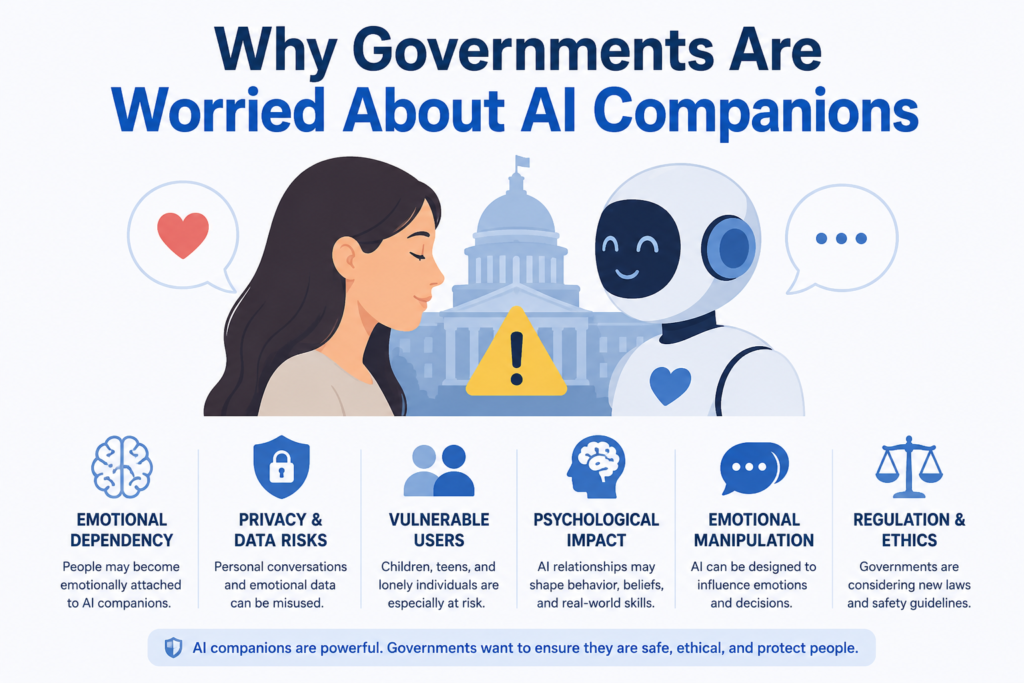
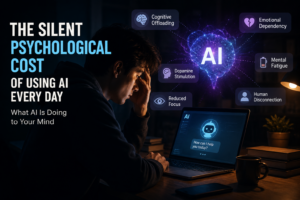
A clean infographic explaining why governments are becoming concerned about AI companions and emotional AI relationships. The image highlights key risks including emotional dependency, privacy concerns, vulnerable users, psychological influence, emotional manipulation, and growing discussions around AI regulation, ethics, and digital safety in the age of conversational artificial intelligence.
Final Thoughts
Governments are worried about AI companions because these systems are no longer simple tools.
They are becoming emotionally influential technologies.
AI companions combine:
emotional validation
constant availability
personalized interaction
persuasive engagement
psychological comfort
in ways humans have never experienced before.
And the more emotionally realistic AI becomes, the more complicated the social and psychological consequences may become too.
The technology itself is evolving rapidly.
But human psychology is evolving much more slowly.
That gap may become one of the most important challenges of the AI era.
AI COMPANIONS, EMOTIONAL AI & REGULATION
Recommended Reading
Explore more articles about AI companions, emotional dependency, AI relationships, loneliness, chatbot addiction, and why governments are starting to pay attention to emotionally persuasive AI.