The Decision-Making Habit Jeff Bezos Uses (And Why It Matters More Than Ever)
Most people think productivity is about working harder. Jeff Bezos built one of the world’s largest companies by thinking differently: protecting decision quality instead of maximizing activity.
In interviews over the years, Bezos has repeatedly emphasized one idea that sounds surprisingly simple:
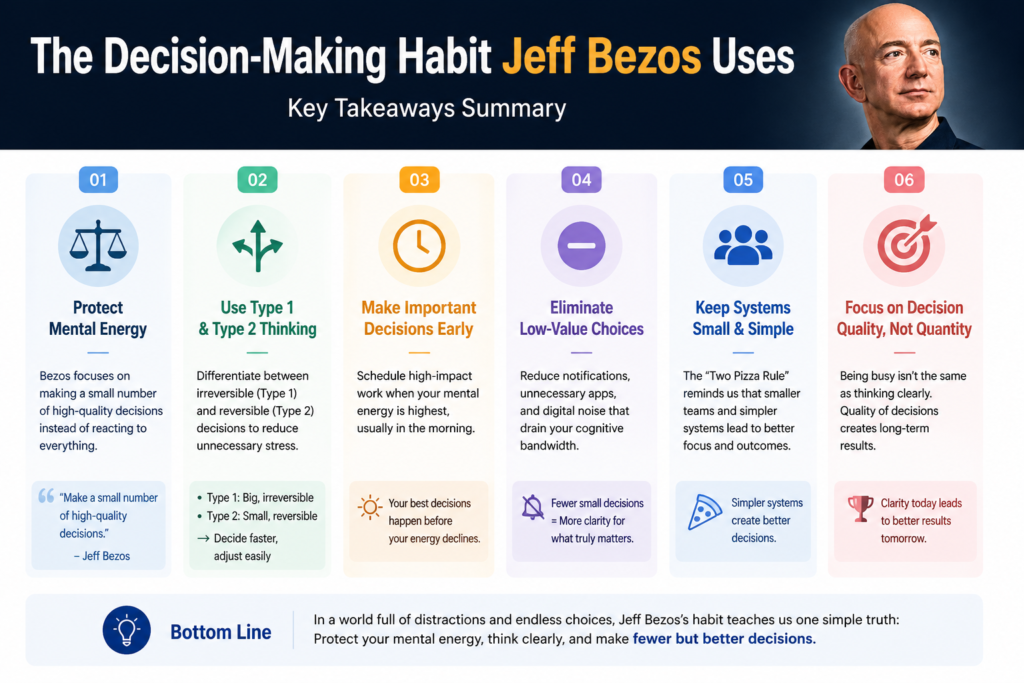
“Make a small number of high-quality decisions.”
At first glance, it doesn’t sound revolutionary. But in a world overloaded with notifications, endless scrolling, multitasking, and AI-driven distractions, this habit may explain why some people stay mentally sharp while others constantly feel exhausted.
And after trying parts of Bezos’s approach in my own routine for several weeks, I realized something uncomfortable:
I wasn’t tired because I worked too much. I was tired because my brain was making hundreds of meaningless decisions every day.
Why Modern Decision Fatigue Is Becoming a Serious Problem
Psychologists call this phenomenon decision fatigue.
The idea became widely known after research by social psychologist Roy Baumeister suggested that mental energy declines after repeated choices throughout the day.
One famous study involving judges found that favorable parole decisions dropped significantly later in the day, especially before breaks. Researchers argued that mental exhaustion influenced decision quality over time.
In other words:
The human brain is not designed to make unlimited high-quality decisions continuously.
Yet modern life constantly demands them:
Which notification should I check?
Should I answer this email now?
Which app should I open?
What should I watch?
What should I buy?
Which AI tool should I use?
Should I multitask?
Individually, these decisions feel small. Together, they quietly drain cognitive bandwidth.
Jeff Bezos’s “High-Quality Decisions” Philosophy
Jeff Bezos has discussed decision-making repeatedly in shareholder letters and interviews.
One of his best-known ideas is the distinction between:
Type 1 decisions → irreversible, high-impact
Type 2 decisions → reversible, low-risk
This framework appeared in Amazon shareholder communications and became one of the company’s most cited leadership concepts.
The insight is powerful because most people treat every decision with the same emotional weight.
But Bezos argues that many decisions should be made quickly because they can easily be reversed.
This reduces unnecessary mental friction.
The Real Productivity Secret Most People Ignore
When people hear “successful habits,” they often think about:
waking up at 5 AM
extreme discipline
grinding harder
optimizing every minute
But Bezos focuses on something more fundamental:
protecting mental clarity.
In a public interview, Bezos once explained why he schedules important meetings earlier in the day. He said he likes to make “high IQ decisions” before his energy declines.
That idea stayed with me because I noticed the same pattern in my own life.
Some of my worst decisions happened late at night:
impulsive online purchases
doomscrolling
distracted multitasking
unnecessary stress responses
Meanwhile, my best writing and clearest thinking almost always happened in the morning before digital noise accumulated.
Why This Matters Even More in the AI Era
The modern internet is built to capture attention.
Social media platforms, recommendation systems, and even productivity apps constantly compete for cognitive space.
Researchers from Harvard Business Review and attention researchers in behavioral psychology have increasingly discussed how constant context switching reduces deep focus and increases mental fatigue.
This creates a dangerous cycle:
More digital stimulation
More micro-decisions
More cognitive exhaustion
Worse judgment
Lower productivity
Ironically, many people respond by adding more productivity systems instead of reducing unnecessary inputs.
Bezos’s philosophy works because it simplifies.
The “Two Pizza Rule” and Mental Efficiency
Another famous Bezos concept is Amazon’s “Two Pizza Rule.”
The idea: If a team cannot be fed with two pizzas, the team is too large.
At first, this sounds like a management gimmick. But psychologically, it reflects something deeper:
Smaller systems reduce communication complexity and decision overload.
The same principle applies personally.
When life becomes too cluttered:
too many apps
too many goals
too many tabs
too many notifications
mental clarity disappears.
What I Tried Personally (And What Happened)
A few months ago, I noticed my attention span was getting worse.
Even while working, I constantly switched between:
Slack
email
YouTube
AI tools
news
social media
Technically, I was “busy.” But mentally, I felt fragmented.
So I experimented with a simplified decision routine inspired by Bezos-style thinking:
Changes I made:
turned off most notifications
stopped checking email every few minutes
planned important work earlier in the day
reduced daily priority lists to 3 items
removed unnecessary app choices
The result wasn’t dramatic overnight.
But within about a week, something noticeable happened:
My brain felt quieter.
Not more motivated. Not magically disciplined.
Just less mentally crowded.
That alone improved focus more than most productivity hacks I had tried before.
What Neuroscience Says About Cognitive Overload
Neuroscience research increasingly supports the idea that constant cognitive switching harms performance.
According to studies involving working memory and attentional control, excessive switching increases mental load and reduces sustained concentration.
This is why many high performers intentionally reduce small decisions:
simplified clothing
structured routines
controlled schedules
limited distractions
Even Steve Jobs became famous for minimizing trivial daily choices.
The goal isn’t rigidity.
The goal is preserving mental energy for decisions that actually matter.
The Hidden Cost of Too Many Choices
Modern culture celebrates endless options.
But psychologist Barry Schwartz explored the opposite idea in his book The Paradox of Choice: too many choices can increase anxiety and dissatisfaction.
This explains why people often feel mentally exhausted despite accomplishing very little.
The issue is not always workload.
Sometimes it’s cognitive fragmentation.
How to Apply Bezos’s Decision Habit in Real Life
You don’t need to become a billionaire founder to benefit from this mindset.
Here are a few realistic ways to apply it:
1. Make important decisions earlier
Protect your highest mental energy hours.
2. Reduce reversible decision stress
Not every choice deserves perfectionism.
3. Eliminate low-value choices
Fewer unnecessary decisions = more mental clarity.
4. Stop treating every notification as urgent
Most digital interruptions are not truly important.
5. Focus on decision quality, not decision quantity
Being constantly busy is not the same as thinking clearly.
Final Thoughts
The internet teaches people to optimize speed.
Jeff Bezos’s decision philosophy teaches something more valuable:
protect cognitive energy first.
Because in a distracted world, clear thinking is becoming a competitive advantage.
And honestly, that may matter more now than ever before.
Decision Fatigue & Focus
Related Articles About Focus, Mental Clarity, and Productivity
Explore more insights about decision fatigue, deep focus, digital distractions, and the mental systems successful people use to protect their attention in an increasingly noisy world.
These resources support the article’s main ideas about Jeff Bezos’s decision-making philosophy, decision fatigue, and the psychology of cognitive overload.