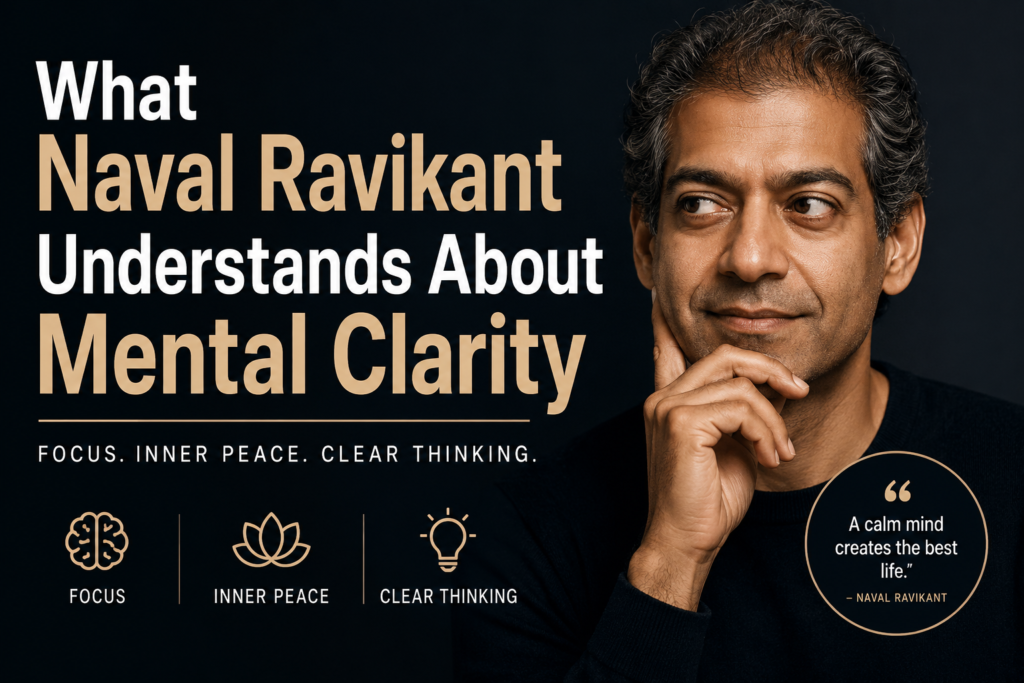
What Naval Ravikant Understands About Mental Clarity
In a world obsessed with speed, stimulation, and constant productivity, mental clarity has quietly become one of the rarest advantages.
Most people wake up and immediately consume:
notifications
news feeds
emails
short-form videos
endless opinions
The result is subtle but powerful: a mind that feels constantly busy, yet rarely calm.
That’s one reason why the ideas of Naval Ravikant have resonated so deeply with people searching for clarity, focus, and a more intentional life.
Unlike traditional productivity gurus, Naval rarely talks about “working harder.” Instead, he often emphasizes:
stillness
clear thinking
reducing internal noise
protecting mental space
And honestly, after spending months trying different productivity systems myself, I’ve realized something uncomfortable:
The biggest threat to focus today is not laziness. It’s cognitive overload.
Why Mental Clarity Matters More Than Ever
Modern life is designed to fragment attention.
Researchers studying attention and cognitive load have repeatedly found that constant interruptions impair working memory, reduce deep focus, and increase mental fatigue.
A growing body of neuroscience research also suggests that excessive context-switching makes sustained concentration significantly harder.
This explains why many people feel mentally exhausted even after relatively unproductive days.
The brain never truly rests.
It simply keeps reacting.
Naval Ravikant’s Philosophy of Clarity
One of Naval’s most widely shared ideas is deceptively simple:
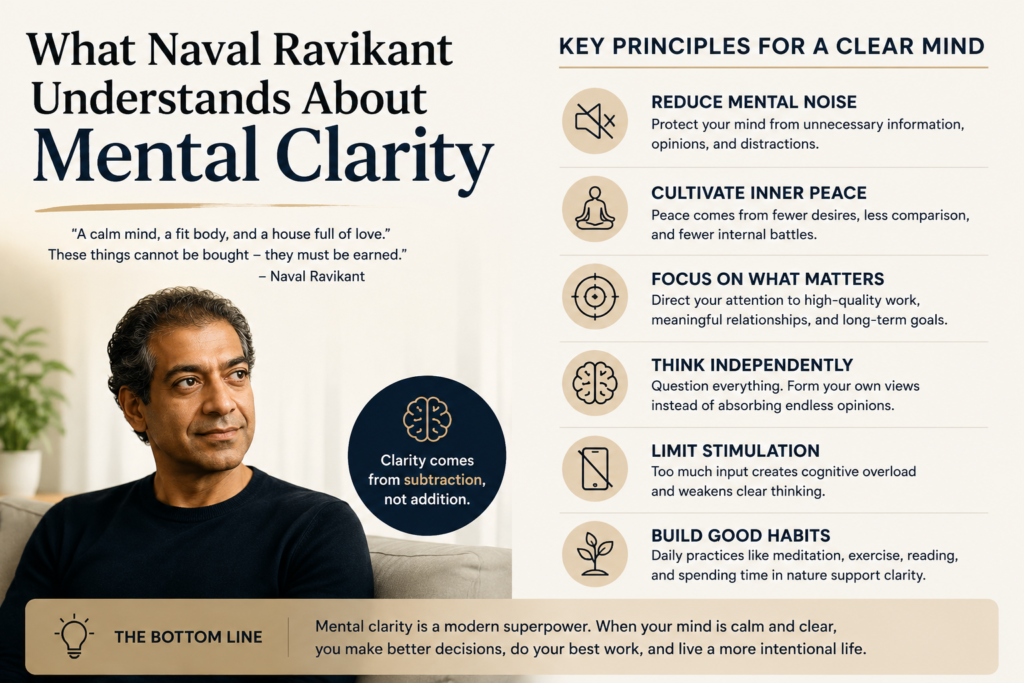
“A calm mind, a fit body, and a house full of love. These things cannot be bought — they must be earned.”
That quote spread widely online because it feels increasingly rare in modern culture.
Most people pursue optimization without protecting inner stability.
But Naval approaches clarity differently.
Instead of constantly adding:
more tools
more systems
more apps
more information
he often advocates removing unnecessary mental noise.
That distinction matters.
Because clarity rarely comes from adding more stimulation.
It often comes from subtraction.
The Hidden Cost of Constant Mental Stimulation
Today’s digital environment rewards reaction, not reflection.
Social platforms compete aggressively for attention. Algorithms are designed to maximize engagement. Productivity apps constantly encourage optimization.
Ironically, many people become overwhelmed while trying to become more productive.
Psychologist Barry Schwartz explored a similar idea in The Paradox of Choice, arguing that too many options often increase anxiety rather than freedom.
Naval’s philosophy aligns closely with this concept: too much input creates internal noise.
And internal noise destroys clarity.
Why Smart People Often Feel Mentally Exhausted
One surprising thing I noticed personally is that mental exhaustion does not always come from difficult work.
Sometimes it comes from:
too many tabs open
too many small decisions
too much scrolling
too much comparison
too much information consumption
There was a period where I constantly switched between:
YouTube
AI tools
Slack
articles
productivity apps
social media
Technically, I was learning.
But mentally, I felt scattered.
That’s when Naval’s ideas about stillness started making more sense to me.
Naval’s View on Happiness and Inner Peace
Naval frequently connects happiness with the absence of mental conflict.
In interviews and podcasts, he often describes peace not as excitement, but as:
fewer unnecessary desires
fewer internal battles
less comparison
more presence
This perspective aligns with ideas found in both mindfulness research and ancient philosophical traditions like Buddhism and Stoicism.
The goal is not to become passive.
The goal is to stop living in constant psychological turbulence.
The Relationship Between Clarity and Focus
Mental clarity is not simply “feeling calm.”
It directly affects:
decision-making
creativity
emotional control
attention span
long-term thinking
This is why many successful founders intentionally protect solitude and quiet thinking time.
Even Warren Buffett has famously discussed the importance of uninterrupted reading and thinking.
In a distracted world, clear thinking itself becomes a competitive advantage.
Why Constant Information Consumption Is Dangerous
Modern culture treats information like productivity.
But consuming more information does not automatically create wisdom.
Naval has repeatedly emphasized the importance of independent thinking: not blindly absorbing endless opinions from the internet.
This idea feels especially relevant now.
Because many people no longer have silence long enough to think clearly about anything.
There is always:
another video
another feed
another notification
another update
The mind becomes reactive instead of intentional.
What Helped Me Personally
After reading more about Naval’s philosophy, I started experimenting with a few small changes:
What I changed:
reduced unnecessary notifications
stopped checking news constantly
spent more time walking without headphones
removed several productivity apps
created intentional quiet time during the day
The result was not instant enlightenment.
But something subtle changed: my thoughts became less fragmented.
I noticed:
deeper focus
less mental urgency
better emotional stability
less compulsive scrolling
Ironically, reducing stimulation improved productivity more than adding new systems ever did.
Why Mental Clarity Is Becoming a Modern Superpower
The economy increasingly rewards:
attention
creativity
deep thinking
emotional stability
Yet modern technology constantly attacks all four.
This is why Naval’s ideas continue spreading online.
Not because they are trendy.
But because many people are exhausted by constant mental noise.
How to Build More Mental Clarity
You do not need to completely disconnect from technology.
But you can reduce unnecessary cognitive overload.
Practical ideas:
spend time without constant stimulation
reduce context switching
protect quiet mornings
stop consuming endless opinions
simplify digital environments
allow boredom occasionally
create space for uninterrupted thinking
Clarity usually appears when mental noise decreases.
Not when stimulation increases.
Final Thoughts
Naval Ravikant understands something modern culture often ignores:
A clear mind is more valuable than constant stimulation.
Because in a world filled with noise, the ability to think calmly and intentionally is becoming increasingly rare.
And perhaps that is the real advantage most people are searching for.
Mental Clarity & Focus
Related Articles About Clear Thinking and Digital Focus
Explore more insights about mental clarity, cognitive overload, digital distractions, and the habits that help protect deep focus in a noisy world.
These resources support the article’s main ideas about Naval Ravikant, mental clarity, happiness, cognitive overload, and the value of reducing unnecessary mental noise.