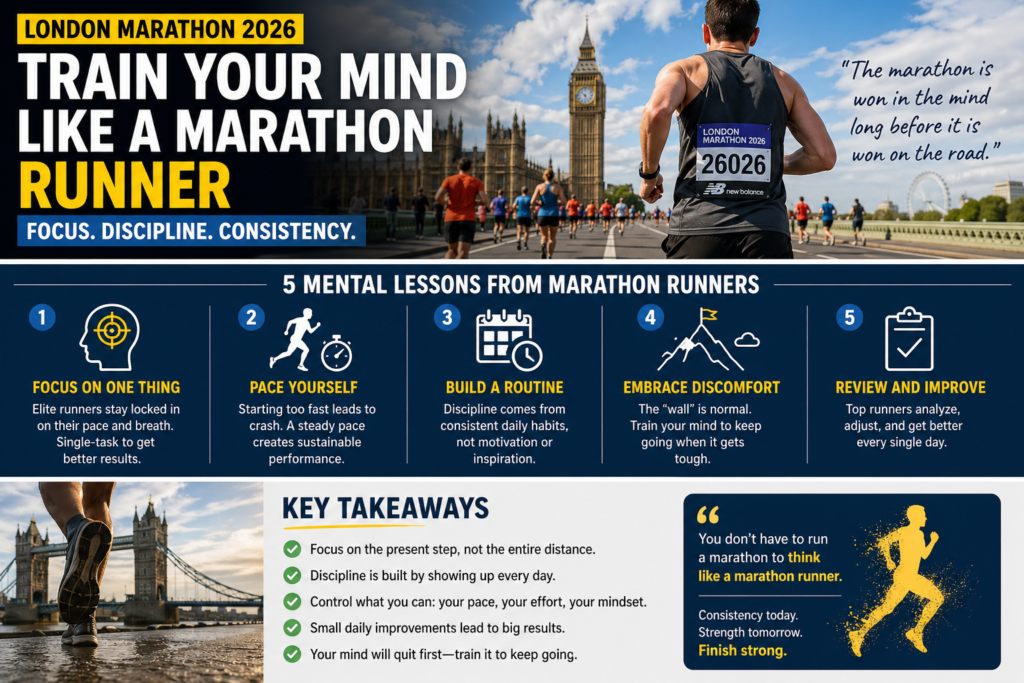
When people search for the London Marathon 2026, they usually look for results, records, or highlights.
But what actually decides the race isn’t visible on a leaderboard.
It’s the ability to stay focused, pace effort, and keep moving when motivation disappears.
That same challenge shows up in everyday work. Not at kilometer 30—but at 3 p.m., when your energy dips and distractions take over.
This guide isn’t about running. It’s about thinking like a marathon runner—and applying that mindset to focus, discipline, and consistent output.
Why Marathon Thinking Works in Daily Life
Endurance athletes don’t chase intensity. They build consistency.
They:
control pace instead of sprinting early
reduce noise and distractions
follow a plan even when it gets uncomfortable
Performance research points the same way. Frequent task switching degrades efficiency and increases error rates (Rubinstein, Meyer & Evans, 2001). And habits, once formed, rely more on repetition than willpower (Lally et al., 2010).
In short: 👉 Consistency beats bursts of effort.
What the London Marathon Teaches About Focus
The London Marathon is 42.195 km. Thousands start. Fewer finish strong.
Most runners don’t fail because they’re unfit. They struggle because they:
go out too fast
lose rhythm
let fatigue dictate decisions
The pattern is familiar.
It’s the same reason a workday unravels:
too many priorities
no pacing
reacting instead of executing
1. Train Focus with Single-Task Endurance
Marathoners don’t switch goals mid-run. They hold one objective—pace—for a long time.
What to apply
Work in single-task blocks:
60–90 minutes
one clear outcome
no switching
Example
Instead of:
email → document → messages → scrolling
Do: 👉 one uninterrupted writing block
Result
deeper focus
fewer mistakes
less mental fatigue
2. Pace Your Work (Don’t Start Too Fast)
Case Study: London Marathon Pacing
A common mistake is starting too fast. The crowd energy is high, adrenaline spikes, and runners burn energy early.
By the halfway point:
pace drops
focus slips
fatigue compounds
Elite runners use a negative split—finishing as fast or faster than they started.
What to apply
Translate pacing into your day:
start at controlled intensity
build momentum
maintain a steady rhythm
What I changed
I stopped pushing maximum effort in the morning and shifted to:
controlled start
consistent output
no early burnout
Result
more stable productivity
less afternoon crash
3. Build Discipline Through Routine, Not Motivation
Professional runners don’t decide whether to train. The schedule decides.
“Discipline is choosing between what you want now and what you want most.”
What to apply
Create a fixed starting routine:
same time
same first task
no decision required
Example
Every weekday:
9:00–10:30 → deep work
Result
reduced decision fatigue
consistent execution
4. Expect the “Wall” and Plan for It
Mental Reality: The 30km Wall
Around 30km, many runners hit “the wall”:
energy drops
focus fades
quitting becomes tempting
Elite runners don’t rely on motivation here. They rely on training and routine.
What to apply
You will hit your own wall:
loss of focus
low energy
resistance
Use a simple rule: 👉 continue for 10 more minutes
Result
tasks get finished
momentum returns
resistance weakens
5. Reflect and Adjust (Every Day)
No marathon follows a perfect line. Even top runners adjust pace mid-race.
What to apply
End your day with a 5-minute review:
what worked
what didn’t
what changes tomorrow
Why it matters
Deliberate practice improves through feedback (Ericsson, 1993).
Result
faster improvement
clearer direction
A Simple Mental Model from Endurance Sports
Runners use a phrase:
👉 “Stay where your feet are.”
It means:
focus only on the current step
ignore total distance
avoid overwhelm
Apply it to work
focus on the current task
ignore the full workload
execute step by step
What Changed for Me
After applying these principles:
1. I stopped multitasking
→ better focus
2. I paced my work
→ less burnout
3. I followed a routine
→ consistent results
Final Insight
The London Marathon isn’t won at the start.
It’s won through: 👉 controlled effort, sustained focus, and discipline under fatigue
Work is no different.
Most people don’t fail because they lack ability. They fail because they:
rush early
lose focus
stop too soon
Conclusion
If you want to improve productivity:
focus on one task at a time
pace your effort
build a repeatable routine
expect resistance
adjust daily
You don’t need to run a marathon.
But if you train your mind like a marathon runner, you’ll work with clarity, endurance, and consistency.
FOCUS, DISCIPLINE & ENDURANCE
Recommended Reading
Explore more articles about mental discipline, productivity systems, focus training, resilience, and high-performance habits inspired by endurance challenges.