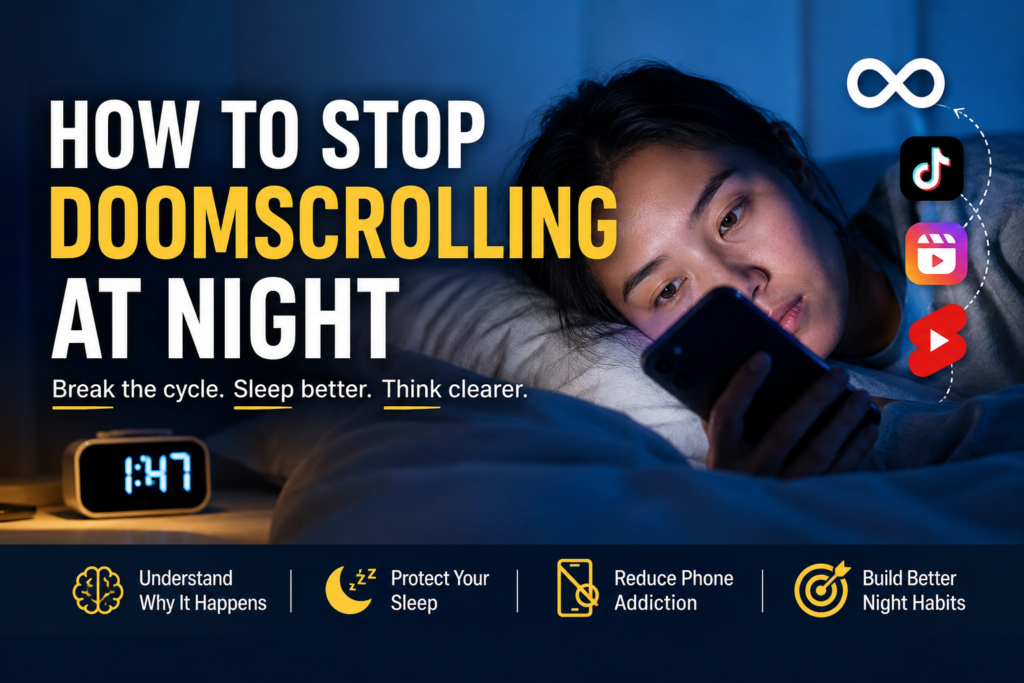
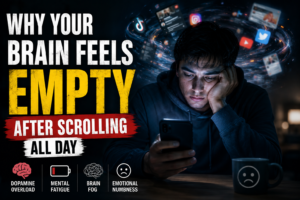
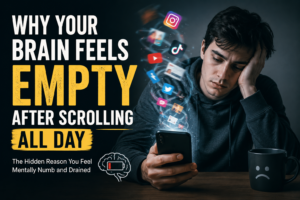
How to Stop Doomscrolling at Night (Even If You’re Addicted to Your Phone)
Why You Keep Scrolling Even When You’re Exhausted
You open TikTok for “just five minutes.”
Then you check Instagram Reels.
Then YouTube Shorts.
Suddenly, it’s 1:43 AM.
Your eyes hurt. Your brain feels overloaded. You know you should sleep — but somehow, you keep scrolling anyway.
This habit has a name: doomscrolling.
And it’s becoming one of the biggest productivity and mental health problems of the digital age.
The average person now spends several hours a day consuming short-form content, especially at night when the brain is already mentally fatigued. According to multiple sleep and behavioral studies, nighttime phone usage is strongly associated with lower sleep quality, increased anxiety, reduced focus, and emotional exhaustion.
The problem is not simply “lack of discipline.”
Modern apps are designed to keep your attention for as long as possible.
And at night, your brain becomes especially vulnerable to that system.
What Is Doomscrolling?
Doomscrolling refers to the habit of endlessly consuming negative, stimulating, or emotionally addictive content online.
Originally, the term was associated with constantly reading bad news during stressful events. But today, doomscrolling has evolved into something broader:
endless TikTok scrolling
binge-watching Reels
late-night Shorts addiction
compulsive social media checking
“just one more video” behavior
The dangerous part is that most people don’t even realize they’re doing it.
The scrolling feels passive.
But mentally, your brain is constantly processing:
new information
emotional triggers
dopamine rewards
comparison
novelty
That constant stimulation makes true mental rest almost impossible.
Why Doomscrolling Feels Impossible to Stop
One reason doomscrolling is so addictive is because modern apps use what psychologists call a “variable reward system.”
You never know what the next swipe will give you.
Maybe:
a funny video
shocking news
relationship drama
financial advice
celebrity gossip
motivational content
That unpredictability creates a dopamine loop similar to slot machines.
Books like Dopamine Nation and Stolen Focus explain how constant stimulation rewires attention and increases compulsive behavior.
Social platforms optimize for engagement — not mental clarity.
The more emotionally reactive you become, the longer you stay on the platform.
And nighttime is when this becomes most dangerous.
Why Nighttime Scrolling Is Worse Than Daytime Scrolling
At night, your brain is already depleted.
Decision fatigue, stress, loneliness, unfinished work, and anxiety tend to peak before sleep.
That’s why many people unconsciously use scrolling as a form of emotional escape.
But instead of helping you recover, doomscrolling often creates:
overstimulation
sleep procrastination
fragmented attention
emotional exhaustion
brain fog the next morning
Researchers studying sleep behavior have consistently found that blue light exposure and stimulating content before bed reduce melatonin production and delay sleep cycles.
In simple terms:
Your brain stays mentally “awake” even when your body is exhausted.
How TikTok, Reels, and Shorts Rewire Attention
Short-form content platforms are engineered around speed and novelty.
Every swipe gives your brain:
a new image
a new emotion
a new topic
a new dopamine hit
Over time, this changes how attention works.
Long-form concentration becomes harder because the brain adapts to rapid stimulation.
This is one reason many people now struggle to:
read books
focus deeply
finish tasks
work without checking their phone
stay mentally present
The problem is not intelligence.
It’s attention fragmentation.
Your brain becomes trained to expect constant novelty.
The Hidden Link Between Doomscrolling and Anxiety
Many people scroll because they feel anxious.
Ironically, doomscrolling often increases anxiety instead of reducing it.
Why?
Because the brain never gets closure.
You consume:
endless opinions
breaking news
arguments
alarming headlines
emotionally charged content
Without giving your nervous system time to process anything.
This creates a constant low-level stress response.
Over time, many people begin experiencing:
mental fatigue
irritability
reduced motivation
sleep anxiety
decreased productivity
The brain starts feeling “busy” all the time.
Even during rest.
How to Stop Doomscrolling at Night
Most advice online focuses on willpower.
But willpower alone usually fails.
The real solution is reducing friction between you and sleep.
Here are practical systems that actually work.
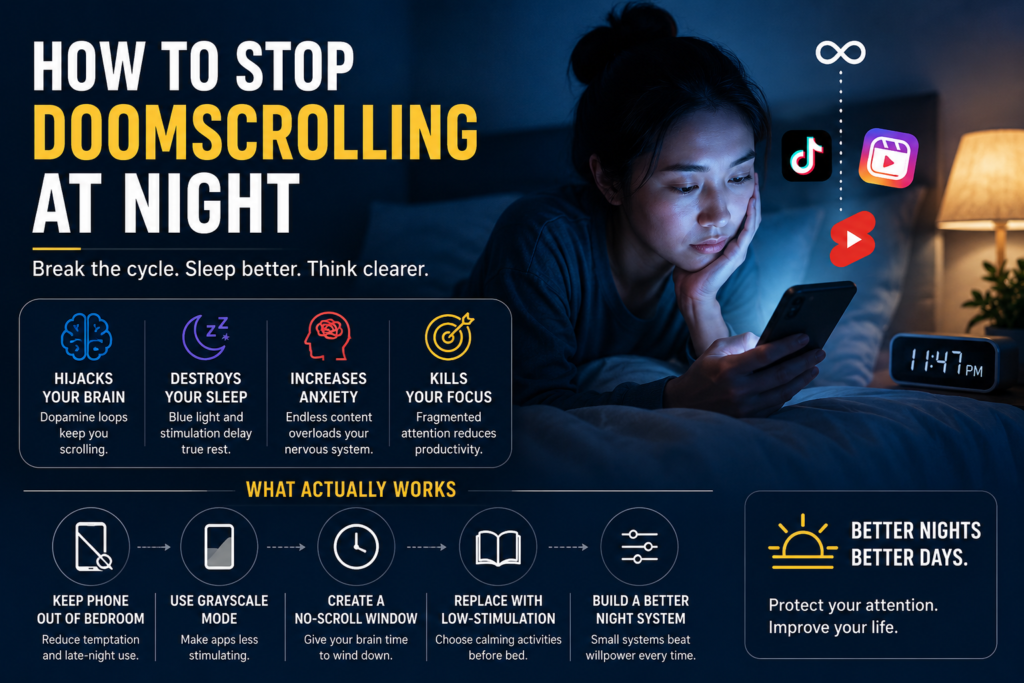
1. Charge Your Phone Outside the Bedroom
This is one of the most effective strategies.
If your phone is next to your bed, your brain will automatically reach for it during vulnerable moments.
Colorful interfaces are intentionally stimulating.
Switching your phone to grayscale reduces dopamine response and makes scrolling less rewarding.
Many people report significantly lower screen time after enabling this feature.
3. Replace Endless Scrolling With “Low-Stimulation Content”
The brain usually wants decompression — not necessarily social media.
Try replacing doomscrolling with:
audiobooks
calming podcasts
ambient music
paper books
journaling
The goal is lowering stimulation, not forcing productivity.
4. Create Friction Before Opening Apps
Small barriers matter.
Examples:
logging out of TikTok daily
removing apps from the home screen
using app timers
enabling Focus Mode
keeping social apps inside folders
Even a few extra seconds can interrupt automatic behavior loops.
5. Stop Using Your Phone as Emotional Recovery
This is the hardest truth.
Many people are not addicted to content itself.
They are addicted to escaping discomfort.
Scrolling becomes:
stress relief
loneliness relief
boredom relief
emotional avoidance
But constant avoidance prevents genuine recovery.
Sometimes your brain doesn’t need more content.
It needs silence.
The Productivity Cost Nobody Talks About
Most people think doomscrolling only affects sleep.
But the real damage often appears the next day.
Poor sleep combined with overstimulation reduces:
decision-making quality
deep focus
memory retention
emotional regulation
creativity
This is why many people feel mentally drained before the workday even begins.
Their brain never fully recovered overnight.
A Better Night System
Instead of trying to “quit your phone completely,” build a better nighttime system.
A realistic system might look like this:
phone charging outside bedroom
30-minute no-scroll rule before sleep
dim lighting
low-stimulation audio
fixed bedtime
morning sunlight exposure
Small systems beat motivation every time.
Final Thoughts
Your problem is not laziness.
Your brain is fighting billion-dollar algorithms designed to capture attention.
Doomscrolling is not simply a bad habit.
It’s a modern environment problem.
The good news is that attention can recover.
Sleep can improve.
Focus can return.
But only when you stop treating rest like another screen-based activity.
DOOMSCROLLING & SLEEP
Recommended Reading
Explore more articles about doomscrolling, nighttime anxiety, digital addiction, cognitive overload, sleep disruption, and how modern apps are designed to keep your brain awake.
Bedtime Device Use & Sleep Research
— Research found that using electronic devices before sleep reduced sleep duration and negatively affected sleep quality.
Restricting Phone Use Before Bed
— A four-week study found that limiting phone use before bedtime improved sleep quality, reduced pre-sleep arousal, and increased working memory.