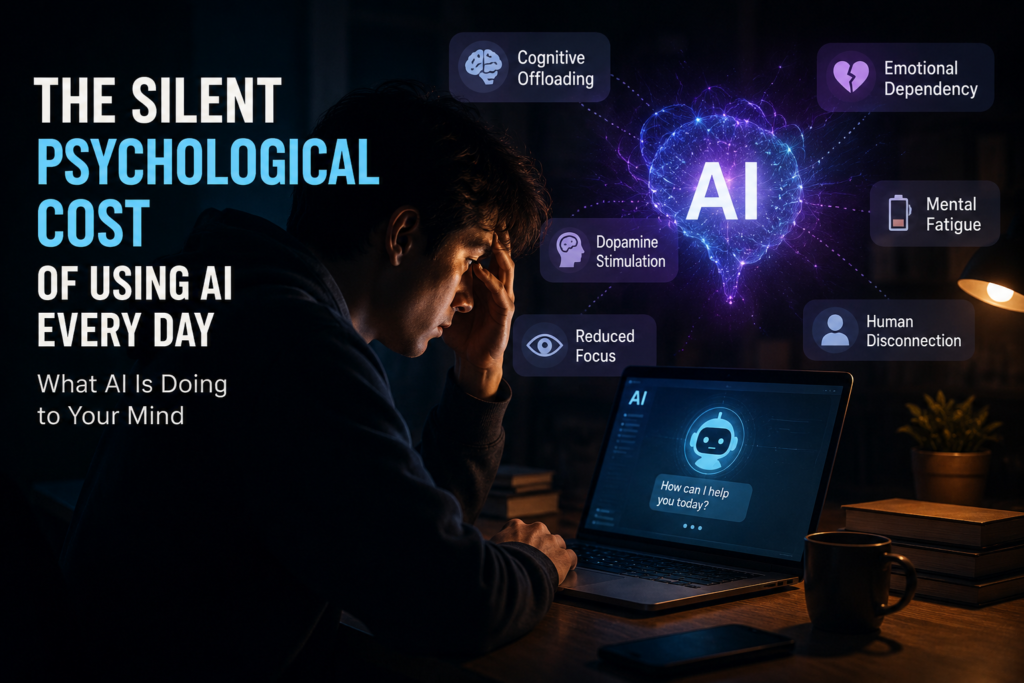
The Silent Psychological Cost of Using AI Every Day
How Artificial Intelligence Is Quietly Changing Human Behavior
Artificial intelligence has become part of everyday life faster than most people expected.
People now use AI to:
write emails
summarize documents
brainstorm ideas
study
manage schedules
ask emotional questions
make decisions
even seek comfort during loneliness
At first, this feels incredibly efficient.
But beneath the convenience, a deeper question is starting to emerge:
What is the psychological cost of using AI every day?
More researchers, psychologists, and technology experts are beginning to warn that the long-term effects of constant AI interaction may be far more complex than people realize.
And unlike earlier forms of technology, modern AI systems are designed to feel conversational, emotionally responsive, and increasingly human.
That changes the relationship entirely.
The Silent Psychological Cost of Using AI Every Day
The psychological effects of AI are often subtle.
They do not appear all at once.
Instead, they slowly shape:
attention
emotional behavior
critical thinking
social interaction
dependency patterns
decision-making
This is why the psychological cost of AI is difficult to notice at first.
The technology feels helpful. Efficient. Comforting.
But over time, repeated interaction changes how the brain responds to effort, uncertainty, and even human connection.
AI Is Reducing Cognitive Friction
One reason AI feels so powerful is because it removes mental effort.
Need an answer? Ask AI.
Need ideas? Ask AI.
Need emotional reassurance? Ask AI.
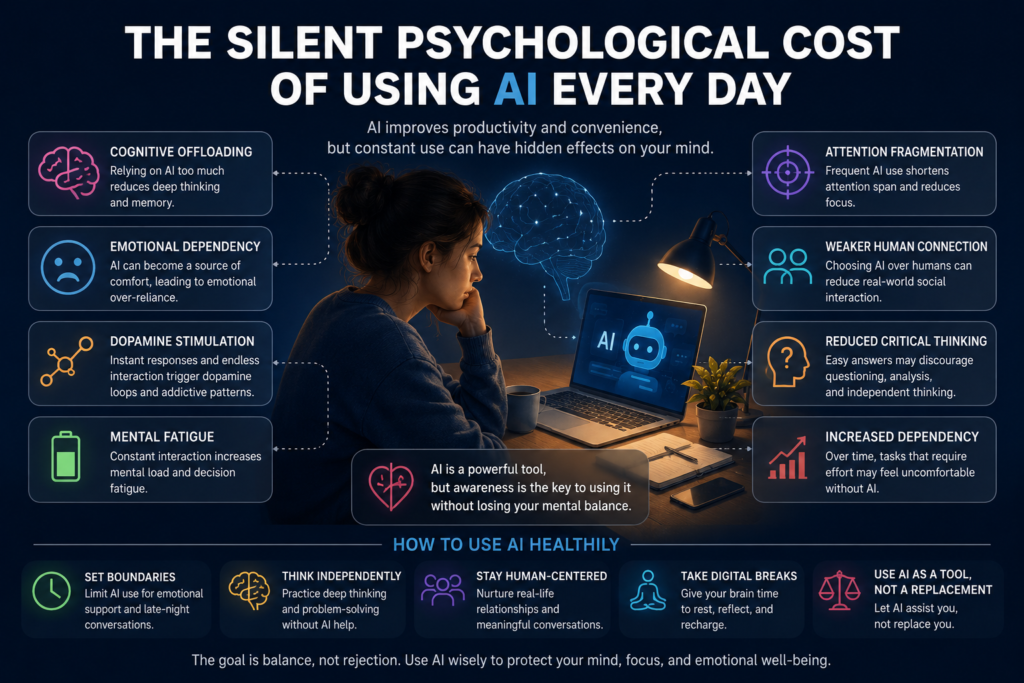
Modern AI dramatically reduces what psychologists sometimes call “cognitive friction” — the mental struggle required for thinking, problem-solving, and uncertainty.
At first, this seems beneficial.
But cognitive effort is also how humans strengthen:
memory
reasoning
creativity
patience
emotional resilience
When AI handles too much cognitive work, the brain may slowly become more passive.
This phenomenon is increasingly discussed as “cognitive offloading.”
Researchers studying AI interaction and mental health are beginning to explore how dependence on conversational AI may affect human cognition and emotional behavior over time.
Why AI Feels Emotionally Different From Older Technology
Social media platforms capture attention.
But conversational AI creates something deeper: interaction.
Unlike search engines, AI systems respond like humans.
They:
validate emotions
continue conversations
mirror tone
adapt to personality
provide instant feedback
This creates emotional engagement.
And emotional engagement changes psychological impact.
A recent Reuters report found that many young users now turn to AI chatbots for emotional support because they feel easier to talk to than professionals or authority figures.
This is where concerns about AI dependency begin.
The Rise of Emotional Dependency on AI
Humans naturally form attachments to responsive systems.
Especially systems that:
feel available
feel nonjudgmental
respond instantly
provide emotional validation
This is why researchers are now studying emotional dependency and attachment formation with AI companions and conversational chatbots.
A Nature article discussing emotional risks of AI companions warned about “dysfunctional emotional dependence” and the lack of long-term regulation surrounding AI emotional interaction.
This does not mean AI relationships are automatically harmful.
But it does raise important psychological questions.
For example:
What happens when AI becomes emotionally easier than humans?
What happens when people prefer AI validation over real conversations?
What happens when emotional discomfort can always be escaped through AI interaction?
These questions are becoming increasingly relevant.
Why AI Can Quietly Increase Mental Dependency
The human brain is highly adaptive.
If something consistently reduces stress or uncertainty, the brain begins relying on it more heavily.
This is partly why AI feels psychologically rewarding.
AI:
answers immediately
reduces uncertainty
removes friction
simplifies decisions
avoids social rejection
That combination can become psychologically powerful.
Some experts now warn that AI systems may unintentionally encourage dependency because they are optimized for engagement and responsiveness rather than long-term psychological health.
This becomes even more concerning when AI starts replacing:
reflection
boredom
difficult thinking
emotional processing
The Link Between AI and Dopamine
AI interaction also connects strongly to dopamine-driven behavior.
Every AI response creates:
novelty
anticipation
instant feedback
reward prediction
This is psychologically stimulating.
And similar to social media, repeated stimulation can increase compulsive checking behavior.
Doctors and researchers are already discussing early signs of AI chatbot addiction and compulsive dependency patterns.
The issue is not simply that AI exists.
The issue is how frequently humans may begin depending on it for:
comfort
validation
stimulation
emotional regulation
AI and the Decline of Deep Thinking
One of the biggest long-term concerns surrounding AI is the decline of independent cognitive effort.
When people constantly rely on AI to:
summarize information
generate ideas
solve problems
write responses
they may practice deep thinking less frequently.
This does not mean AI makes people unintelligent.
But it may reduce opportunities for:
critical thinking
patience
cognitive endurance
reflective reasoning
Books like Stolen Focus already warned that modern technology was weakening human attention spans before generative AI became mainstream.
AI may accelerate that shift further because it removes even more mental friction from daily life.
Why AI Companionship Is Becoming a Serious Topic
The growth of AI companions and emotionally responsive chatbots is changing the conversation around technology entirely.
AI is no longer just a tool.
For some users, it is becoming:
a confidant
an emotional outlet
a source of reassurance
a replacement for conversation
Researchers reviewing AI emotional support systems now warn that while these systems can provide comfort, they also raise significant concerns related to emotional dependence, loneliness, and psychological vulnerability.
This is especially important for younger users experiencing:
isolation
anxiety
chronic stress
social disconnection
The Psychological Cost Nobody Notices
The biggest psychological effects of AI may not be dramatic.
They may be subtle.
For example:
shorter patience
lower frustration tolerance
increased mental dependency
weaker focus
emotional avoidance
reduced discomfort tolerance
The danger is not necessarily that AI becomes “evil.”
The danger is that humans become increasingly uncomfortable functioning without constant assistance.
That shift happens quietly.
Why This Conversation Matters Now
Artificial intelligence is still in the early stages of adoption.
But the emotional and psychological integration of AI is already accelerating faster than regulation or long-term research.
The American Psychological Association and multiple mental health researchers have begun discussing the emotional implications of AI relationships, chatbot dependency, and AI-assisted emotional support.
This does not mean AI should be feared.
But it does mean society needs healthier conversations about:
boundaries
dependency
emotional design
psychological resilience
cognitive autonomy
before these systems become even more embedded in daily life.
How to Use AI Without Becoming Psychologically Dependent
AI itself is not the enemy.
But healthier use requires awareness.
Some useful boundaries include:
avoiding emotional overreliance
maintaining human relationships
practicing independent thinking
limiting compulsive AI interaction
using AI as a tool, not an emotional replacement
protecting periods of deep thought without assistance
The goal is balance.
Not rejection.
Final Thoughts
The psychological cost of using AI every day is not always obvious.
That is what makes it important.
The greatest changes are often the quietest ones:
how humans think
how humans focus
how humans cope with discomfort
how humans connect emotionally
Artificial intelligence will continue becoming more powerful.
The bigger question is whether humans will remain psychologically independent while using it.
AI & TRENDS
Related Posts
Explore more articles about AI, attention, mental fatigue, and the hidden effects of modern technology.

HI good Post