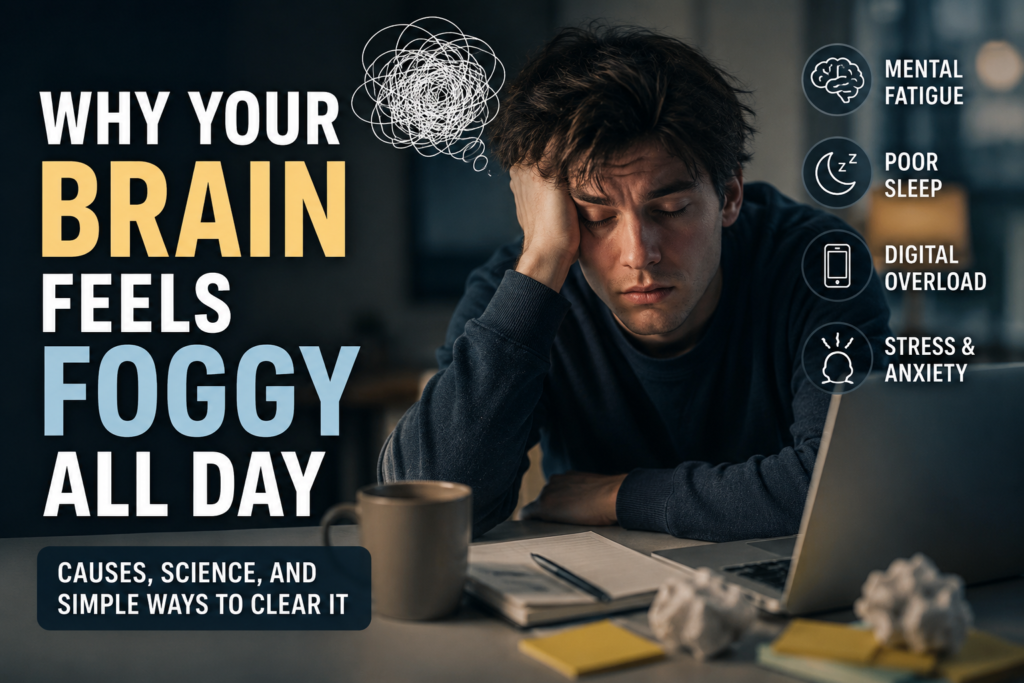
Why Your Brain Feels Foggy All Day
You sleep.
You drink coffee.
You try to focus.
But somehow your brain still feels slow, tired, distracted, and mentally cloudy.
Many people describe it the same way:
“It feels like my brain never fully wakes up.”
This feeling is often called brain fog — a state of mental fatigue that affects focus, clarity, memory, motivation, and cognitive energy.
Brain fog is not officially classified as a medical condition itself.
Instead, it is a symptom connected to stress, overstimulation, poor recovery, sleep disruption, information overload, and modern digital habits.
And lately, more people than ever seem to be experiencing it.
What Does Brain Fog Actually Feel Like?
Brain fog can look different for everyone, but common symptoms include:
- Difficulty concentrating
- Forgetfulness
- Mental fatigue
- Slow thinking
- Reduced motivation
- Feeling mentally “heavy”
- Trouble finding words
- Constant distraction
- Lack of mental clarity
Some people describe it as:
- “My thoughts feel blurry.”
- “My brain feels overloaded.”
- “I can’t think deeply anymore.”
In many cases, the problem is not intelligence.
It is cognitive exhaustion.
Your Brain Was Not Designed for Constant Stimulation
Modern life overwhelms the human brain constantly.
Every day, most people are exposed to:
- Endless notifications
- Short-form videos
- AI-generated content
- News overload
- Social media scrolling
- Continuous multitasking
- Rapid context switching
The human nervous system evolved in environments with far slower information cycles.
Today, the brain rarely gets true recovery time.
In The Shallows, author Nicholas Carr argued that modern technology changes how humans think, focus, and process information over time.
The internet rewards speed.
But the brain still needs slowness to recover properly.
Why Information Overload Creates Mental Fog
Psychologists have studied cognitive overload for decades.
The brain has limited working memory capacity.
When too much information enters too quickly, mental performance begins to decline.
This can create:
- Reduced focus
- Decision fatigue
- Attention fragmentation
- Mental exhaustion
- Lower emotional resilience
Modern digital environments are designed to continuously capture attention.
Every notification, update, headline, or algorithmic recommendation competes for cognitive resources.
Eventually, the brain becomes mentally saturated.
Sleep Problems Quietly Make Brain Fog Worse
One of the biggest hidden causes of brain fog is poor sleep quality.
Even small disruptions to sleep can affect:
- Memory
- Attention
- Emotional regulation
- Cognitive speed
- Problem-solving ability
Unfortunately, modern technology often damages sleep indirectly.
Research consistently shows that excessive screen exposure — especially at night — can interfere with melatonin production and circadian rhythms.
Late-night scrolling may feel relaxing temporarily.
But cognitively, the brain often remains overstimulated long after the screen turns off.
Why Your Attention Span Feels Broken
Many people believe they are “losing focus.”
But often, their brains are simply overstimulated.
Digital platforms train attention to constantly expect novelty:
- New videos
- New messages
- New headlines
- New recommendations
- New stimulation
Over time, the brain adapts to shorter attention cycles.
Long-form thinking begins to feel harder.
This is one reason many people now struggle to:
- Read books deeply
- Focus without checking devices
- Sit quietly without stimulation
- Finish long tasks uninterrupted
The brain becomes conditioned for rapid switching instead of sustained concentration.
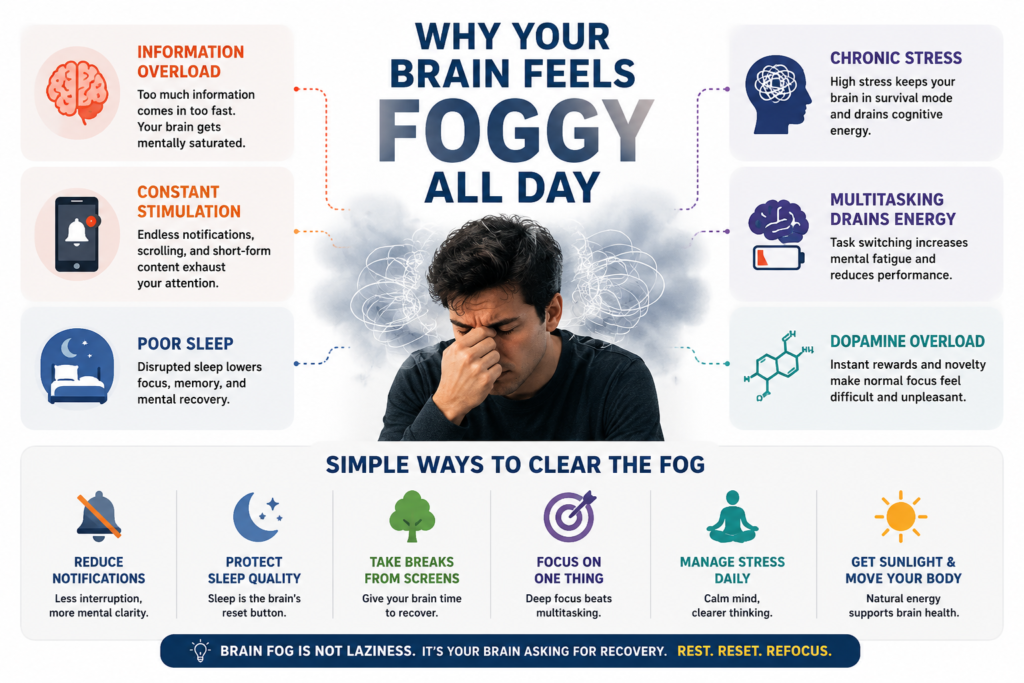
Chronic Stress Keeps the Brain in Survival Mode
Stress affects cognition more than most people realize.
When the nervous system remains under constant pressure, the brain prioritizes short-term survival instead of long-term clarity.
Stress hormones like cortisol can affect:
- Memory formation
- Focus
- Emotional regulation
- Mental energy
This creates a state where the brain feels continuously tired, even without intense physical work.
Modern stress is often psychological rather than physical:
- Financial pressure
- Social comparison
- Productivity anxiety
- Information overload
- Digital overstimulation
The body still responds as if it is under threat.
Why Multitasking Drains Mental Energy
Many people assume multitasking improves efficiency.
Research consistently shows the opposite.
The brain does not truly perform multiple complex tasks simultaneously.
Instead, it rapidly switches attention between them.
Every switch creates a small cognitive cost.
Over time, constant task switching increases:
- Mental fatigue
- Error rates
- Cognitive exhaustion
- Reduced concentration
This is why many people end the day feeling mentally drained despite not accomplishing as much as expected.
Brain Fog and the Dopamine Problem
Modern technology heavily stimulates dopamine systems.
Dopamine is connected to:
- Motivation
- Reward anticipation
- Novelty-seeking behavior
Short-form content, social media notifications, and instant digital rewards create continuous dopamine stimulation.
The brain gradually becomes accustomed to higher levels of novelty and stimulation.
As a result, slower activities begin to feel mentally uncomfortable.
This can make normal focus feel unusually difficult.
Why AI and Digital Tools May Intensify Brain Fog
AI tools improve productivity in many ways.
But they also increase cognitive input dramatically.
People now consume more:
- Information
- Options
- Summaries
- Notifications
- Recommendations
- Digital interactions
The brain processes all of this continuously.
Many users feel mentally exhausted not because they are physically overworked, but because their cognition rarely gets downtime anymore.
This is one reason phrases like:
- “mental overload”
- “digital exhaustion”
- “AI burnout”
- “brain fog”
are becoming increasingly common online.
The Brain Needs Recovery More Than Optimization
Modern culture constantly promotes optimization:
- Optimize productivity
- Optimize workflows
- Optimize schedules
- Optimize efficiency
But cognitive performance depends heavily on recovery.
The brain needs:
- Deep sleep
- Silence
- Boredom
- Reflection
- Nature
- Uninterrupted focus
Without recovery, mental clarity slowly declines.
This is why many high-performing people still experience brain fog despite being productive externally.
Small Habits That May Help Reduce Brain Fog
Brain fog usually does not disappear instantly.
But several habits consistently help improve cognitive clarity over time:
Reduce constant notifications
Less interruption reduces cognitive fragmentation.
Protect sleep quality
Consistent sleep schedules matter more than many people realize.
Spend time away from screens
Mental recovery often requires periods without stimulation.
Avoid excessive multitasking
Deep focus is cognitively healthier than constant switching.
Create quiet moments
The brain processes information better during low-stimulation states.
Limit doomscrolling
Continuous negative information increases mental fatigue significantly.
Why More People Feel Mentally Exhausted Today
The modern world creates a perfect environment for brain fog:
- Endless stimulation
- Permanent connectivity
- Digital overload
- Attention fragmentation
- Chronic stress
- Reduced recovery time
Humans are processing more information than ever before.
But biologically, the brain has not evolved nearly as fast as technology has.
That mismatch may explain why so many people feel mentally exhausted all the time.
Final Thoughts
Brain fog is not always laziness, lack of discipline, or low intelligence.
Often, it is the result of a brain pushed beyond its natural recovery limits.
Modern technology makes information infinitely accessible.
But human attention remains biologically limited.
The more overstimulated life becomes, the more important mental recovery becomes too.
Because sometimes the real problem is not that your brain is weak.
It is that your brain never truly gets a chance to rest.
Recommended Reading
Explore more articles about brain fog, mental fatigue, attention problems, digital overload, AI burnout, and simple ways to protect mental clarity.
Why You Feel Mentally Tired but Physically Fine
Understand why your mind can feel drained even when your body is not physically exhausted.
Cognitive LoadWhy Everything Feels Mentally Expensive Now
Learn how hidden decisions, digital pressure, and constant stimulation make everyday life feel mentally heavy.
Attention FatigueWhy AI Makes Your Brain Feel Like ADHD
Explore how AI overstimulation can fragment attention and make the brain feel restless and unfocused.
Sleep & ScreensHow to Stop Doomscrolling at Night
See why late-night scrolling keeps the brain overstimulated and makes mental recovery harder.
External References
- Harvard Health: Brain Fog and Mental Clarity — Explains how stress, uncertainty, and mental strain can affect memory, focus, and cognitive clarity.
- Sleep Foundation: Brain Fog — Overview of how poor sleep, stress, and daily habits can contribute to brain fog and mental fatigue.
- American Psychological Association: How Stress Affects the Body — Research-based explanation of how chronic stress affects attention, memory, mood, and the nervous system.
- Nielsen Norman Group: Attention and Digital Interfaces — Insights into how digital distraction, cognitive load, and interface design affect attention and mental performance.
You May Also Like