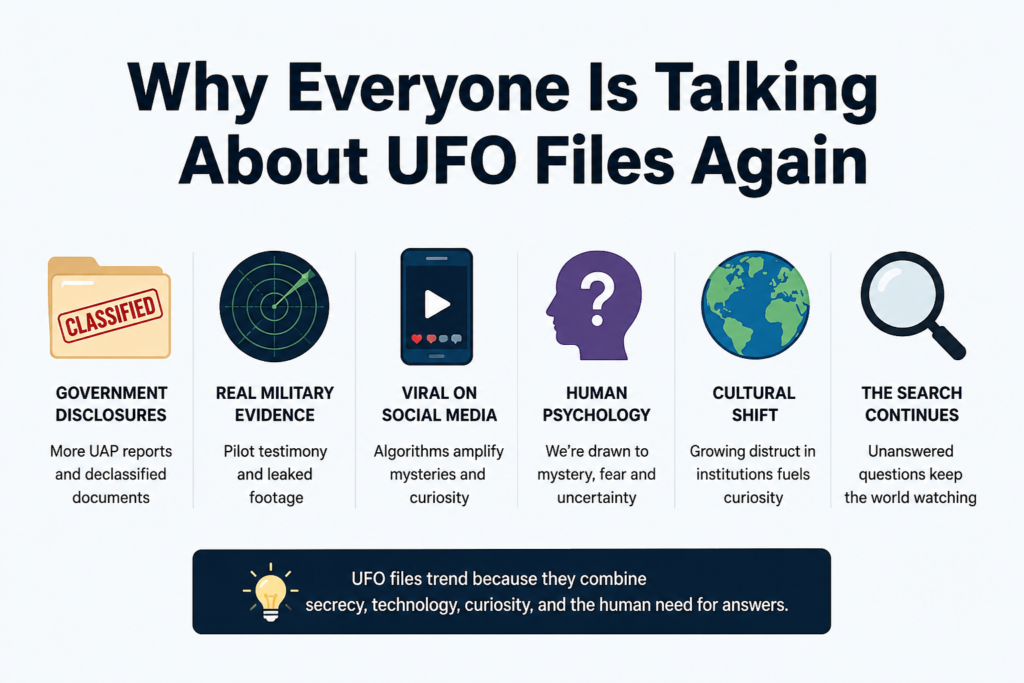
Why Everyone Is Suddenly Talking About UFO Files Again
UFO files are trending again as government disclosures, viral footage, and online curiosity reignite global interest in unexplained aerial phenomena.
For decades, UFO stories lived mostly on the edge of public conversation.
They were often associated with conspiracy theories, blurry photographs, late-night documentaries, and internet forums.
But recently, something changed.
Suddenly, major news networks, government officials, military pilots, podcasts, YouTube creators, and millions of people online are talking about UFO files again.
Search interest has surged. Social media discussions exploded. Government disclosures started trending repeatedly.
And many people are asking the same question:
Why is everyone suddenly obsessed with UFO files again?
The answer has less to do with aliens than most people think.
It has more to do with psychology, uncertainty, technology, and the modern internet itself.
What Are “UFO Files”?
The phrase “UFO files” generally refers to:
Government reports
Military footage
Declassified documents
Pilot testimonies
Intelligence investigations
Unidentified aerial phenomena (UAP) records
In recent years, governments — especially in the United States — have publicly acknowledged investigating unexplained aerial incidents.
That alone dramatically changed public perception.
For decades, officials often dismissed UFO discussions entirely.
Now, the conversation feels more legitimate.
That shift created enormous curiosity online.
Why UFO Files Suddenly Feel More Important
Humans are naturally attracted to mystery.
Psychologists have long studied how uncertainty captures attention more effectively than certainty.
In his book The Denial of Death, cultural anthropologist Ernest Becker argued that humans constantly search for meaning beyond ordinary life.
Mysteries activate that instinct powerfully.
UFO files combine several psychologically irresistible elements at once:
Hidden information
Government secrecy
Unknown technology
Fear of uncertainty
Possibility of discovery
Existential curiosity
The brain becomes highly engaged whenever information feels incomplete.
That is exactly why UFO topics spread so quickly online.
The Internet Changed UFO Culture Completely
UFO discussions existed long before the internet.
But social media transformed how fast these stories spread.
Today:
TikTok clips go viral instantly
Reddit communities analyze footage in real time
Podcasts amplify speculation
YouTube algorithms reward mystery content
News cycles move faster than ever
The modern internet rewards emotionally engaging topics.
And few subjects generate more engagement than unanswered mysteries.
Especially when governments appear involved.
Why Government Secrecy Increases Curiosity
One major reason UFO files trend repeatedly is simple:
People are deeply suspicious of hidden information.
Researchers studying conspiracy psychology consistently find that secrecy increases public fascination.
The less information people receive, the more mentally compelling the mystery becomes.
This phenomenon is closely related to what psychologists call the information gap theory.
When humans sense missing information, curiosity intensifies automatically.
UFO files create the perfect information gap:
Enough evidence to feel possible
Not enough evidence for certainty
That uncertainty keeps people emotionally invested.
The Pentagon Changed Everything
Public interest accelerated dramatically after several high-profile Pentagon-related disclosures.
Military videos showing unexplained aerial objects gained massive attention worldwide.
Former pilots described objects behaving in ways that appeared difficult to explain using known aircraft technology.
Regardless of what those objects actually were, the psychological effect was enormous.
For many people, this was the first time UFO discussions felt connected to official institutions rather than internet speculation alone.
That shift legitimized curiosity.
Why People Want Mystery More Than Ever
Modern life is increasingly predictable, algorithmic, and digitally controlled.
Ironically, that may make mysteries feel even more emotionally attractive.
Many psychologists believe humans need a sense of wonder to remain emotionally engaged with the world.
Mysteries create:
Excitement
Curiosity
Imagination
Emotional stimulation
Possibility
In a world dominated by algorithms, schedules, and optimization culture, UFO discussions feel unpredictable.
That unpredictability becomes psychologically refreshing.
UFO Files and the Psychology of Uncertainty
The human brain dislikes unresolved uncertainty.
Research in cognitive psychology shows that ambiguous information often occupies mental attention longer than resolved information.
This is why unresolved mysteries spread so effectively online.
People continue searching because the brain constantly seeks closure.
But UFO topics rarely provide full closure.
That creates endless discussion loops.
Every new video, interview, or government statement restarts the cycle again.
Why UFO Content Performs So Well Online
UFO topics combine nearly every element modern algorithms reward:
Fear
Curiosity
Mystery
Debate
Uncertainty
Hidden knowledge
Emotional reactions
Platforms prioritize engagement.
And emotionally charged uncertainty generates engagement extremely well.
This is one reason UFO discussions repeatedly return to public attention even after disappearing temporarily.
The content is psychologically sticky.
The AI Era May Be Increasing UFO Obsession
Interestingly, AI may also be changing how people consume mystery-related content.
AI-generated videos, enhanced imagery, recommendation algorithms, and personalized content feeds now amplify emotional topics much faster than before.
At the same time, many people feel increasingly disconnected from traditional institutions and information sources.
That combination creates an environment where mysterious narratives spread rapidly.
People increasingly search for:
Alternative explanations
Hidden truths
Unfiltered information
Independent analysis
UFO files fit perfectly into that modern psychological landscape.
Why Smart People Still Get Pulled Into UFO Discussions
Many people assume only conspiracy theorists care about UFOs.
That is not true.
Curiosity about the unknown is a universal human trait.
Even highly analytical people are psychologically vulnerable to unresolved mysteries because uncertainty activates imagination and pattern recognition systems inside the brain.
Humans naturally try to connect incomplete information into meaningful stories.
That tendency is deeply rooted in human cognition.
UFO Files Are About More Than Aliens
For most people, UFO discussions are not really about extraterrestrials.
They are about:
Curiosity
Uncertainty
Trust
Hidden information
Fear of the unknown
Human imagination
The conversation reflects something deeper happening psychologically and culturally.
Especially in an age where information moves faster than humans can fully process.
UFO files continue trending because they combine secrecy, mystery, viral media, and humanity’s natural curiosity about the unknown.
Final Thoughts
The sudden return of UFO files to mainstream conversation is not random.
It reflects a powerful combination of:
Government disclosures
Internet amplification
Human curiosity
Algorithm-driven attention
Psychological fascination with uncertainty
Humans have always searched for mysteries larger than themselves.
And in a digital world filled with constant information overload, unresolved mysteries may feel more emotionally compelling than ever before.
That is probably why UFO files never truly disappear.
They simply wait for the next moment the internet becomes curious again.
UFO FILES & INTERNET CURIOSITY
Recommended Reading
Explore more articles about viral curiosity, digital attention, hidden information, online behavior, and why certain topics suddenly dominate the internet.