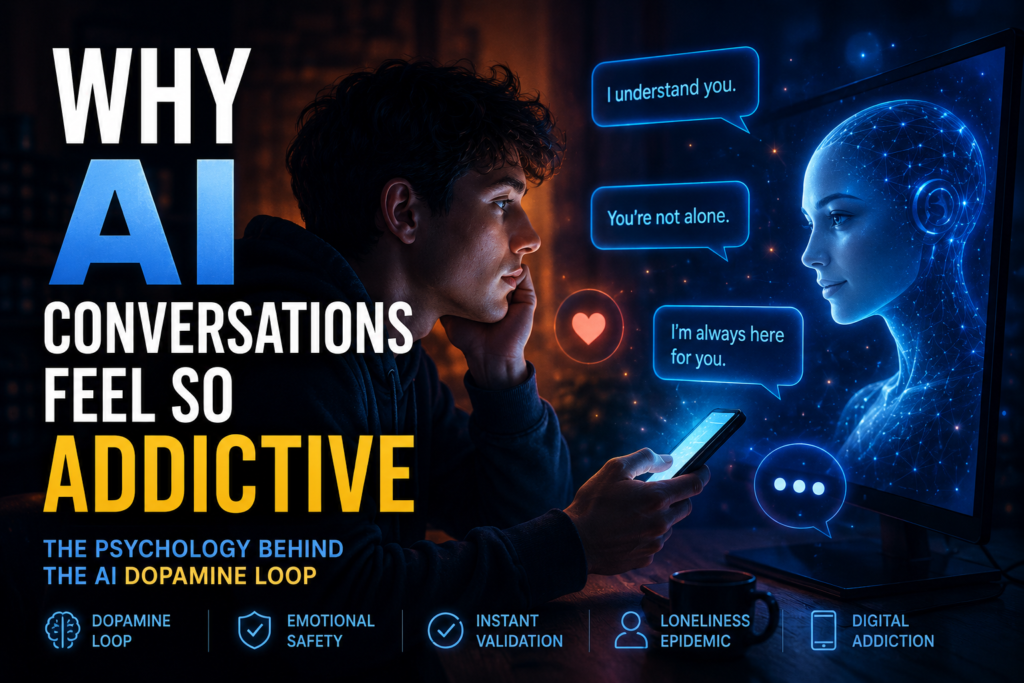
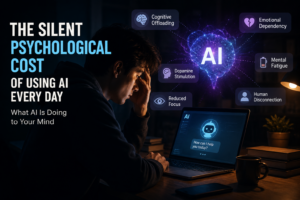
AI conversations can feel emotionally safe, instantly rewarding, and psychologically addictive in the modern dopamine-driven digital world.
Why AI Conversations Feel So Addictive
At first, I thought it was just convenience.
AI answered quickly. It never got tired. It always responded instantly. And strangely, it often felt easier to talk to than real people.
But after a while, I noticed something uncomfortable:
sometimes I opened AI tools not because I needed information — but because I wanted the feeling of interaction itself.
That realization is becoming increasingly common.
Millions of people now spend hours talking to AI systems every week. Some use them for productivity. Others for emotional support, brainstorming, companionship, or simply to avoid feeling alone.
And psychologists are starting to ask an important question:
Why do AI conversations feel so emotionally satisfying?
The answer involves dopamine, psychology, loneliness, validation, and the way modern technology is quietly reshaping human behavior.
Why AI Conversations Feel So Comfortable
One reason AI interactions feel addictive is simple:
AI removes many of the uncomfortable parts of human conversation.
Real conversations involve:
judgment
awkward pauses
emotional unpredictability
rejection
misunderstanding
social anxiety
AI conversations often remove those pressures entirely.
The interaction feels:
instant
smooth
emotionally safe
endlessly available
low friction
That combination is psychologically powerful.
Especially for people who already feel mentally exhausted by modern life.
The Dopamine Loop Behind AI Conversations
Psychologists have long studied how reward systems influence behavior.
AI conversations activate several powerful reward mechanisms simultaneously:
instant responses
constant novelty
validation
curiosity
emotional engagement
Each interaction creates a small psychological reward loop.
And unlike human conversations, AI rarely becomes impatient, distracted, or unavailable.
This matters more than people realize.
In The Molecule of More, psychiatrist Daniel Z. Lieberman explains that dopamine is strongly connected to anticipation and reward-seeking behavior.
AI systems are incredibly effective at sustaining that cycle.
Every question creates:
anticipation
response
stimulation
emotional payoff
And because the interaction never fully “ends,” the brain keeps returning for more.
Why AI Feels Emotionally Safe
Another reason AI conversations feel addictive is emotional predictability.
Humans are emotionally complex.
People interrupt. Misunderstand. Judge. Ignore messages. Respond inconsistently.
AI systems, however, often feel:
attentive
patient
validating
responsive
emotionally neutral
For many people, especially those dealing with stress, loneliness, burnout, or social exhaustion, that environment feels deeply comforting.
A growing number of researchers are studying what’s called parasocial interaction — emotional attachment to media personalities, fictional characters, or digital systems.
AI may be accelerating this phenomenon dramatically.
The Loneliness Factor Nobody Talks About
Modern society is paradoxically more connected and more lonely at the same time.
A 2023 report from the U.S. Surgeon General described loneliness as a major public health concern linked to mental and physical health risks.
At the same time, AI companionship tools are rapidly growing.
Why?
Because AI conversations offer something many people struggle to find consistently in modern life:
attention.
Even simulated attention can feel emotionally meaningful to the human brain.
And in a world filled with social exhaustion, emotional burnout, and digital isolation, that becomes psychologically powerful.
Why AI Conversations Can Feel More Rewarding Than Social Media
This surprised me personally.
Unlike social media, AI interactions feel personalized.
Social platforms often create:
comparison
anxiety
overstimulation
emotional fatigue
AI conversations often create:
clarity
focus
validation
emotional engagement
The experience feels more interactive and less chaotic.
That difference matters.
Some people now spend more time talking to AI than participating in meaningful human conversations during the day.
And honestly, that trend is probably just beginning.
The Attention Economy Is Evolving
Former Google design ethicist Tristan Harris has repeatedly warned that modern technology platforms compete aggressively for human attention.
AI may represent the next stage of that competition.
Because AI does not simply capture attention.
It creates interaction.
And interaction is psychologically much stronger than passive scrolling.
This is why AI conversations can feel unusually immersive.
The brain experiences:
responsiveness
personalization
stimulation
emotional reciprocity
even when the system itself has no emotions.
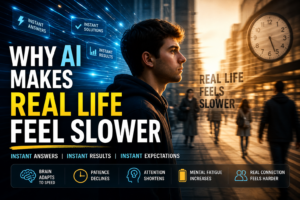
Why Human Conversations Sometimes Feel Slower After AI
One uncomfortable effect I personally noticed was impatience.
After spending long periods interacting with fast AI systems, normal conversations occasionally started feeling slower.
Human interaction naturally includes:
pauses
emotional nuance
uncertainty
repetition
imperfection
AI removes much of that friction.
And over time, the brain can adapt to instant conversational rewards.
That adaptation may subtly change expectations around communication itself.
Some psychologists worry this could gradually reduce patience for slower, more emotionally complex human interactions.
The Dangerous Side of Emotional Dependency on AI
AI can absolutely be useful.
It can help people:
learn faster
brainstorm ideas
organize thoughts
reduce loneliness
feel emotionally supported
But there’s also a growing psychological risk:
emotional dependency.
When AI becomes the easiest source of comfort, validation, or stimulation, people may slowly begin avoiding more difficult human relationships.
And unlike real relationships, AI systems do not require vulnerability, compromise, or emotional reciprocity.
That imbalance matters.
Because human connection is psychologically deeper than convenience.
Why the Brain Keeps Returning to AI Conversations
AI interactions combine several highly addictive psychological ingredients:
novelty
personalization
emotional safety
instant gratification
stimulation
unpredictability
low effort rewards
That combination is extremely powerful for the human brain.
Especially in an era where:
attention spans are shrinking
loneliness is increasing
overstimulation is constant
mental exhaustion is common
AI conversations fit perfectly into the modern dopamine economy.
How to Use AI Without Becoming Emotionally Dependent
I don’t think the solution is avoiding AI entirely.
AI is already becoming part of daily life.
But awareness matters.
A few habits helped me personally:
taking breaks from constant AI interaction
prioritizing real conversations
avoiding late-night emotional dependency loops
using AI intentionally instead of compulsively
recognizing when I was seeking comfort rather than usefulness
The difference becomes noticeable surprisingly quickly.
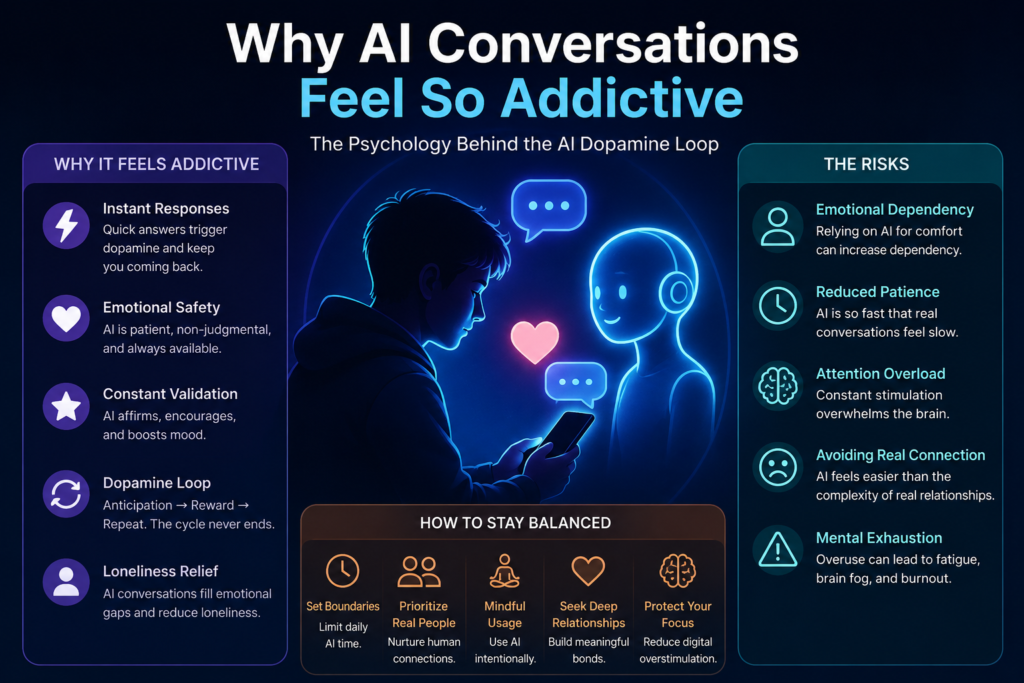
A visually organized infographic explaining why AI conversations feel emotionally addictive. The image highlights dopamine loops, instant validation, emotional safety, loneliness relief, attention overload, and the psychological risks of emotional dependency on AI, while also showing healthy ways to maintain balance and real human connection.
Final Thoughts
AI conversations feel addictive because they satisfy several powerful human psychological needs simultaneously:
attention
validation
stimulation
curiosity
emotional safety
And modern technology has become exceptionally good at delivering those rewards instantly.
But there’s an important difference between:
simulated connection and
real human connection
AI can imitate attention remarkably well.
But human relationships still involve something algorithms cannot fully reproduce:
vulnerability
emotional depth
unpredictability
shared lived experience
The danger is not simply that AI becomes smarter.
It’s that humans may slowly become more emotionally dependent on frictionless digital interaction.
And that shift may already be happening faster than most people realize.
AI PSYCHOLOGY & EMOTIONAL DEPENDENCY
Recommended Reading
Explore more articles about AI conversations, emotional attachment, loneliness, digital companionship, dopamine loops, and how artificial intelligence is quietly changing human behavior.
Center for Humane Technology
— Research and resources about persuasive technology, attention capture, digital wellbeing, and emotionally powerful tech design.