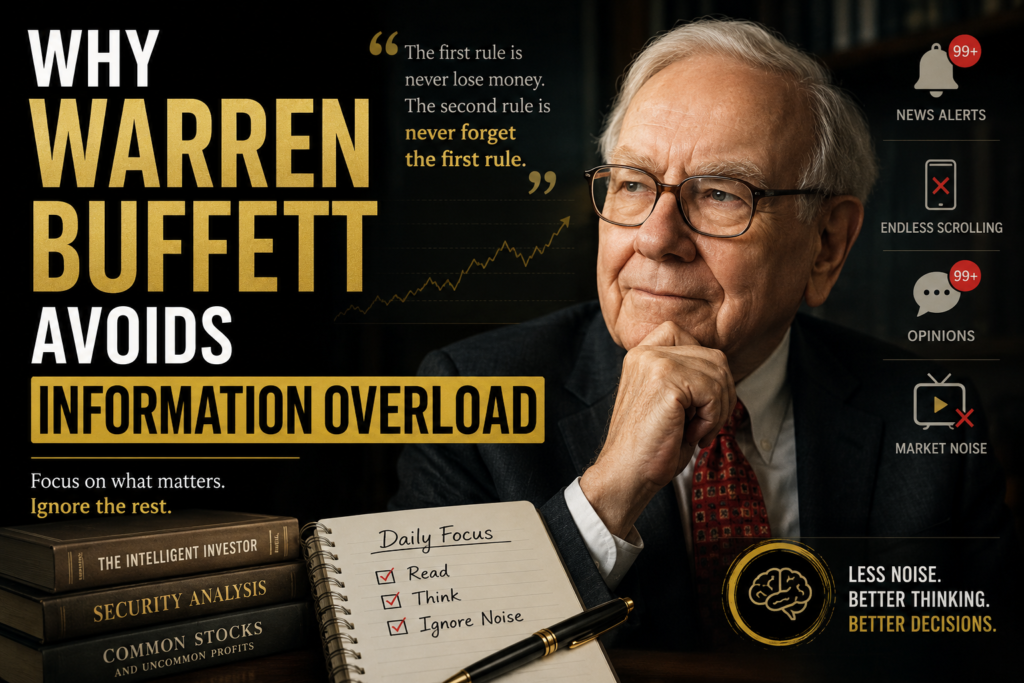
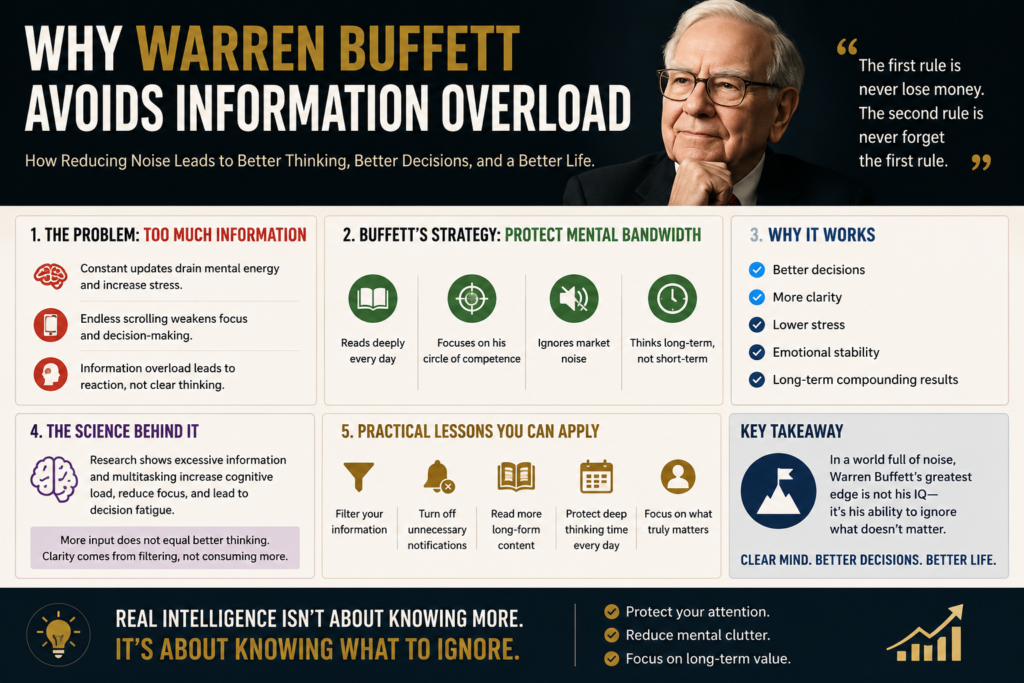
A visual summary of Warren Buffett’s philosophy on avoiding information overload, protecting mental clarity, and focusing on long-term thinking.
Why Warren Buffett Avoids Information Overload
Every day, millions of people wake up and immediately consume information.
News alerts. Social media feeds. Market predictions. Short videos. Endless opinions.
Modern life rewards constant stimulation, yet many people feel mentally exhausted despite consuming more information than ever before.
That’s one reason why the habits of Warren Buffett continue to fascinate people across industries.
Buffett is not known for reacting quickly to noise. He is known for thinking clearly while the world becomes louder.
And in an era dominated by distraction, that ability may be more valuable than ever.
The Surprising Habit Behind Warren Buffett’s Clarity
When people think about Buffett, they often focus on investing.
But one of his most important habits has nothing to do with stock picking.
It’s information filtering.
Buffett has repeatedly emphasized the importance of:
quiet thinking
reading deeply
avoiding emotional reactions
ignoring unnecessary noise
In interviews, he has described spending large portions of the day simply reading and thinking.
At first, that sounds unproductive by modern standards.
But psychologically, it makes perfect sense.
Because the human brain was never designed to process an infinite stream of information every hour.
Why Information Overload Is Becoming Dangerous
Researchers studying cognitive overload have increasingly warned about the effects of excessive information consumption.
Studies involving attention and working memory suggest that constant information switching:
reduces concentration
increases stress
weakens decision-making quality
increases mental fatigue
The problem is not information itself.
The problem is uncontrolled input.
Today, most people consume information continuously without giving the brain time to process or reflect.
The result is a mind that constantly reacts instead of thinking clearly.
Buffett’s “Circle of Competence” Philosophy
One of Buffett’s most famous ideas is the concept of the Circle of Competence.
The principle is simple: focus deeply on what you truly understand, and ignore unnecessary complexity outside that area.
This matters because modern culture encourages the opposite.
People feel pressure to:
react to every trend
follow every market movement
consume every opinion
stay updated on everything
But Buffett’s philosophy suggests that clarity often comes from selective ignorance.
Not every piece of information deserves your attention.
The Psychological Cost of Constant Updates
Psychologists have long studied how excessive stimulation affects mental well-being.
Research on cognitive fatigue suggests that constant interruptions reduce mental efficiency and increase emotional stress over time.
This feels especially relevant today because the internet rewards urgency.
Everything feels important:
breaking news
viral posts
financial panic
online debates
productivity trends
But Buffett’s behavior reflects a very different mindset: ignore most noise and focus on long-term thinking.
What I Noticed Personally
A while ago, I realized I had developed a habit of constantly checking information.
Even during work, I kept switching between:
news apps
social media
YouTube
productivity videos
AI tools
random articles
I told myself I was “staying informed.”
But mentally, I felt scattered.
Ironically, the more information I consumed, the harder it became to think clearly.
That’s when Buffett’s approach started making more sense to me.
Instead of trying to know everything, I began reducing unnecessary input:
fewer notifications
less market/news checking
more uninterrupted reading
more time thinking without screens
The result wasn’t immediate productivity.
It was mental quietness.
And honestly, that felt far more valuable.
Why Buffett Reads So Much
Buffett has famously said that reading forms the foundation of his thinking process.
According to multiple interviews and biographies, he spends much of his day reading annual reports, books, and long-form material instead of constantly reacting to short-term noise.
This aligns with research suggesting that deep reading improves comprehension, critical thinking, and long-term memory formation.
Short-form content creates stimulation.
Deep reading creates understanding.
That distinction matters.
Information Consumption vs. Wisdom
Modern culture often treats information like intelligence.
But Buffett demonstrates something different: wisdom is not the same as constant input.
In fact, too much information can reduce clarity.
Psychologist Barry Schwartz discussed similar ideas in The Paradox of Choice, explaining how excessive options often increase anxiety and decision fatigue.
The same principle applies to information.
More input does not always create better judgment.
Sometimes it creates confusion.
Why Calm Thinking Is Becoming Rare
One reason Buffett stands out is emotional stability.
While markets panic, he often remains patient.
While people react emotionally to headlines, he focuses on long-term fundamentals.
This mindset reflects something deeper than investing skill.
It reflects cognitive discipline.
And cognitive discipline becomes increasingly difficult in environments built around:
instant reactions
endless notifications
outrage cycles
constant comparison
The modern attention economy profits from distraction.
But clear thinking usually requires distance from noise.
Practical Lessons From Buffett’s Approach
You do not need to become an investor to apply Buffett’s philosophy.
The core principle is surprisingly practical:
protect mental bandwidth.
Some realistic ways to do this include:
reducing unnecessary information intake
limiting reactive scrolling
reading more deeply instead of constantly browsing
protecting uninterrupted thinking time
avoiding emotional overconsumption of news
The goal is not ignorance.
The goal is intentional attention.
Why Information Overload Hurts Focus
Modern attention fragmentation quietly damages:
concentration
emotional regulation
patience
decision-making
creativity
This explains why many people feel mentally exhausted despite spending most of the day consuming “helpful” content.
The brain never fully settles.
It simply keeps reacting.
Buffett’s habits suggest something increasingly rare: clarity often requires silence.
Final Thoughts
Warren Buffett understands something modern culture often forgets:
Not all information deserves your attention.
In a world overloaded with noise, the ability to think calmly and selectively may become one of the most valuable skills anyone can develop.
And perhaps real intelligence is not about consuming more information.
Perhaps it is about knowing what to ignore.
Information Overload & Clear Thinking
Related Articles About Focus, Decision-Making, and Mental Clarity
Explore more insights about information overload, attention management, decision fatigue, and the habits that help protect clear thinking in a noisy digital world.