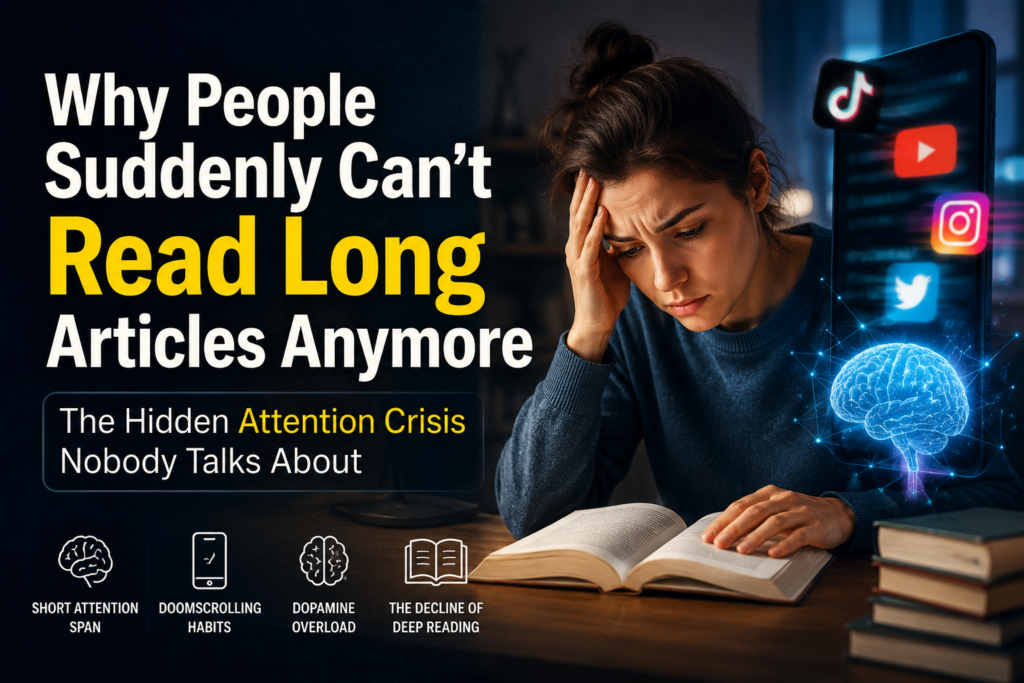
Why People Suddenly Can’t Read Long Articles Anymore
The Hidden Attention Crisis Nobody Talks About
There was a time when I could sit down and read a 300-page book for hours without checking my phone once.
Now? Even reading a five-minute article sometimes feels strangely exhausting.
A few months ago, I noticed something uncomfortable. I kept opening articles that genuinely interested me — psychology, productivity, AI, business — but halfway through, my brain wanted to escape. I would suddenly open YouTube, check notifications, or scroll social media without even realizing it.
At first, I thought I was just tired.
But after talking with friends, coworkers, and even seeing discussions explode across Reddit, X, and YouTube, I realized something bigger was happening:
People are losing the ability to tolerate deep reading.
And according to neuroscientists, psychologists, and media researchers, this isn’t just “lack of discipline.” It may be one of the biggest cognitive shifts caused by the modern internet.
Why Long Articles Suddenly Feel So Hard to Read
The strange thing is that most people still want to learn.
We save articles. We buy books. We open tabs with good intentions.
But somewhere between the first paragraph and the middle of the page, attention collapses.
According to research from Microsoft Canada, the average human attention span in digital environments has significantly decreased over the past decade, largely due to constant media switching and mobile consumption habits.
Neuroscientist Maryanne Wolf, author of Reader, Come Home, warns that digital reading patterns are literally rewiring how we process information. Instead of “deep reading,” many people now skim, scan, and jump between fragments of information.
Her concern is simple but serious:
“The human brain is not born to read. Reading changes the brain.”
And today, the internet is changing it again.
The Internet Trained Our Brains for Speed, Not Depth
That’s why reading now feels mentally “heavy” to many people.
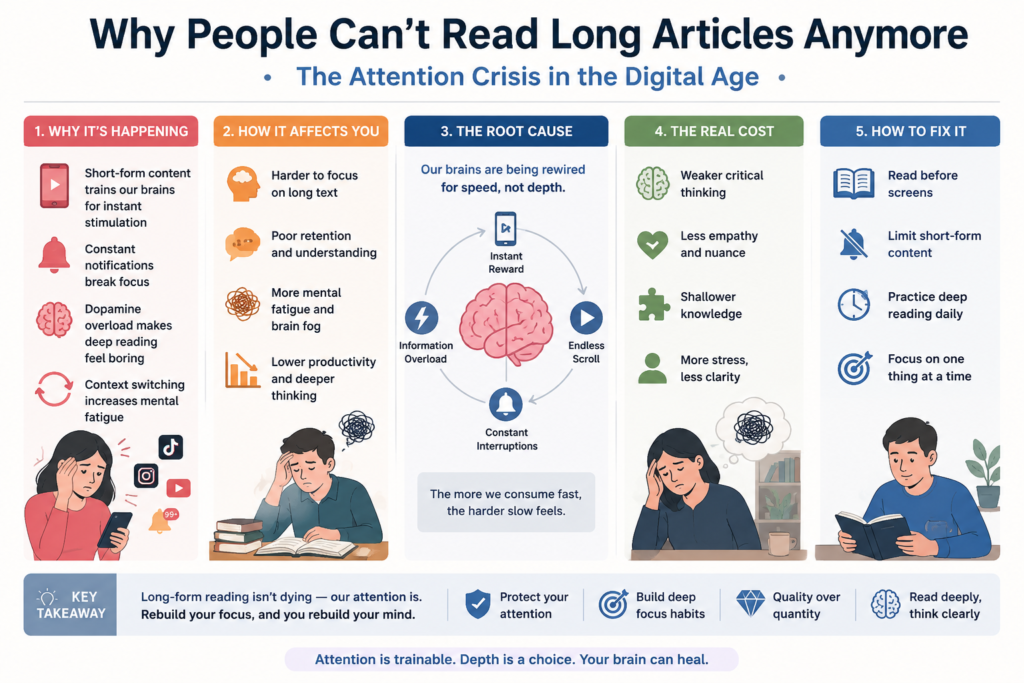
Psychologists call this cognitive switching cost — the mental fatigue caused by rapidly jumping between tasks, platforms, and information streams.
The more fragmented your attention becomes during the day, the harder deep reading feels at night.
Doomscrolling Changed the Way We Consume Information
The problem isn’t only short videos.
It’s the pattern of consumption.
Today, most people consume information like this:
headline
reaction
clip
comment
swipe
next
next
next
Your brain adapts to this rhythm.
Nicholas Carr explored this phenomenon years ago in The Shallows, where he argued that the internet encourages shallow processing instead of reflective thinking.
His famous question still feels disturbingly relevant:
“What if I do all my reading on the web not so much because the way I read has changed, but because the way I THINK has changed?”
That line hit me hard the first time I read it.
Because honestly, it explains modern internet life perfectly.
AI and Algorithmic Content Made Attention Worse
Ironically, AI tools designed to help productivity may also be making attention more fragmented.
Today, information arrives faster than humans can psychologically process it.
Every day we consume:
AI summaries
viral threads
productivity hacks
endless “top 10” lists
auto-generated content
algorithmic recommendations
The result?
Information abundance but attention scarcity.
A 2024 report from the Reuters Institute found that many users increasingly avoid long-form news because it feels emotionally draining and cognitively exhausting.
People are not necessarily becoming less intelligent.
They’re becoming overstimulated.
Why Your Brain Feels Restless While Reading
One of the biggest signs of attention fragmentation is this:
You read words, but nothing emotionally “sticks.”
You finish paragraphs and realize:
you remember nothing
your brain drifted away
you reread sentences repeatedly
reading feels like effort instead of immersion
I noticed this happening especially after spending long hours consuming short-form content.
After 30 minutes of scrolling, my brain suddenly struggled with books I used to enjoy easily.
That’s not laziness.
It’s conditioning.
Neuroscientists often describe attention as trainable. The brain strengthens whatever behavior gets repeated most often.
If your daily media diet is built around speed and interruption, deep reading starts to feel unnatural.
The Real Cost of Losing Deep Reading
This issue matters more than people realize.
Deep reading is connected to:
critical thinking
empathy
memory retention
creativity
analytical reasoning
Maryanne Wolf argues that deep reading allows humans to form richer emotional and intellectual connections with ideas.
Without it, people become more reactive and less reflective.
And honestly, you can already see signs of this online:
shorter outrage cycles
emotional overreaction
inability to process nuance
instant opinions without depth
headline-only understanding
The internet rewards speed.
But wisdom usually requires slowness.
How I Slowly Rebuilt My Attention Span
What helped me wasn’t quitting technology completely.
It was rebuilding friction.
A few small changes made a surprisingly big difference:
1. Reading Before Screens
Instead of checking my phone immediately after waking up, I started reading for 10 minutes first.
My concentration improved within weeks.
2. Removing Infinite Scroll Apps
I noticed my brain felt calmer after limiting short-form content.
Especially at night.
3. Printing Long Articles
This sounds old-fashioned, but printed reading dramatically improved focus for me.
No tabs. No notifications. No temptation.
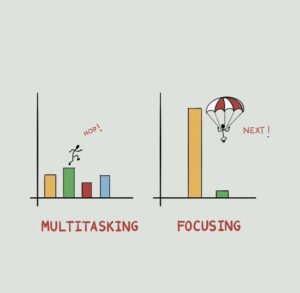
4. Practicing “Single-Task Attention”
Reading without music, multitasking, or background videos retrained my brain to tolerate mental stillness again.
At first it felt uncomfortable.
Then it started feeling peaceful.
The Future of Attention May Become a Competitive Advantage
In a world flooded with distractions, the ability to focus deeply is becoming rare.
And rare skills become valuable.
Ironically, people who can still:
read deeply
think clearly
focus longer
resist constant stimulation
may gain enormous advantages in work, learning, creativity, and decision-making.
Cal Newport, author of Deep Work, warned about this years ago:
“The ability to perform deep work is becoming increasingly rare at exactly the same time it is becoming increasingly valuable.”
That prediction now feels incredibly accurate.
Final Thoughts
Maybe the real issue isn’t that people suddenly became lazy.
Maybe modern technology slowly trained our brains to expect stimulation every few seconds.
And once your brain adapts to speed, silence starts feeling uncomfortable.
That’s why long articles feel harder to read now.
Not because your brain is broken.
But because your attention has been continuously fragmented by the systems surrounding you every day.
The good news?
Attention can recover.
Slowly.
One focused page at a time.
Read Next: Build Your Focus Back
If long articles feel harder to read now, these related guides will help you understand why your attention feels scattered — and how to rebuild it.