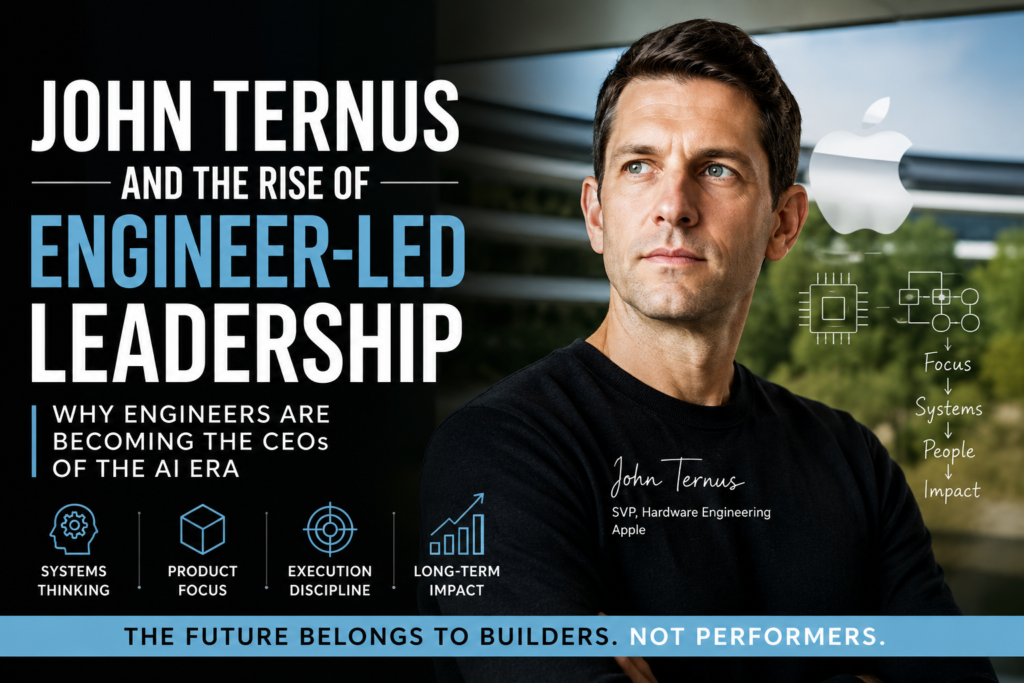
John Ternus and the Rise of Engineer-Led Leadership
Introduction
For years, the tech industry celebrated charismatic founders.
Visionary speakers. Aggressive growth strategists. Executives who dominated headlines.
But the AI era may be changing what companies actually need from leadership.
Today, many of the most valuable technology companies are quietly shifting toward something different:
engineer-led leadership.
Not louder leadership.
Not more inspirational leadership.
More technical leadership.
And few executives represent that shift better than Apple’s John Ternus.
While the world focuses on artificial intelligence, massive cloud infrastructure, and software ecosystems, companies are increasingly discovering that execution, systems thinking, and product discipline matter more than ever.
The future may belong less to celebrity executives — and more to builders.
Why Engineer-Led Leadership Is Becoming More Valuable
Modern technology systems have become extraordinarily complex.
In earlier business eras, executives could often operate primarily through delegation and high-level strategy.
But modern technology companies increasingly require leaders who deeply understand the products they oversee.
Researchers studying organizational performance have repeatedly found that technical literacy improves strategic decision-making in innovation-heavy industries.
A Harvard Business Review analysis on leadership and technical organizations noted that companies often struggle when executives become too disconnected from product realities.
This is especially important in the AI era.
Because AI is no longer isolated software.
It is becoming integrated into hardware, operating systems, user interfaces, and physical products.
That integration rewards leaders who understand systems from the inside.
Why Apple’s Leadership Model Is Different
Unlike many Silicon Valley companies, Apple has historically favored operational discipline over public hype.
Even Steve Jobs — often remembered for presentation skills — was deeply product-focused.
Apple’s culture has long prioritized:
hardware-software integration,
execution quality,
supply chain precision,
long-term product development,
controlled iteration.
John Ternus emerged directly from that environment.
Rather than building a personal media brand, he became known internally for operational consistency and engineering leadership.
That matters more than many people realize.
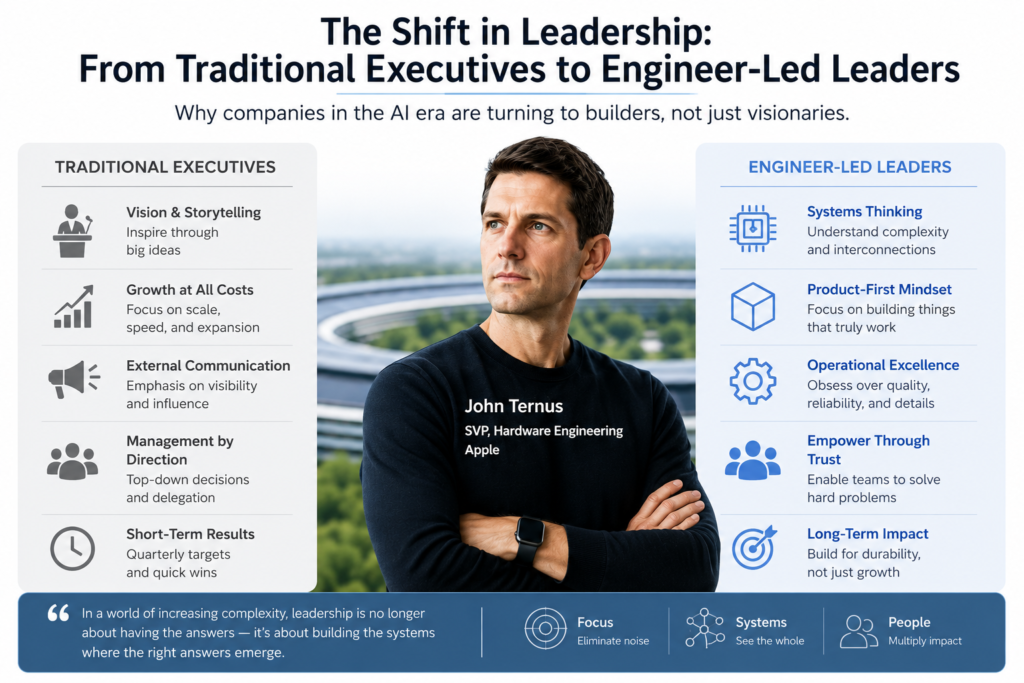
Because modern leadership is increasingly shifting from presentation-driven authority to execution-driven trust.
In highly complex organizations, teams often trust leaders who understand technical constraints, not just business narratives.
The AI Era Is Rewarding Systems Thinkers
One reason engineer-led leadership is becoming more important is because AI systems are deeply interconnected.
A single AI feature now touches:
cloud infrastructure,
hardware acceleration,
battery efficiency,
privacy architecture,
interface design,
computational cost,
user behavior.
This requires systems thinking.
Systems thinking is the ability to understand how interconnected components influence one another over time.
Researchers at MIT and organizational psychology scholars have repeatedly emphasized that modern organizations increasingly depend on leaders capable of managing complexity rather than isolated functions.
This is where engineering-oriented leaders often excel.
Engineers are trained to think in:
constraints,
dependencies,
scalability,
optimization,
tradeoffs.
Those skills are becoming leadership advantages.
Why Calm Leadership May Outperform Charismatic Leadership
The internet era rewarded visibility.
The AI era may reward stability.
Modern organizations operate under constant pressure:
information overload,
accelerated competition,
global uncertainty,
rapid technological change.
In unstable environments, emotionally reactive leadership often creates organizational instability.
Calm leadership becomes valuable.
John Ternus represents a quieter style of leadership that contrasts sharply with the high-performance theater often associated with Silicon Valley.
And there is growing evidence that calmer leadership cultures improve execution quality.
Research in organizational psychology consistently shows that emotionally stable leadership improves team trust, long-term performance, and decision consistency.
In industries where product cycles take years rather than weeks, emotional stability matters.
Especially at Apple scale.
Product-First Leadership Is Returning
Over the last decade, many companies became obsessed with growth metrics.
But the AI transition is exposing weaknesses in companies that optimized primarily for speed rather than product quality.
Users are becoming increasingly sensitive to:
reliability,
privacy,
trust,
integration quality,
ecosystem consistency.
These are areas where engineer-led cultures often perform better.
Apple’s competitive advantage has rarely been being first.
Its advantage has often been integration quality and execution discipline.
That is deeply connected to engineering culture.
And leaders like John Ternus represent continuity of that philosophy.
Why Technical Leaders Often Make Better Long-Term Decisions
One overlooked advantage of technical leadership is long-term thinking.
Engineers frequently optimize for:
sustainability,
maintainability,
scalability,
failure prevention.
This mindset often produces slower but more durable decision-making.
Behavioral economists have repeatedly found that short-term incentive structures distort organizational judgment.
Technical leaders may sometimes resist rapid decisions because they better understand downstream consequences.
In the AI era, that restraint may become increasingly valuable.
Especially as companies deploy technologies with long-term social and economic impact.
The Shift From “Visionary CEOs” to “Builder CEOs”
The technology industry may be entering a new leadership phase.
For years, investors rewarded:
aggressive expansion,
media visibility,
disruption narratives.
But AI systems are forcing companies to confront operational reality.
Can the product actually scale?
Can the infrastructure support demand?
Can privacy be protected?
Can hardware handle computational requirements?
Can execution remain stable under pressure?
These questions favor builders.
Not performers.
Builder CEOs often prioritize:
operational discipline,
infrastructure quality,
product consistency,
technical depth,
organizational focus.
And that may define the next generation of leadership.
Why This Matters Beyond Apple
The rise of engineer-led leadership is not only about Apple.
It reflects a broader shift happening across modern organizations.
As technology becomes more deeply integrated into everyday life, companies increasingly require leaders who understand:
systems,
engineering constraints,
long-term architecture,
human behavior,
operational scalability.
The AI era is making complexity unavoidable.
And complexity changes what effective leadership looks like.
The future may belong less to executives who simply explain technology — and more to leaders who truly understand how it works.
Final Thoughts
John Ternus represents something larger than a possible future Apple CEO.
He represents a shift in how leadership itself is evolving.
The AI era is changing what organizations value:
less noise,
less performance,
less hype,
more execution,
more systems thinking,
more technical depth.
For years, leadership culture rewarded visibility.
But increasingly, the modern world may reward people who quietly build reliable systems that actually work.
And that may be why engineer-led leadership is becoming one of the defining management trends of the AI era.
FAQ Section
Who is John Ternus?
John Ternus is a senior Apple executive known for leading hardware engineering efforts and overseeing major product development initiatives inside Apple.
Why are engineer-led CEOs becoming more important?
Modern AI systems and technology ecosystems are becoming increasingly complex, rewarding leaders who understand technical systems, product integration, scalability, and operational execution.
What is engineer-led leadership?
Engineer-led leadership emphasizes systems thinking, technical understanding, product quality, operational discipline, and long-term execution over charisma or media visibility.
Why does systems thinking matter in the AI era?
AI systems now affect hardware, software, infrastructure, privacy, and user experience simultaneously. Leaders who understand interconnected systems are better equipped to manage this complexity.
ENGINEER-LED LEADERSHIP
Recommended Reading
Explore more articles about leadership consistency, engineering culture, decision-making under pressure, productivity systems, and long-term execution discipline.
Apple Leadership: John Ternus
— Official profile of Apple’s senior hardware engineering leader known for product-focused execution and operational discipline.
McKinsey: Advantages of Engineering Leaders
— Research on why technically grounded leaders often excel in complex environments requiring long-term execution and organizational trust.