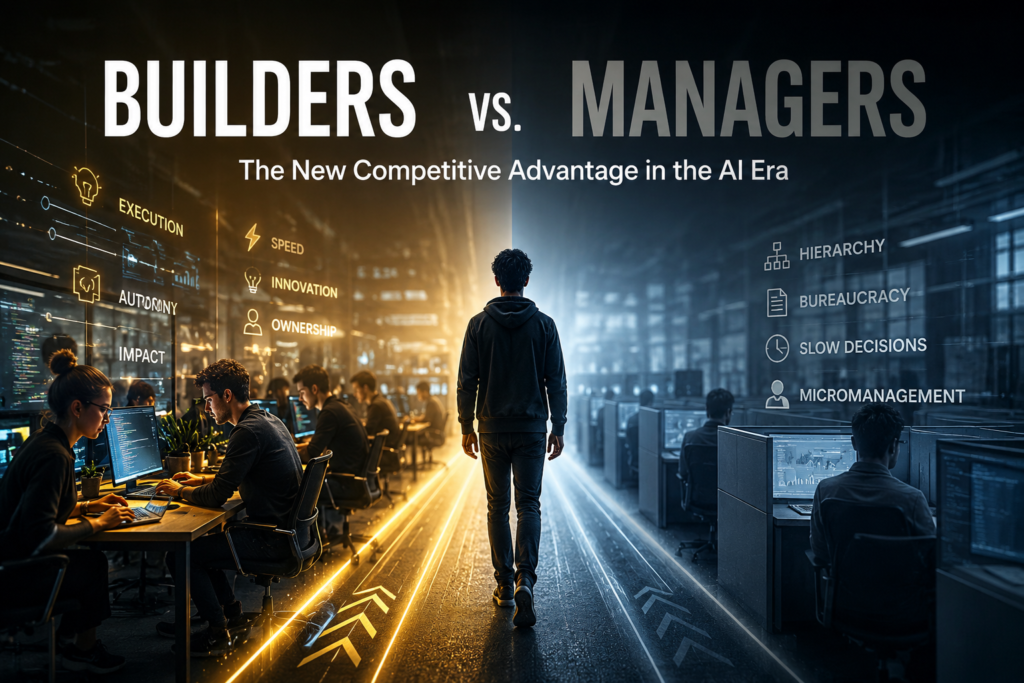
Why AI Companies Suddenly Want Builders, Not Managers
Introduction
For decades, modern companies operated through layers.
Executives created strategy. Managers coordinated teams. Employees executed tasks.
That structure worked reasonably well in slower business environments.
But the AI era is quietly changing how companies think about work itself.
Across Silicon Valley, executives are increasingly questioning whether traditional management structures still make sense in organizations powered by artificial intelligence, automation, and highly leveraged technical teams.
And many companies are reaching the same conclusion:
They need more builders.
Not more managers.
In recent months, leaders from companies like Coinbase, Airbnb, and Block have openly discussed reducing management layers while increasing the importance of hands-on contributors and “player-coach” employees.
This is not just another hiring trend.
It reflects a deeper shift in how modern organizations create value.
What Companies Mean By “Builders”
A builder is not simply an engineer.
The term increasingly refers to people who:
solve problems directly,
execute quickly,
understand systems,
ship products,
improve workflows,
reduce organizational friction.
Builders are operators.
They tend to work close to the actual output of the company rather than managing communication layers around the work.
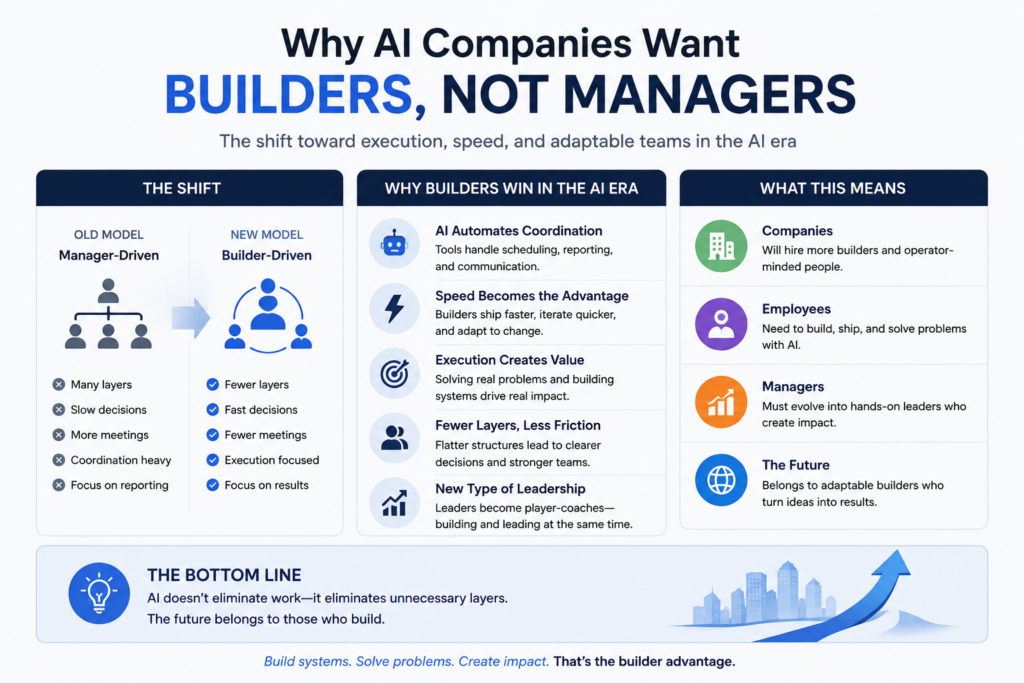
In many AI companies, the value of coordination itself is shrinking because AI tools now automate large portions of:
scheduling,
reporting,
documentation,
project tracking,
workflow organization.
As automation expands, companies increasingly reward people who can directly create leverage.
That leverage may come from:
writing code,
designing systems,
managing AI workflows,
improving operations,
solving technical bottlenecks.
The internet rewarded communication.
The AI era increasingly rewards execution.
Why Traditional Management Structures Are Under Pressure
One reason this shift is happening is because AI dramatically lowers coordination costs.
Historically, companies needed layers of management because communication itself was expensive.
Managers translated information between teams. They tracked progress. They organized workflows. They handled reporting structures.
But AI tools increasingly automate those processes.
Research and industry analysis now suggest that many companies are flattening organizational structures as AI systems improve workflow coordination and decision support.
Coinbase CEO Brian Armstrong recently stated that the company would move away from “pure managers,” favoring employees who directly contribute while also leading smaller teams.
Airbnb CEO Brian Chesky made similar comments, arguing that traditional people-management roles may lose value in AI-driven organizations.
This does not mean management disappears entirely.
But it does mean the definition of valuable management is changing.
Why AI Changes The Economics of Work
AI systems create leverage.
One employee equipped with powerful AI tools can now produce work that previously required multiple people.
Developers can generate documentation faster. Designers can prototype faster. Researchers can summarize information instantly. Small teams can ship products at startup speed.
This changes hiring priorities.
Companies begin asking different questions:
Who can build?
Who can solve problems independently?
Who can adapt quickly?
Who can operate AI systems effectively?
In this environment, organizations increasingly value employees who combine technical ability with execution discipline.
Researchers studying AI-assisted development environments have also found that developers increasingly prefer AI systems that reduce repetitive coordination work while preserving meaningful creative ownership.
That distinction matters.
Companies are not only automating labor.
They are reorganizing around speed and adaptability.
The Rise of “Player-Coach” Employees
One of the clearest trends in AI companies is the rise of the “player-coach.”
This refers to leaders who both:
contribute directly,
and coordinate teams.
Instead of supervising from a distance, these employees stay close to the work itself.
This model is becoming increasingly attractive because AI tools reduce the need for administrative oversight while increasing the importance of technical understanding.
In highly technical organizations, credibility often comes from participation rather than hierarchy.
Employees trust leaders who understand operational reality.
Not just reporting dashboards.
This is especially true in AI environments where systems evolve extremely quickly.
A manager disconnected from the underlying work may struggle to make effective decisions.
Why Builders Create Faster Organizations
Modern organizations increasingly compete on speed.
Not only speed of development — but speed of adaptation.
Large communication-heavy organizations often struggle under these conditions.
Builders reduce organizational drag.
They:
make decisions faster,
simplify workflows,
reduce meetings,
shorten feedback loops,
solve problems directly.
Research on engineering productivity has repeatedly shown that organizational friction and excessive coordination can reduce productivity even in highly skilled technical teams.
This is one reason many companies are flattening structures.
The more layers an organization adds, the slower information moves.
The slower decisions become.
Why AI Companies Are Obsessed With Execution
The AI era is exposing a major weakness inside many organizations:
too much discussion, not enough execution.
Modern companies generate enormous amounts of:
meetings,
strategy documents,
dashboards,
planning frameworks,
communication overhead.
But AI systems increasingly compress execution time.
When execution becomes faster, organizational delay becomes more visible.
This changes company culture.
Execution itself becomes a competitive advantage.
That is why many AI companies now prioritize:
operators,
builders,
technical generalists,
systems thinkers,
adaptable employees.
Not because management is useless — but because organizations can no longer afford excessive friction.
The Risk of Removing Too Many Managers
At the same time, some experts warn that companies may overcorrect.
Middle management has historically played an important role in:
mentoring,
translating strategy,
stabilizing teams,
filtering organizational noise.
Some leadership researchers argue that removing too much middle management may create leadership pipeline problems later.
AI may reduce administrative management.
But human coordination still matters.
Especially in large organizations.
The future likely belongs not to “manager-free companies,” but to companies where managers are expected to operate as builders themselves.
Why Builder Culture Fits The AI Era
AI rewards people who can:
learn quickly,
adapt continuously,
experiment rapidly,
integrate systems,
solve practical problems.
Builder culture aligns naturally with those conditions.
Builders tend to:
prioritize outcomes over process,
reduce unnecessary complexity,
focus on shipping,
optimize systems directly.
This is increasingly becoming the dominant mindset inside modern technology organizations.
Especially startups.
But increasingly large enterprises as well.
Even product managers inside major technology firms are becoming more hands-on with AI tools, prototyping, workflows, and automation systems rather than operating purely as coordinators.
The distinction between “technical employee” and “business employee” is beginning to blur.
Why This Trend Extends Beyond Silicon Valley
This shift is not limited to tech companies.
AI is gradually transforming:
finance,
healthcare,
logistics,
manufacturing,
construction,
consulting,
media.
As AI systems integrate deeper into operations, organizations increasingly reward employees who can combine:
technical understanding,
operational thinking,
execution capability,
systems awareness.
The future workplace may increasingly favor people who can build systems rather than only supervise them.
That trend is already visible.
Final Thoughts
For years, companies optimized for scale through hierarchy.
The AI era is changing that logic.
Modern organizations increasingly want:
fewer layers,
faster decisions,
more execution,
stronger operators,
adaptable builders.
This does not mean leadership disappears.
But it does mean leadership is becoming more operational, more technical, and more directly connected to the work itself.
The companies that move fastest in the AI era may not be the ones with the largest management structures.
They may be the ones filled with people who know how to build.
FAQ Section
What is a builder employee?
A builder employee is someone who directly creates value through execution, problem-solving, system improvement, or technical contribution rather than primarily coordinating other employees.
Why are AI companies reducing management layers?
AI tools increasingly automate reporting, coordination, scheduling, and workflow management, reducing the need for traditional administrative management structures.
What is a player-coach in modern companies?
A player-coach is a leader who both contributes directly to operational work and manages smaller teams rather than functioning as a purely administrative manager.
Will AI eliminate middle management completely?
Most experts believe management will evolve rather than disappear. Companies will likely favor managers who also contribute operationally and understand technical systems.
AI STARTUPS & EXECUTION CULTURE
Recommended Reading
Explore more articles about AI-native companies, execution-focused culture, engineer-led leadership, builder mindsets, and why startups increasingly prioritize operators over traditional management layers.
Coinbase & The “Player-Coach” Model
— Coinbase shifted toward eliminating “pure managers” and emphasized leaders who actively build and execute alongside teams.
Why Everyone Is Becoming an “AI Builder”
— AI tools are blurring the line between engineers, product managers, and operators as companies prioritize direct execution capability.
Middle Management in the AI Era
— Analysis of how AI automation is flattening organizations and increasing demand for hands-on builders over coordination-heavy roles.