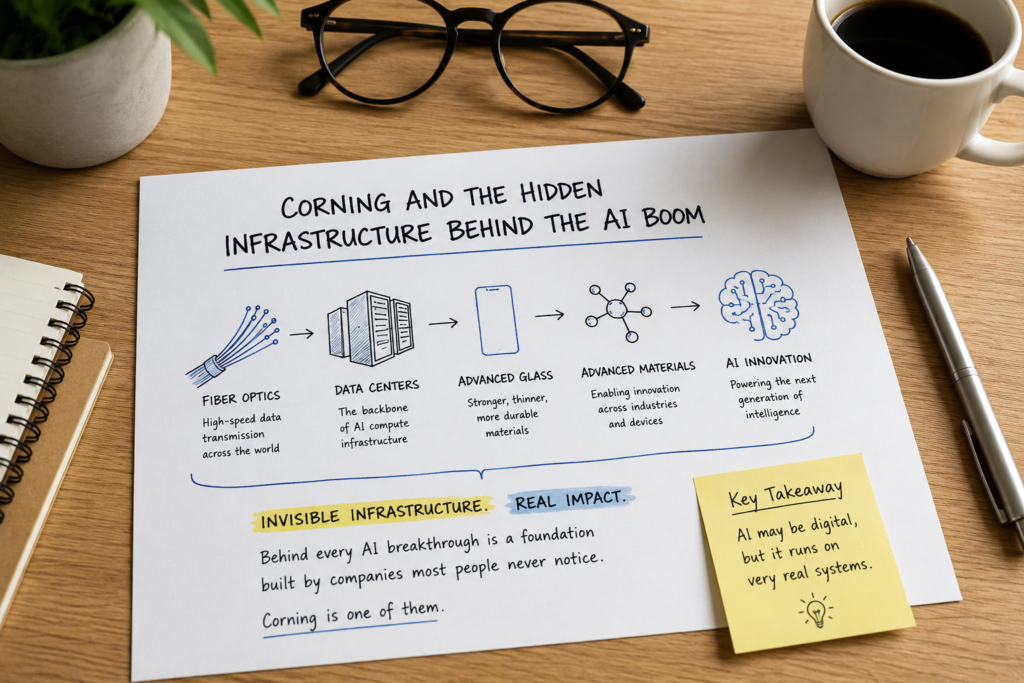
Corning and the Hidden Infrastructure Behind the AI Boom
Introduction
When people talk about the AI boom, they usually mention the same companies.
NVIDIA. OpenAI. Microsoft. Google.
The visible layer of artificial intelligence receives most of the attention.
But modern AI systems depend on something far less glamorous:
infrastructure.
Behind every AI model, every cloud system, every large-scale data center, there are companies building the physical foundation that makes the AI era possible.
One of those companies is Corning.
Most consumers know Corning because of Gorilla Glass.
But inside the technology industry, Corning has quietly become part of the invisible infrastructure powering modern computing, telecommunications, and AI systems.
And the rise of artificial intelligence may make companies like Corning more important than ever.
Why The AI Boom Is Really An Infrastructure Boom
Artificial intelligence appears digital.
But AI is deeply physical.
Every AI request requires:
servers,
networking systems,
fiber-optic communication,
cooling infrastructure,
advanced materials,
semiconductor manufacturing,
high-speed data transmission.
Large AI models consume enormous amounts of computational power.
Researchers from institutions including Stanford and MIT have repeatedly emphasized that the future growth of AI increasingly depends on physical infrastructure constraints rather than software innovation alone.
In practical terms, AI scaling now depends on whether the world can build enough:
chips,
energy systems,
optical networking,
advanced data centers.
This is where companies like Corning enter the story.
Why Fiber Optics Matter More Than Most People Realize
Modern AI systems move enormous amounts of data.
That data must travel between:
servers,
GPUs,
cloud infrastructure,
global internet systems.
Fiber optics are the backbone of that movement.
Corning is one of the world’s most important manufacturers of optical fiber and telecommunications infrastructure.
Without fiber-optic systems, large-scale AI models would struggle to operate efficiently across distributed networks.
As AI workloads grow, demand for faster data transfer continues increasing.
Industry analysts have repeatedly noted that hyperscale AI data centers require significantly more fiber connectivity than traditional cloud infrastructure.
This is partly because AI clusters involve constant communication between GPUs and distributed computing systems.
In other words:
AI does not only depend on chips.
It depends on the roads connecting the chips.
The AI Era Is Creating Massive Data Center Expansion
One of the biggest technology trends of the decade is data center expansion.
Companies including Microsoft, Amazon, Google, and Meta are investing billions into AI infrastructure construction.
According to industry reports from McKinsey and Goldman Sachs, AI data center demand is expected to accelerate dramatically over the next several years due to the computational requirements of generative AI systems.
But data centers are not simply rooms filled with computers.
They require:
networking infrastructure,
heat management systems,
specialized glass,
optical communication systems,
power distribution,
advanced materials.
Corning operates directly inside several of these categories.
That is why infrastructure companies increasingly matter in the AI economy.
Why Invisible Companies Often Become The Most Important
Technology history repeatedly shows the same pattern:
the companies creating foundational infrastructure often receive less public attention than the companies operating on top of that infrastructure.
Few consumers think about:
semiconductor equipment manufacturers,
optical fiber producers,
server cooling systems,
industrial material science companies.
But modern technology ecosystems cannot function without them.
Historian Vaclav Smil has frequently written about how modern civilization depends on invisible industrial systems that most people rarely notice.
Electric grids. Industrial materials. Supply chains. Logistics systems.
AI infrastructure follows the same pattern.
The visible layer captures attention.
The invisible layer creates stability.
Why Material Science Matters In The AI Era
Artificial intelligence is often discussed as software.
But AI advancement increasingly depends on material science.
High-performance computing systems require:
specialized glass,
thermal management,
durable components,
optical precision,
semiconductor manufacturing compatibility.
Corning has spent decades operating in advanced materials research.
This gives the company unusual strategic importance in industries requiring long-term engineering expertise.
Many infrastructure companies succeed because they solve extremely difficult physical problems rather than consumer-facing problems.
That work rarely becomes viral.
But it becomes essential.
The Growing Importance Of Optical Networking
As AI models become larger, networking speed becomes increasingly important.
Moving data efficiently between systems is now a major engineering challenge.
This is one reason optical networking has become a major focus inside hyperscale infrastructure.
Researchers studying AI systems architecture increasingly point to bandwidth bottlenecks as one of the key limitations of future AI scaling.
In simple terms:
faster chips alone are not enough.
The systems surrounding those chips must also evolve.
That includes:
fiber optics,
interconnect systems,
optical communication infrastructure.
Corning operates directly in that ecosystem.
Why The Market Often Underestimates Infrastructure Companies
Investors frequently become fascinated with visible innovation.
Consumer AI products attract attention because they are easy to understand.
Infrastructure companies are different.
Their products often appear technical, industrial, or invisible to ordinary consumers.
But infrastructure businesses sometimes become extraordinarily valuable because modern systems depend on them continuously.
Cloud computing created massive demand for:
semiconductors,
networking equipment,
fiber infrastructure.
The AI boom may accelerate that pattern even further.
Especially as governments and corporations race to build AI-capable infrastructure globally.
Why AI Is Increasing Demand For Physical Systems
For years, technology narratives focused heavily on software.
But the AI era is bringing physical constraints back into focus.
AI requires:
energy,
cooling,
networking,
data transmission,
specialized manufacturing,
advanced industrial supply chains.
This is partly why technology companies are increasingly investing directly into infrastructure partnerships.
The AI economy is no longer purely digital.
It is becoming industrial.
And industrial revolutions tend to reward companies operating quietly beneath the surface.
Why Corning Represents A Bigger Trend
Corning matters not only because of its products.
It matters because it represents a broader shift happening across the technology industry.
The future of AI may depend less on flashy applications — and more on resilient infrastructure.
This includes companies working in:
advanced materials,
optical systems,
industrial engineering,
semiconductor tooling,
energy systems,
data center architecture.
Many of the most important AI companies over the next decade may be companies most consumers rarely think about.
The Hidden Infrastructure Economy
One reason infrastructure businesses are becoming more important is because modern digital systems have reached extraordinary scale.
AI systems now require:
enormous power consumption,
massive physical networking,
highly optimized communication systems.
Books like Chip War by Chris Miller have highlighted how geopolitical competition increasingly revolves around supply chains and foundational technology infrastructure rather than only consumer products.
The AI race follows the same logic.
The companies controlling critical infrastructure layers may become strategically powerful even if they remain relatively invisible to the public.
Why The Future Of AI May Depend On Boring Companies
Historically, many transformative industries depended on companies that initially seemed unexciting.
Railroads. Electric grids. Industrial steel. Semiconductors. Telecommunications infrastructure.
The same pattern may emerge in AI.
While the public focuses on AI applications, the long-term winners may include companies quietly solving:
transmission problems,
infrastructure bottlenecks,
networking limitations,
material science challenges.
Corning operates directly inside that world.
And that may explain why infrastructure is becoming one of the most important stories of the AI era.
Final Thoughts
Artificial intelligence may appear to be a software revolution.
But underneath the software is a massive physical system.
Servers. Fiber optics. Advanced materials. Data centers. Energy infrastructure. Industrial engineering.
The companies building these systems rarely dominate headlines.
But modern AI may not function without them.
Corning represents a growing reality inside the technology industry:
the future increasingly belongs not only to companies creating intelligence — but to companies building the infrastructure that allows intelligence to exist at scale.
FAQ Section
What does Corning do?
Corning is a technology and materials science company known for products including Gorilla Glass, fiber-optic systems, optical communications infrastructure, and advanced industrial materials.
Why is Corning important to AI infrastructure?
AI systems require large-scale data transmission, networking infrastructure, and advanced materials. Corning plays a major role in optical fiber and communication systems used inside AI data centers.
What is hidden AI infrastructure?
Hidden AI infrastructure refers to the physical systems powering artificial intelligence behind the scenes, including networking, energy systems, semiconductors, cooling systems, and optical communication technology.
Why are infrastructure companies becoming more important?
As AI systems scale globally, demand is rapidly increasing for physical infrastructure capable of supporting massive computational workloads and high-speed data transmission.
AI INFRASTRUCTURE & HIDDEN WINNERS
Recommended Reading
Explore more articles about AI infrastructure, hidden technology suppliers, engineer-led execution, semiconductor ecosystems, and the physical systems powering the AI boom.
Reuters: Corning Partners With Nvidia
— Reuters reported that Corning partnered with Nvidia to massively expand U.S. optical fiber production for AI data centers.
Meta’s $6 Billion Corning Agreement
— Meta announced a multiyear agreement with Corning to secure optical fiber infrastructure for advanced AI data center expansion.
Optical Fiber: The Hidden AI Bottleneck
— MarketWatch explained how optical connectivity has become one of the most critical hidden infrastructure layers in the AI boom.