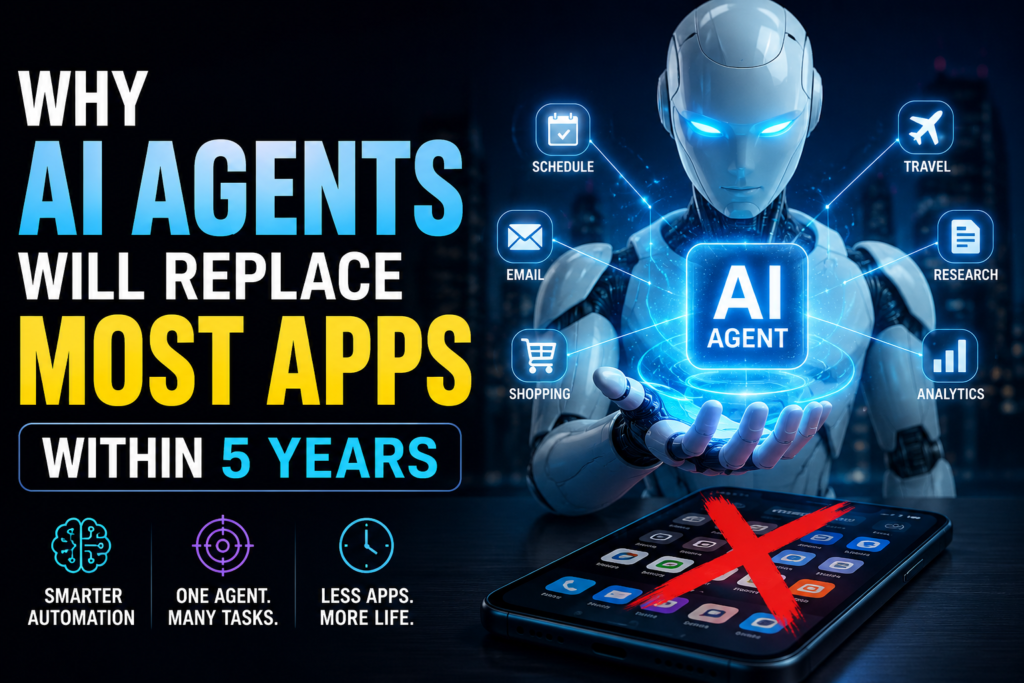
AI agents may become the next major computing platform by replacing traditional apps with intelligent automation and task execution.
Why AI Agents Will Replace Most Apps Within 5 Years
Artificial intelligence is no longer just answering questions. It is beginning to take actions.
That shift may completely change how people use software over the next five years.
For decades, apps have dominated the digital world. Every task required opening a separate platform:
One app for email
One for scheduling
One for shopping
One for banking
One for editing
One for customer support
But AI agents are changing that model fast.
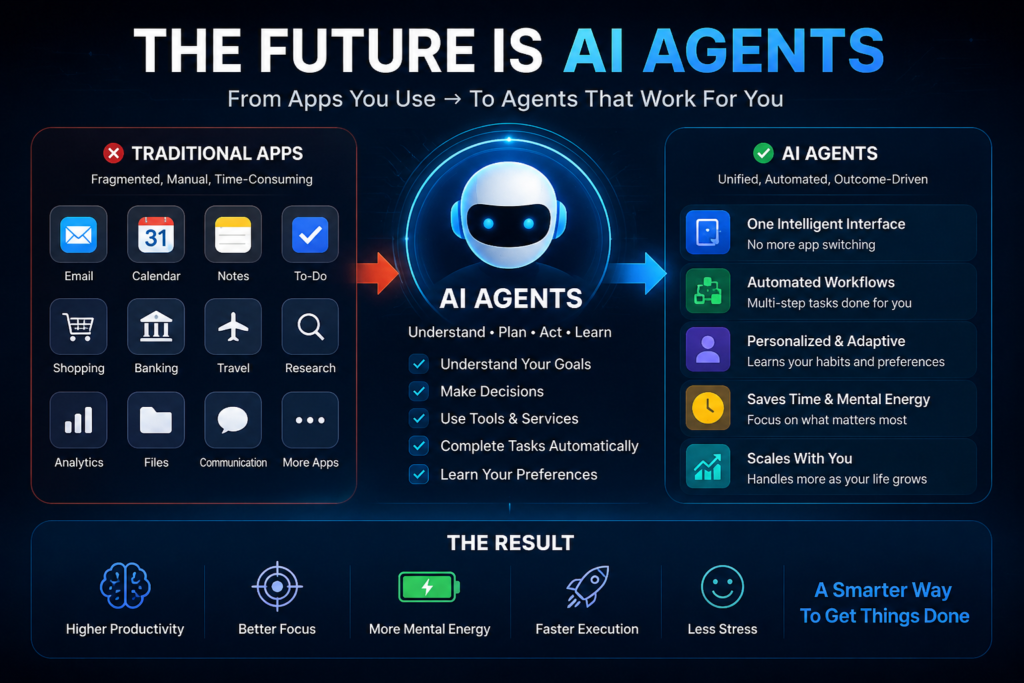
Instead of manually switching between dozens of apps, users are starting to rely on AI systems that can understand goals, make decisions, and complete tasks automatically.
The future of technology may no longer revolve around apps. It may revolve around intelligent AI agents working on your behalf.
What Are AI Agents?
An AI agent is an artificial intelligence system capable of:
Understanding instructions
Planning actions
Using tools or websites
Completing multi-step tasks
Learning user preferences over time
Unlike traditional chatbots, AI agents are designed to act, not just respond.
For example, a modern AI agent could:
Compare flight prices
Book a hotel
Update your calendar
Send confirmation emails
Reorganize your schedule
—all from a single request.
This is why many technology analysts believe “agentic AI” is becoming the next major computing platform.
According to recent enterprise AI reports from major firms like Google Cloud and Deloitte, AI agents are expected to become one of the largest technology shifts since smartphones.
Why Traditional Apps Are Becoming Inefficient
The current app ecosystem creates constant friction.
Most users already experience:
Notification overload
App fatigue
Password exhaustion
Endless context switching
Productivity loss from multitasking
Research from the University of California Irvine found that constant task switching significantly reduces cognitive performance and increases mental fatigue.
Traditional apps were built for manual interaction. AI agents are built for outcomes.
That difference matters.
Instead of asking:
“Which app should I open?”
People are beginning to ask:
“Can AI just handle this for me?”
That behavioral change is extremely important.
AI Agents Reduce Friction
The biggest reason AI agents may replace apps is simple:
They reduce friction.
Historically, the most successful technologies removed steps from human behavior.
Examples include:
Google simplifying web navigation
Netflix removing physical rentals
Smartphones replacing multiple devices
Cloud software eliminating local installation
AI agents remove another layer entirely.
They eliminate the need to manually coordinate between platforms.
This creates a fundamentally different user experience.
Big Tech Is Already Betting on AI Agents
The shift is not theoretical anymore.
Major companies are aggressively investing in AI agent ecosystems:
OpenAI developing autonomous task execution
Google integrating AI agents into Workspace and Search
Microsoft embedding Copilot across Windows and Office
Amazon building shopping and productivity agents
Anthropic focusing on long-running AI workflows
The reason is obvious:
The company controlling the AI agent layer could eventually control user interaction across the internet.
That is an enormous business opportunity.
Why AI Search Is Replacing Traditional Navigation
Search behavior is already changing.
Instead of browsing websites manually, users increasingly ask AI systems directly:
“Find the cheapest flight.”
“Summarize this report.”
“Compare these products.”
“Plan my weekly meals.”
This shift matters because apps historically depended on users visiting them directly.
AI agents may eventually become the middle layer between users and services.
In other words:
Users may stop navigating apps manually altogether.
The Smartphone Parallel
Many experts compare AI agents to the early smartphone revolution.
Before smartphones:
Cameras were separate
GPS devices were separate
MP3 players were separate
Portable gaming devices were separate
The smartphone unified them.
AI agents may do something similar for software itself.
Instead of dozens of apps, users may rely on one intelligent interface capable of coordinating everything behind the scenes.
Why Businesses Love AI Agents
Companies are especially interested in AI agents because they reduce operational costs.
AI agents can already assist with:
Customer support
Scheduling
Data entry
Internal reporting
Sales outreach
Research automation
Workflow management
According to McKinsey’s AI productivity research, automation and generative AI could add trillions of dollars in economic value globally over the next decade.
That financial incentive guarantees aggressive adoption.
AI Agents Could Destroy Average Productivity
One emerging concern is inequality.
Highly skilled workers using AI agents may become dramatically more productive than average workers.
This creates what some analysts call an “AI productivity gap.”
Workers who understand AI workflows could potentially outperform larger teams that still rely on manual systems.
This is already happening in areas like:
Marketing
Software development
Data analysis
Content production
Customer service
The result may fundamentally reshape the future of work.
The Hidden Problem: Overdependence on AI
Despite the advantages, there are risks.
Psychologists and researchers have started discussing concerns around:
Cognitive dependency
Reduced problem-solving ability
Attention fragmentation
AI emotional attachment
Decision outsourcing
If AI agents become deeply integrated into daily life, humans may gradually delegate too much thinking to machines.
This could create long-term social and psychological consequences that are still poorly understood.
Why Most Apps May Eventually Become Invisible
Apps themselves may not completely disappear.
But they may become invisible infrastructure.
Instead of opening apps directly, AI agents may simply communicate with them in the background through APIs and automation systems.
Users would only interact with the agent interface.
This is similar to how cloud computing became invisible to most consumers despite powering much of the modern internet.
The Companies Most at Risk
AI agents threaten platforms built entirely around user attention and repetitive interaction.
Industries potentially vulnerable include:
Basic productivity apps
Traditional search engines
Simple scheduling tools
Customer support platforms
Basic e-commerce navigation systems
The more repetitive a task is, the more likely AI agents can automate it.
Why This Shift Is Happening Faster Than Expected
Technology adoption tends to happen slowly—until it suddenly accelerates.
AI agents are benefiting from several trends happening simultaneously:
Better large language models
Cheaper cloud computing
Improved AI memory systems
Faster inference speeds
Massive enterprise investment
User familiarity with ChatGPT-style interfaces
That combination creates unusually fast momentum.
Many analysts now believe the AI agent economy could become one of the defining technology trends of the late 2020s.
AI agents may replace fragmented apps by combining automation, decision-making, and intelligent workflows into a single interface.
Final Thoughts
The internet was built around websites. The smartphone era was built around apps.
The next era may be built around AI agents.
That does not necessarily mean apps disappear overnight.
But it does mean software interaction is changing rapidly.
People increasingly want outcomes—not interfaces.
And the systems that can deliver those outcomes fastest will likely dominate the future of technology.
AI AGENTS & PRODUCTIVITY
Recommended Reading
Explore more articles about AI agents, productivity systems, mental overload, automation, digital behavior, and the future of intelligent workflows.