Why Your Attention Span Keeps Getting Worse

You sit down to focus for five minutes.
Then suddenly:
- You check your phone
- Open another tab
- Watch a short video
- Read a notification
- Forget what you were doing
For many people, this pattern now feels completely normal.
And that is exactly the problem.
Millions of people feel like their attention span is getting worse every year.
Long videos feel too slow.
Books feel harder to finish.
Deep work feels mentally exhausting.
Even moments of silence feel uncomfortable.
So what happened to human attention?
The answer is bigger than simple “distraction.”
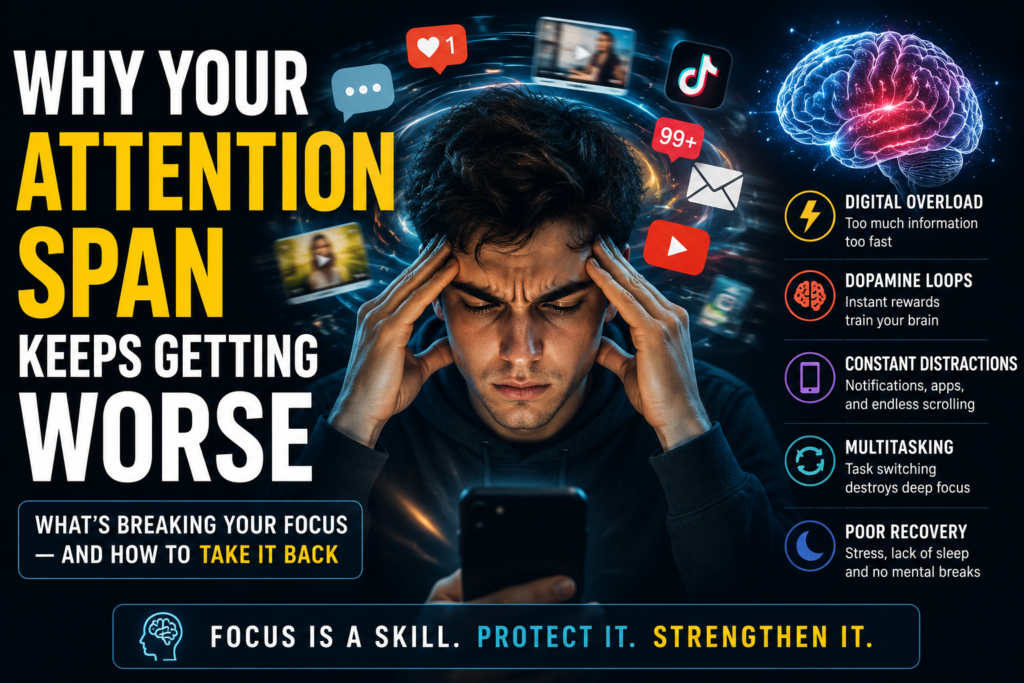
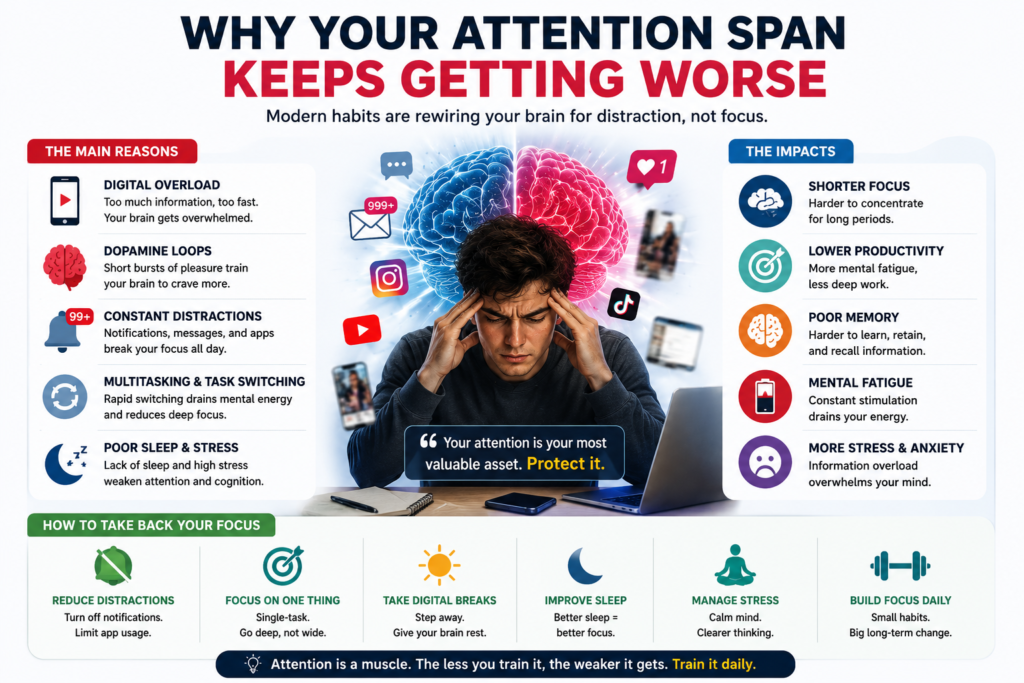
Modern technology, social media, AI systems, digital overload, dopamine-driven platforms, and nonstop stimulation are reshaping how the brain processes focus itself.
Your Brain Is Being Trained to Expect Constant Stimulation
The human brain adapts to repeated behavior.
Every time you:
- Refresh a feed
- Open TikTok
- Check notifications
- Switch apps
- Scroll social media
your brain receives small bursts of novelty and reward.
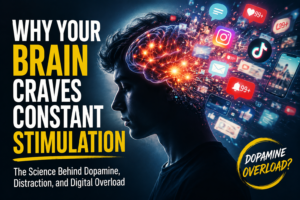
Psychologists often connect this process to dopamine — a neurotransmitter heavily involved in motivation, anticipation, and reward-seeking behavior.
Modern digital platforms are carefully optimized to maximize engagement.
That means your attention is constantly being trained to expect:
- Speed
- Novelty
- Instant rewards
- Rapid emotional stimulation
Over time, slower activities begin to feel mentally difficult.
Why Long Attention Feels Harder Than Before
Deep focus requires cognitive stability.
But modern digital environments constantly interrupt attention.
Research from the University of California Irvine found that repeated interruptions significantly reduce concentration and increase mental fatigue.
The brain pays a cognitive cost every time attention switches between tasks.
This is why many people now struggle with:
- Reading books
- Watching long videos
- Studying deeply
- Working without distractions
- Staying mentally present
The brain becomes conditioned for rapid switching instead of sustained focus.
Social Media Changed Human Attention Completely
Social media platforms compete aggressively for human attention.
Algorithms reward emotionally stimulating content because emotionally reactive users stay engaged longer.
This created a new digital environment dominated by:
- Short-form videos
- Endless scrolling
- Instant gratification
- Constant novelty
- Emotional stimulation
In Stolen Focus, journalist Johann Hari argues that modern systems are actively fragmenting human concentration on a societal scale.
Attention is no longer simply personal.
It has become part of the digital economy.
Your Attention Span Is Not “Broken”
Many people assume they are lazy or undisciplined.
But often, the brain is simply overstimulated.
The nervous system was never designed to process:
- Thousands of headlines
- Endless notifications
- 24/7 connectivity
- Constant media consumption
- Infinite algorithmic stimulation
Modern attention problems are often environmental, not personal failures.
The brain adapts to whatever environment it repeatedly experiences.
Unfortunately, modern digital environments reward distraction constantly.
Why AI May Accelerate Attention Problems
AI tools increase cognitive speed dramatically.
Information arrives faster than ever:
- Instant summaries
- Instant answers
- AI-generated recommendations
- Personalized feeds
- Constant optimization
This creates a state researchers often describe as cognitive overload.
The brain receives too much input without enough recovery time.
Many users now experience:
- Mental fatigue
- Attention fragmentation
- Reduced patience
- Difficulty focusing deeply
- Continuous stimulation cravings
This is one reason terms like:
- “brain fog”
- “attention fatigue”
- “AI burnout”
are becoming increasingly common.
Dopamine Loops Quietly Control Attention
Modern digital systems operate on what behavioral scientists call variable reward systems.
The brain never fully knows what reward might appear next:
- A funny video
- A new message
- A viral post
- Breaking news
- A better AI answer
That unpredictability keeps attention locked in.
This mechanism is psychologically powerful because intermittent rewards often create stronger behavioral habits than predictable ones.
It is the same principle used in gambling systems and social media engagement design.
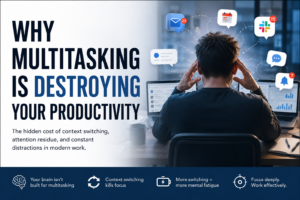
Why Multitasking Makes Focus Worse
Many people believe multitasking improves productivity.
Research consistently shows the opposite.
The brain does not truly focus on multiple complex tasks simultaneously.
Instead, it rapidly switches between them.
Every switch creates:
- Cognitive fatigue
- Reduced accuracy
- Lower mental clarity
- Slower recovery
Over time, excessive task switching trains the brain to avoid sustained concentration entirely.
This creates the feeling that attention is constantly scattered.
The Attention Economy Is Designed Against You
Technology companies profit from attention.
The longer users remain engaged, the more advertising revenue platforms generate.
As a result, digital systems are optimized to maximize:
- Engagement
- Emotional reactions
- Scroll time
- Screen time
- Habit formation
This means your attention is constantly competing against highly optimized algorithms built by massive technology companies.
Focus is no longer just a personal challenge.
It is an economic battlefield.
Why Silence Feels Uncomfortable Now
Many people struggle to sit quietly without stimulation.
Even short moments of boredom often trigger automatic phone checking.
This happens because the brain becomes accustomed to continuous input.
In previous generations, boredom was normal.
Today, boredom is instantly interrupted by:
- Phones
- AI tools
- Notifications
- Entertainment feeds
- Digital stimulation
But boredom historically played an important cognitive role.
It helped the brain:
- Reflect
- Recover
- Process thoughts
- Build creativity
- Strengthen concentration
Without quiet mental space, attention gradually weakens.
Chronic Stress Also Damages Attention
Stress heavily affects concentration.
When cortisol levels remain elevated for long periods, the brain prioritizes survival-focused thinking rather than deep cognitive clarity.
Modern stress often comes from:
- Financial anxiety
- Productivity pressure
- Digital overload
- Social comparison
- Information fatigue
This creates a nervous system that remains mentally overstimulated almost constantly.
Over time, sustained focus becomes harder to maintain.
Why Attention Recovery Matters More Than Productivity
Modern culture constantly promotes optimization:
- More output
- Faster responses
- More efficiency
- More content consumption
But the brain requires recovery to maintain focus properly.
Attention improves during periods of:
- Silence
- Sleep
- Nature
- Deep rest
- Offline time
- Single-task focus
Without recovery, the nervous system remains overloaded.
Eventually, even simple concentration begins to feel exhausting.
Small Habits That Can Help Rebuild Focus
Attention span usually improves gradually, not instantly.
But several habits consistently help strengthen concentration over time.
Reduce notifications
Less interruption protects cognitive stability.
Practice single-tasking
Deep focus trains attention more effectively than multitasking.
Limit short-form content
Excessive novelty weakens sustained concentration.
Create screen-free periods
The brain needs low-stimulation recovery time.
Improve sleep quality
Sleep is essential for memory, focus, and mental clarity.
Allow boredom sometimes
Quiet moments help restore cognitive balance.
Why Attention Is Becoming More Valuable
In the modern world, attention is increasingly rare.
People who can focus deeply now possess a significant advantage:
- Better learning
- Better creativity
- Better productivity
- Better emotional regulation
- Better decision-making
As digital distraction increases globally, sustained attention may become one of the most valuable cognitive skills of the future.

Final Thoughts
Your attention span is not disappearing randomly.
Modern technology, AI systems, social media algorithms, and digital overstimulation are fundamentally reshaping human focus.
The brain adapts to whatever environment it repeatedly experiences.
Right now, most digital environments reward distraction, speed, and endless stimulation.
That is why so many people feel mentally fragmented all the time.
The solution is not simply “trying harder.”
It is protecting your attention from systems specifically designed to consume it.
Recommended Reading
Explore more articles about attention span, focus problems, digital overload, brain fog, AI burnout, and how modern technology quietly changes concentration.
Why Your Brain Feels Foggy All Day
Understand how digital overload, stress, poor sleep, and constant stimulation can make your mind feel cloudy.
AI & AttentionWhy AI Makes Your Brain Feel Like ADHD
Explore how AI overstimulation can fragment attention and create restless, ADHD-like focus patterns.
MultitaskingWhy Multitasking Destroys Productivity
Learn why task switching weakens deep focus, increases cognitive fatigue, and reduces mental clarity.
DoomscrollingHow to Stop Doomscrolling at Night
See why endless scrolling trains the brain to chase novelty and makes attention recovery harder.
External References
- American Psychological Association: How Stress Affects the Body — Explains how chronic stress can affect attention, memory, emotional regulation, and mental performance.
- Nielsen Norman Group: Attention and Digital Interfaces — Research-based insights into attention, distraction, cognitive load, and how digital interfaces shape focus.
- American Psychological Association: Attention Spans — Psychology discussion on attention spans, distraction, digital habits, and why focus feels harder today.
- Harvard Health: Focus and Mental Performance — Explores why focus is becoming increasingly important for learning, productivity, and cognitive performance.