AI automation can save time — but poorly designed workflows often create hidden stress, maintenance fatigue, and productivity burnout
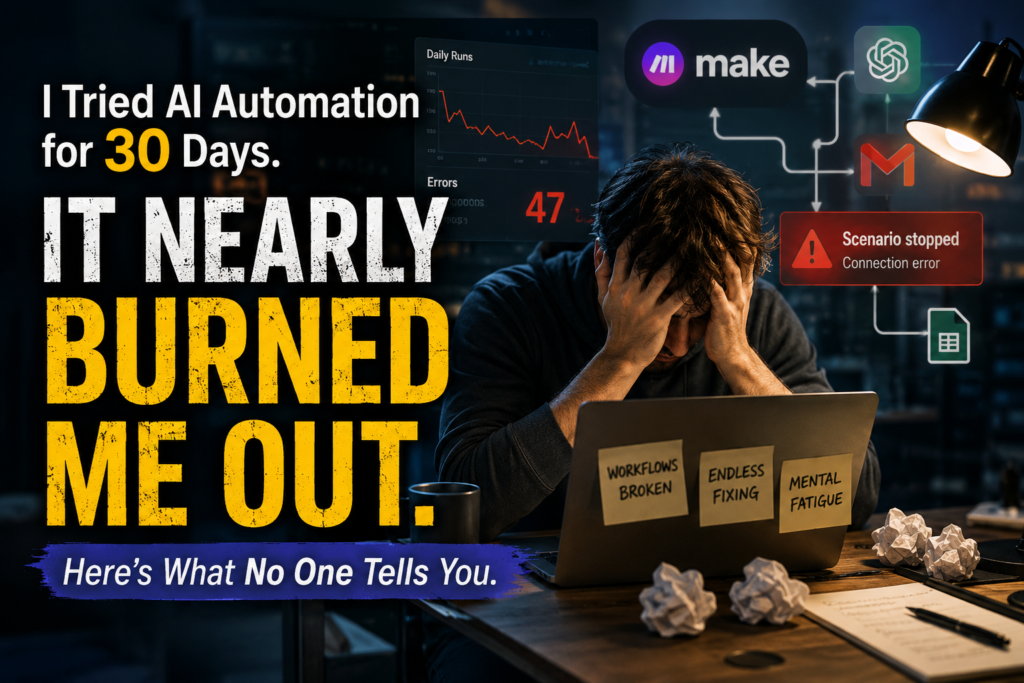
I Tried AI Automation for 30 Days. It Nearly Burned Me Out.
The Hidden Reality Behind ChatGPT Workflows, Make.com Systems, and “Passive Productivity”
Three weeks into my AI automation experiment, I found myself staring at a broken Make.com scenario at 1:12 AM.
Again.
The automation that was supposed to “save time” had stopped pushing tasks into my calendar because one field format changed inside a Google Sheet.
Nothing dramatic happened.
No big error message.
The workflow simply failed quietly in the background while my schedule slowly became chaos.
That moment changed how I see AI productivity forever.
Because almost every AI automation tutorial online shows the exciting part:
building workflows
connecting tools
generating content
automating tasks
But almost nobody talks about what happens after the video ends.
And honestly?
That’s where the real story begins.
Why AI Automation Looks Easy Online
If you spend enough time on YouTube, AI automation starts to feel like a cheat code for life.
You’ll see titles like:
“Build a Fully Automated Business in 20 Minutes”
“Replace Your Job With AI Agents”
“Make Money While You Sleep With ChatGPT”
I watched those videos too.
And to be fair, some of them are technically correct.
The workflows can work.
At least temporarily.
But there’s a huge difference between:
a clean demo environment and
a messy real human life.
That gap is where most automation systems quietly fail.
My AI Productivity Experiment
About a month ago, I decided to automate as much of my workflow as possible.
I connected:
ChatGPT
Make.com
AI scheduling tools
automated summaries
task prioritization systems
email automations
At first, it felt amazing.
The first few days gave me a weird sense of control.
Everything looked optimized.
My dashboard was clean. Tasks were moving automatically. Notifications were firing perfectly. AI-generated schedules appeared every morning.
It felt like I had finally become one of those hyper-productive people online.
Then week two arrived.
The First Hidden Problem: Automation Creates Maintenance Work
Nobody mentions this part enough.
Automation is not “set and forget.”
It’s closer to owning a machine.
Machines require maintenance.
And AI workflows break constantly.
One API changes. One login expires. One prompt output format shifts. One app updates its integration.
Suddenly the entire system starts acting strangely.
During the second week, I spent nearly four hours fixing automations that were originally designed to save me time.
That irony hit me hard.
I realized: I wasn’t removing work.
I was replacing visible work with invisible maintenance.
AI Workflows Fail Quietly — And That’s Dangerous
This was probably the most stressful part.
When humans fail, it’s obvious.
When AI systems fail, they often fail silently.
One morning, my AI scheduling workflow reorganized my tasks based on incomplete context from the previous day.
The result looked organized.
But it was completely wrong.
Important work got pushed down. Low-priority tasks moved up. Deadlines became messy.
The scary part?
I almost trusted it automatically because the output looked professional.
Researchers at Stanford’s Human-Centered AI Institute have warned about this exact issue: humans tend to overtrust confident AI-generated systems, especially in repetitive workflows.
After experiencing it myself, I finally understood what they meant.
The Productivity Trap Nobody Talks About
At some point, I noticed something strange.
I was becoming obsessed with optimizing my system instead of doing meaningful work.
Every day became:
tweaking prompts
adjusting workflows
fixing integrations
reorganizing automations
comparing AI tools
Ironically, my productivity system itself became the biggest distraction.
This reminded me of something Cal Newport once wrote in Deep Work:
“Clarity about what matters provides clarity about what does not.”
That sentence stayed in my head for days.
Because most AI automation systems create the illusion of progress.
You feel productive because:
dashboards move
workflows trigger
notifications appear
But mentally, you still feel exhausted.
Sometimes even worse.
By Week Three, I Felt Mentally Detached From My Own Life
This was unexpected.
The more decisions I automated, the stranger my brain started feeling.
At first, I loved having AI:
prioritize my tasks
structure my day
suggest schedules
summarize information
But eventually I stopped thinking critically about my own workflow.
I was following AI-generated plans almost automatically.
That scared me a little.
Nicholas Carr discussed something similar in The Shallows: the more cognitive labor we outsource to systems, the weaker our deep engagement can become.
I didn’t fully believe that idea before.
Now I do.
AI Automation Also Creates “Invisible Stress”
This is the part almost nobody discusses online.
Automation reduces small frictions.
But it often increases background mental load.
Because somewhere in your brain, you know:
workflows might fail
summaries may be inaccurate
tasks could disappear
schedules may become distorted
So even when the system appears automated, part of your attention remains trapped in monitoring mode.
I started checking my automations constantly.
Not because I wanted to.
Because I stopped trusting them completely.
That constant low-level vigilance became exhausting.
The Biggest Lie About AI Productivity
The internet keeps selling this fantasy:
“Completely automate your life.”
But honestly?
Most healthy systems should probably remain partially human.
The automations that genuinely helped me were surprisingly simple:
summarizing repetitive information
reducing copy-paste work
organizing rough notes
handling repetitive low-risk tasks
That’s it.
The complicated “AI second brain” systems looked impressive online but became fragile very quickly in real life.
The Simpler My System Became, The Better I Felt
Around day 24, I deleted most of my workflows.
Not dramatically.
Just quietly.
I removed:
unnecessary automations
overlapping notifications
AI scheduling loops
productivity dashboards
And almost immediately, my brain felt calmer.
That surprised me more than anything else.
Because I realized the problem was never laziness.
The problem was cognitive overload disguised as optimization.
Why Experience Matters More Than AI Advice Now
In 2026, the internet is full of AI-generated productivity content.
Most of it sounds polished. Most of it sounds smart.
But very little of it feels human.
That’s why readers increasingly search for:
real experiments
honest failures
burnout stories
emotional reality
firsthand experience
Not perfect answers.
Google’s E-E-A-T system increasingly rewards experience-based content for exactly this reason.
Because real humans notice details AI cannot genuinely feel:
frustration
exhaustion
confusion
mental fatigue
emotional resistance
Those details matter.
Especially in productivity.
So… Is AI Automation Worth It?
Yes.
But probably not in the way social media promises.
AI automation works best when it supports your thinking — not replaces it.
The systems that survived in my life were:
simple
flexible
low-maintenance
easy to understand
easy to fix
Not the flashy systems designed for thumbnails and YouTube views.
That distinction matters more than people realize.
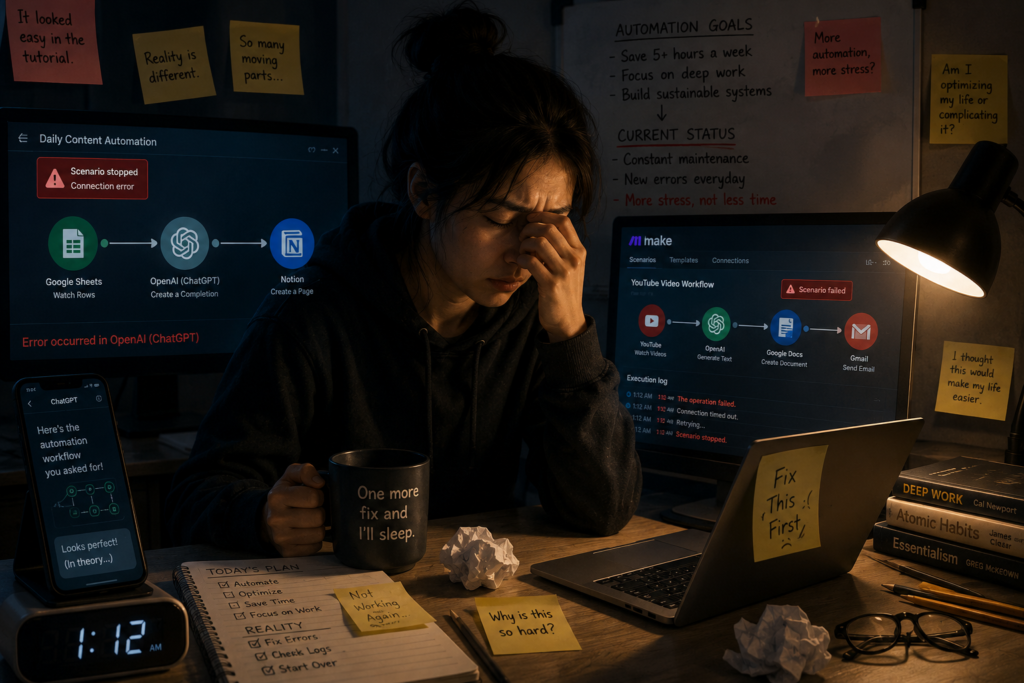
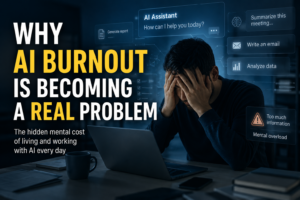
This image captures the hidden reality behind AI automation and productivity systems. After trying to automate daily work using tools like ChatGPT, Make.com, Notion, and workflow integrations, the creator becomes mentally exhausted from constant errors, broken automations, endless maintenance, and digital overload. Sticky notes, failed scenarios, and late-night troubleshooting reflect a real experience many people quietly face: AI automation often promises simplicity, but in real life it can create stress, burnout, and cognitive fatigue instead of saving time.
Final Thoughts
I started this experiment believing automation would remove stress from my life.
Instead, it taught me something uncomfortable:
Sometimes the obsession with optimization becomes the new source of exhaustion.
And honestly?
The most productive change I made wasn’t adding more AI.
It was learning where AI should stop.
AI AUTOMATION & DIGITAL BURNOUT
Recommended Reading
Explore more articles about AI productivity, automation fatigue, attention overload, digital burnout, and how modern systems quietly affect human behavior.
Stanford Human-Centered AI Institute
— Research on AI reliability, human trust in automated systems, and the psychological impact of artificial intelligence.
Microsoft Work Trend Index
— Research reports on workplace productivity, AI adoption, burnout, and digital overload in modern work environments.
Cal Newport — Deep Work
— Insights on focus, distraction, cognitive overload, and why excessive productivity systems often backfire.
Make.com Help Center
— Official troubleshooting resources for AI workflow automation, integrations, and no-code productivity systems.