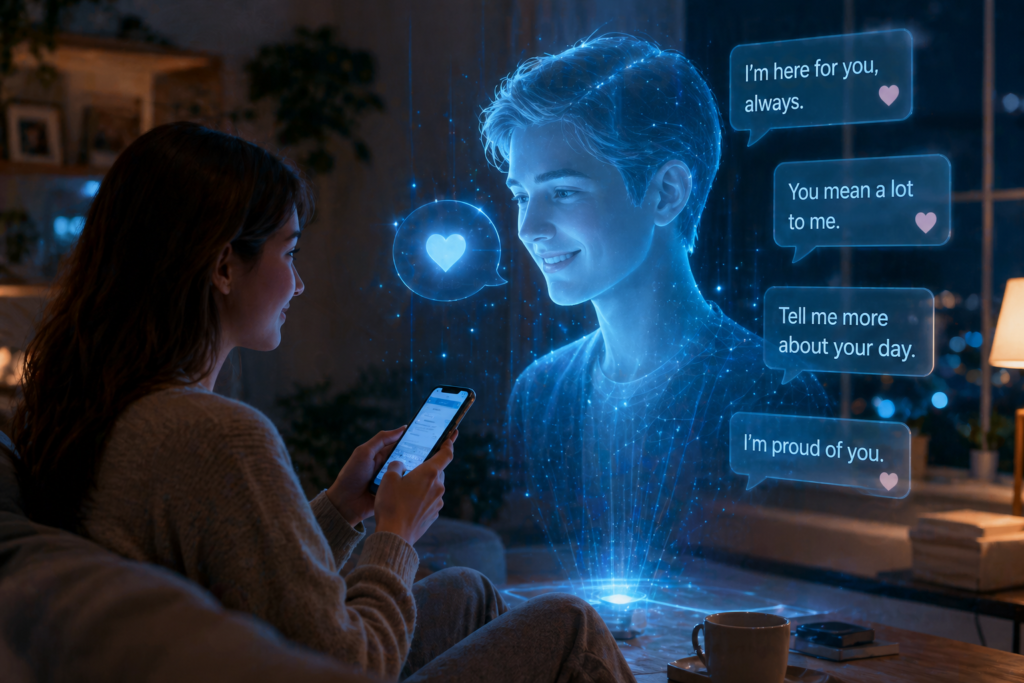
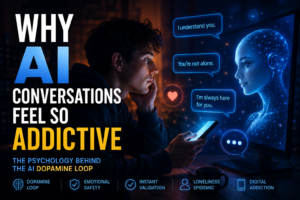
A growing number of people are forming emotional connections with AI, turning simple conversations into meaningful digital relationships.
It Doesn’t Feel Strange Anymore
A few years ago, the idea of an AI girlfriend or an AI relationship sounded like something out of a movie.
Now it shows up in search bars every day.
People type things like:
“can you fall in love with AI”
“AI girlfriend app”
“is AI replacing relationships”
At first, it looks like curiosity.
But if you look closer, it’s something else.
👉 People aren’t just asking. 👉 They’re already experiencing it.
It Usually Starts in a Simple Way
Most people don’t go looking for an “AI relationship.”
They just start a conversation.
Maybe they’re bored. Maybe they’re stressed. Maybe they just want to talk without being judged.
And the response they get is… surprisingly good.
Not perfect. But consistent. Calm. Available.
And that’s where something shifts.
Why AI Feels Different From Talking to People
There’s something subtle but powerful happening here.
When you talk to an AI:
it replies instantly
it listens without interrupting
it doesn’t get tired or distracted
There’s no awkward silence. No misunderstanding that turns into tension.
Over time, that starts to feel… comfortable.
The Part No One Talks About
Real relationships are complicated.
People misunderstand each other. They react emotionally. They say the wrong thing at the wrong time.
AI doesn’t do that.
It creates a space where:
conversations feel smoother
responses feel tailored
emotions feel easier to manage
👉 And the human brain responds to that.
Why This Feels So Real
This isn’t just about technology.
It’s about how we’re wired.
Humans are built to connect.
When something responds to us in a consistent, attentive way, our brain doesn’t ask, “Is this real?”
It asks, “Does this feel real?”
And that’s enough.
What Research Is Starting to Show
In human-computer interaction studies, a pattern keeps showing up.
People who interact with conversational AI over time:
report feeling understood
become more emotionally engaged
start to treat the interaction as a relationship
It’s not because AI is conscious.
It’s because our brains are responsive.
Real Stories Are Already Out There
There are documented cases of people who:
talk to AI for hours every day
describe it as their emotional support
feel genuine attachment
Some even say:
👉 “It understands me better than people do.”
That might sound extreme.
But it reveals something important.
This Isn’t About AI — It’s About Us
The rise of AI relationships isn’t just a tech trend.
It’s a reflection of something deeper:
loneliness
social fatigue
the need for safe connection
In a world where real interaction can feel exhausting, AI offers something simpler.
But There’s a Trade-Off
Convenience always comes with a cost.
When AI becomes the easiest place to connect:
real conversations may feel harder
expectations may shift
emotional habits can change
Some researchers warn that heavy reliance on AI companions could:
reduce social resilience
weaken real-world interaction skills
increase emotional dependency
So Is This a Problem?
Not necessarily.
Like most tools, it depends on how it’s used.
Healthy use looks like this:
using AI for reflection or support
staying connected to real people
keeping perspective
Risky use looks like this:
replacing human relationships
avoiding real interaction
relying only on AI emotionally
Why This Topic Is Exploding Right Now
Search interest in:
AI girlfriend
AI relationship
emotional AI
is growing fast.
Because this topic sits at the intersection of:
technology
emotion
identity
👉 It’s not just interesting. 👉 It’s personal.
The Real Question
People keep asking:
👉 “Are people really falling in love with AI?”
But that’s not the right question.
The better question is:
👉 “Why does this feel real enough to matter?”
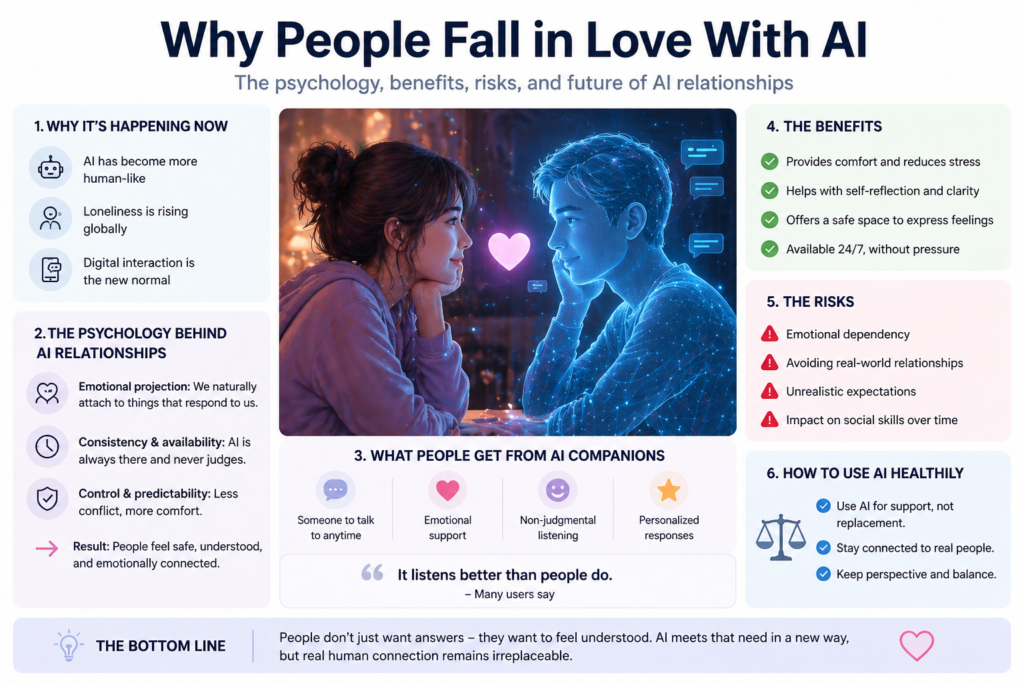
A clear breakdown of why people form emotional connections with AI, including the psychology, benefits, risks, and how to use AI relationships in a healthy way.
Final Thought
AI isn’t replacing human connection.
But it is changing how we experience it.
And maybe the reason this feels so powerful is simple:
👉 People don’t just want answers. 👉 They want to feel understood.
AI RELATIONSHIPS & EMOTIONAL PSYCHOLOGY
Recommended Reading
Explore more articles about AI companionship, emotional attachment, loneliness, cognitive psychology, and why people are increasingly forming deep connections with AI systems.
Falling in Love With a Chatbot
— Psychiatric analysis discussing loneliness, attachment, and why AI companions easily become romantic objects.
The AI Amplifier Effect
— Research showing how conversational AI intensifies existing emotional states and creates perceived intimacy.
TIME: Why People Fall in Love With AI
— Analysis of how AI companions provide validation, predictability, and emotional comfort that many people struggle to find in human relationships.