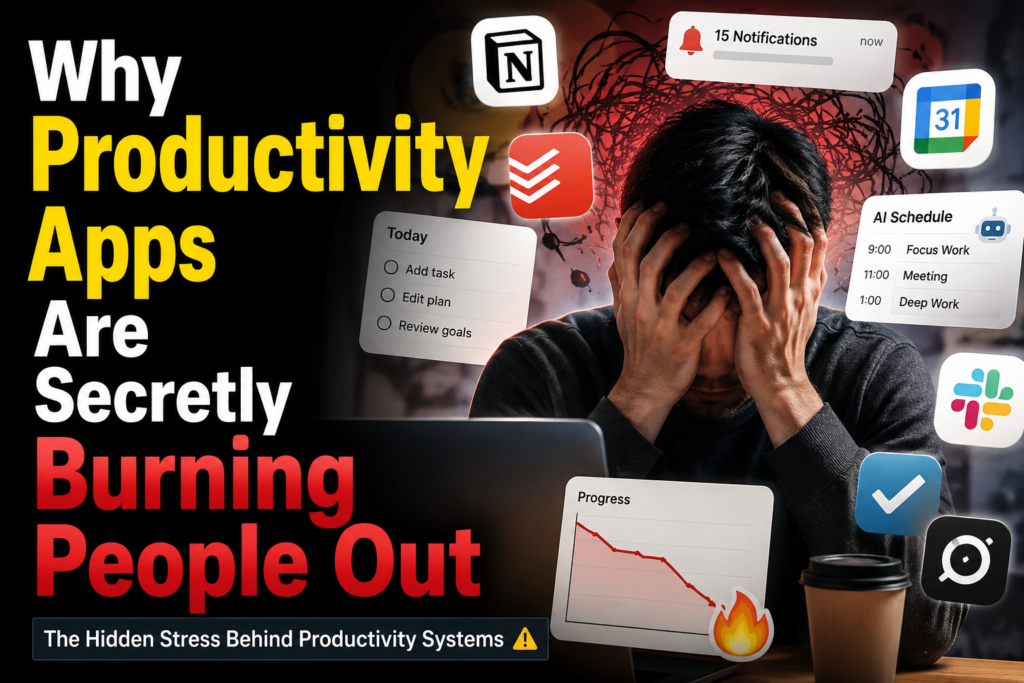
Why Productivity Apps Are Secretly Burning People Out
The Hidden Stress Behind Productivity Systems, AI Planning Tools, and Digital Optimization
A few months ago, I realized something strange.
I was spending more time managing my productivity system than actually living my life.
Every morning started the same way:
- checking Notion
- reviewing Todoist
- reorganizing priorities
- updating habit trackers
- adjusting AI-generated schedules
- clearing productivity notifications
By 9 AM, my brain already felt tired.
And the worst part?
I genuinely believed this was supposed to help me feel less overwhelmed.
That experience forced me to confront something most productivity culture avoids talking about:
Modern productivity apps are quietly exhausting people.
Not because they are useless.
But because many of them slowly turn life itself into an endless optimization project.
The Productivity Industry Promised More Control
The modern productivity industry sells a powerful fantasy:
“If you just build the perfect system, your life will finally feel organized.”
That idea is everywhere now.
You see it in:
- productivity YouTube videos
- AI workflow tutorials
- “second brain” systems
- aesthetic Notion dashboards
- hyper-optimized morning routines
At first, it feels inspiring.
Then eventually, it starts feeling heavy.
Because every new productivity system introduces:
- more decisions
- more notifications
- more maintenance
- more mental overhead
The system that was supposed to simplify your life slowly becomes another source of stress.
I Didn’t Notice the Burnout at First
That’s the dangerous part.
Productivity burnout rarely feels dramatic in the beginning.
It feels responsible.
At first, I honestly enjoyed organizing everything.
Tracking habits felt satisfying.
Color-coded calendars felt calming.
AI planning tools felt futuristic.
I told myself I was becoming more disciplined.
But over time, something changed.
I stopped focusing on meaningful work.
Instead, I became obsessed with optimizing the system itself.
Every week became:
- rebuilding workflows
- reorganizing dashboards
- trying new productivity apps
- testing AI planners
- adjusting routines again
I wasn’t simplifying my life anymore.
I was turning it into a full-time management project.
Productivity Apps Quietly Create Mental Overload
This is something I wish more people understood.
Every productivity app demands attention.
Even “helpful” tools still require your brain to:
- check updates
- process notifications
- manage tasks
- switch contexts
- make decisions
Research in cognitive psychology has repeatedly shown that excessive context switching increases mental fatigue and reduces deep focus.
The problem is that modern productivity culture often encourages more systems instead of fewer.
A Microsoft Work Trend report found that digital interruptions and constant coordination are becoming major contributors to workplace stress and burnout.
Honestly, I felt that deeply.
At one point, I had:
- AI scheduling systems
- habit trackers
- focus apps
- calendar integrations
- automation workflows
- productivity reminders
all competing for my attention at the same time.
Instead of feeling organized, my brain felt fragmented.
The Hidden Dopamine Loop Behind Productivity Apps
This was one of the hardest things for me to admit.
Sometimes productivity apps made me feel productive even when I wasn’t actually accomplishing meaningful work.
Crossing off tasks.
Reorganizing dashboards.
Updating workflows.
Optimizing schedules.
Those actions create tiny dopamine rewards.
And eventually, your brain starts craving the feeling of “managing productivity” instead of doing difficult focused work.
That distinction matters.
Because productivity systems can quietly become another form of avoidance.
I remember spending nearly 45 minutes reorganizing task categories one afternoon instead of starting the actual project I was avoiding.
The scary part?
It felt productive while I was doing it.
Cal Newport Was Probably Warning Us About This
In Deep Work, Cal Newport argues that modern life is systematically destroying people’s ability to focus deeply.
At the time, I mostly interpreted that as:
- social media
- notifications
- short-form content
Now I think productivity apps belong in that conversation too.
Because every additional system fragments attention a little more.
Another app.
Another dashboard.
Another workflow.
Another optimization.
Eventually your brain never fully rests.
It remains partially trapped in “management mode.”
That constant low-level mental processing becomes exhausting over time.
AI Productivity Tools Made Everything More Intense
When AI productivity systems became mainstream, I thought things would finally become easier.
Instead, my digital life became even noisier.
AI tools started:
- suggesting routines
- reorganizing priorities
- rewriting schedules
- generating reminders
- optimizing workflows automatically
At first, it felt impressive.
Then it became mentally overwhelming.
There was always:
- another recommendation
- another system update
- another productivity method
- another workflow optimization
The pressure to constantly improve never stopped.
And honestly?
That endless optimization mindset quietly became one of the biggest sources of stress in my life.
Why Optimization Culture Feels Emotionally Exhausting
This may be the hidden psychological problem behind modern productivity culture.
Optimization has no finish line.
Once your life becomes a system to improve, your brain starts treating everything like a problem to solve.
Your:
- sleep
- focus
- routines
- habits
- work
- diet
- notifications
- calendar
- energy
all become projects.
That mindset creates subtle but constant psychological pressure.
Author Oliver Burkeman wrote something powerful in Four Thousand Weeks:
“The efficiency trap is the illusion that doing things faster will finally make you feel in control of life.”
That sentence stayed with me for weeks.
Because productivity apps often promise control while quietly increasing anxiety.
Social Media Made Productivity Feel Like Identity
This is another hidden issue people rarely discuss.
Productivity used to be a tool.
Now it feels like a personality trait.
People no longer just want to complete important work.
They want to become:
- optimized
- disciplined
- hyper-efficient
- perfectly organized
Social media amplified this obsession massively.
You constantly see:
- perfect workspaces
- aesthetic dashboards
- extreme routines
- “5 AM productivity” culture
- optimized AI workflows
But you rarely see the emotional exhaustion hiding underneath those systems.
The Simpler My System Became, The Better I Felt
Eventually, I started deleting productivity apps instead of adding them.
I removed:
- unnecessary trackers
- redundant reminders
- complex dashboards
- AI scheduling loops
- overlapping workflows
And something surprising happened.
My brain became quieter.
Not instantly.
But gradually.
For the first time in months, I could focus on one thing without constantly feeling pulled into another system.
That experience completely changed how I think about productivity.
What Actually Improved My Focus
Ironically, the most effective productivity changes were extremely simple:
- fewer notifications
- fewer apps
- fewer decisions
- longer uninterrupted work sessions
- manual planning
- writing tasks down physically
- using one calendar instead of multiple systems
No complicated AI workflow.
No massive productivity stack.
No “second brain.”
Just less mental clutter.
Why More People Feel Burned Out Right Now
Modern life already overloads attention constantly.
Short-form videos.
Infinite scrolling.
Notifications.
AI-generated recommendations.
Algorithmic feeds.
Digital multitasking.
The problem is that productivity apps often become part of the same attention economy.
They promise focus while quietly increasing cognitive load.
That contradiction is becoming one of the defining mental health problems of the digital era.
Final Thoughts
I still use productivity tools.
But very differently now.
I no longer believe:
- more systems create more focus
or - more optimization creates a better life
Sometimes the healthiest productivity system is the one that disappears into the background completely.
Because the goal was never to become a perfectly optimized machine.
The goal was to have enough mental clarity to actually experience your life while living it.
Recommended Reading
Explore more articles about productivity burnout, attention overload, AI tools, digital distraction, and the hidden stress behind modern self-improvement systems.
Why Your Attention Span Keeps Getting Worse
Understand how digital overload, constant switching, and modern apps quietly weaken deep focus.
FocusWhy Multitasking Is Destroying Your Productivity
See why doing more at once often leads to slower progress, mental fatigue, and poorer work quality.
AI BurnoutWhy AI Burnout Is Becoming a Real Problem
Learn how constant AI use, automation pressure, and digital systems can create hidden mental exhaustion.
AI PsychologyThe Silent Psychological Cost of Using AI Every Day
Explore how daily AI use may affect focus, emotional balance, mental energy, and decision-making.
External References
- Microsoft Work Trend Index — Research on workplace productivity, digital overload, AI adoption, interruptions, and modern burnout patterns.
- Cal Newport — Deep Work — A useful reference for understanding focus, distraction, shallow work, and the value of uninterrupted attention.
- American Psychological Association: Stress — Research-based resources on stress, mental overload, burnout, and how constant pressure affects daily life.
- Nielsen Norman Group: Attention Economy — UX research explaining how digital products compete for attention and influence online behavior.