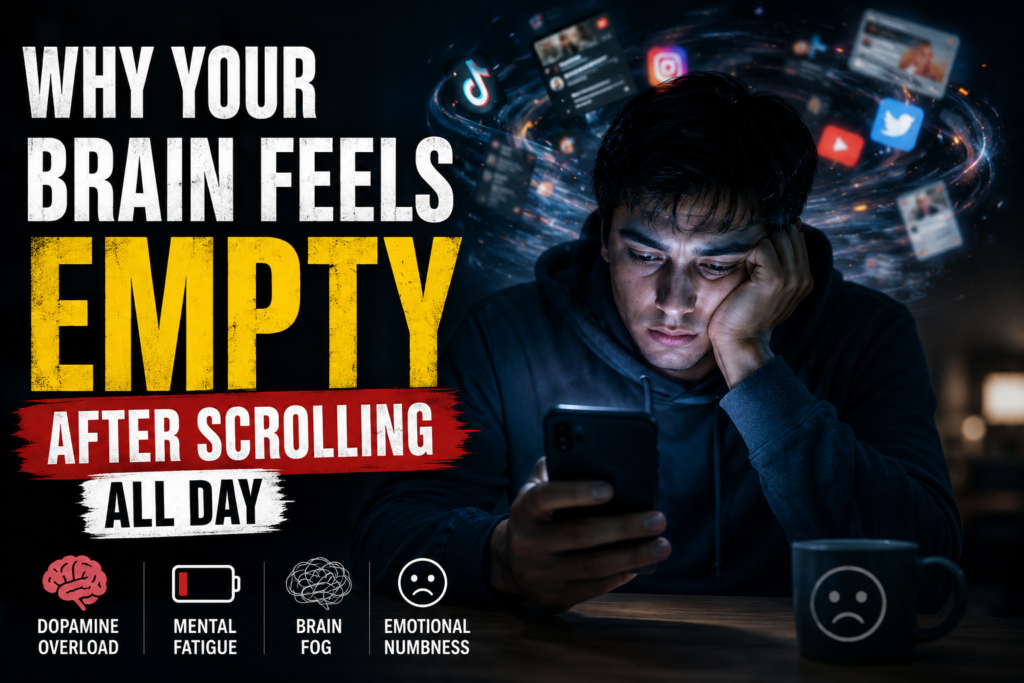
Endless scrolling can overload your brain, reduce focus, and leave you emotionally drained without realizing it.
Why Your Brain Feels Empty After Scrolling All Day
You close the app.
The videos stop. The scrolling ends. The screen goes dark.
But instead of feeling relaxed, your brain feels strangely empty.
Not peaceful. Not rested. Just mentally numb.
A few months ago, I started noticing this feeling almost every night. I would spend “just 10 minutes” scrolling through short videos after work, and suddenly an hour had disappeared. The strange part wasn’t the wasted time. It was the emotional flatness afterward.
My motivation dropped. My thoughts felt slower. Even simple tasks felt mentally heavier.
At first, I thought I was just tired.
But the more I looked into the psychology of doomscrolling, dopamine overload, and digital overstimulation, the more I realized this feeling is becoming incredibly common.
And there’s real science behind it.
Your Brain Was Never Designed for Infinite Scrolling
Modern social media platforms are built around one thing:
Capturing your attention for as long as possible.
Apps like TikTok, Instagram Reels, YouTube Shorts, and endless feeds exploit what psychologists call variable reward systems.
This concept became famous through the work of B. F. Skinner, who discovered that unpredictable rewards create highly compulsive behavior patterns.
Your brain never knows what comes next:
a funny clip
shocking news
emotional story
viral argument
motivational advice
celebrity drama
That uncertainty keeps you scrolling.
The problem is that your brain treats every piece of content as new stimulation.
And eventually, the nervous system becomes overloaded.
Why Scrolling All Day Makes You Feel Emotionally Empty
Most people think scrolling helps them “relax.”
Neurologically, the opposite often happens.
Your attention system becomes fragmented
Research published in journals like Computers in Human Behavior and Nature Communications suggests that constant digital switching weakens sustained attention and increases mental fatigue.
Your brain rapidly jumps between:
outrage
humor
fear
comparison
excitement
advertisements
AI-generated content
negative news
The nervous system never fully recovers.
After enough stimulation, the brain starts emotionally flattening experiences as a defense mechanism.
That hollow feeling after scrolling all day is often a form of attention exhaustion.
Doomscrolling Quietly Changes Your Brain
The term “doomscrolling” became popular during the pandemic, but the behavior never disappeared.
If anything, it became normalized.
People now scroll during:
meals
bathroom breaks
work
conversations
late at night
immediately after waking up
The scary part is that many people no longer notice how overstimulated they’ve become.
In the book Stolen Focus, Johann Hari explains how modern technology is slowly weakening humanity’s ability to sustain deep focus.
One quote from the book spread widely online:
“Your attention didn’t collapse. It was stolen.”
That line resonates because millions of people genuinely feel mentally different now.
Social Media Fatigue Is Becoming a Real Problem
According to mental health researchers and reports discussed by American Psychological Association, excessive social media exposure is increasingly associated with:
anxiety
emotional exhaustion
brain fog
sleep disruption
reduced focus
depressive symptoms
dopamine dependency
This is especially true with short-form content.
Why?
Because short videos create rapid dopamine spikes without giving the brain time to recover.
Over time, ordinary life can begin feeling slower, quieter, and less stimulating by comparison.
That’s one reason many people say they feel emotionally “empty” after scrolling for too long.
The Dangerous Illusion of Digital Rest
Scrolling feels passive.
That’s why people mistake it for recovery.
But passive stimulation can still mentally exhaust the brain.
Especially when the content is:
emotionally intense
highly stimulating
negative
addictive
algorithmically optimized
constantly changing
Your brain continues processing all of it — even when you think you’re “doing nothing.”
That’s why doomscrolling often leaves people feeling mentally drained instead of refreshed.
I Realized My Brain Never Experienced Silence Anymore
One thing that genuinely shocked me was how uncomfortable quiet moments became.
Standing in line? Phone.
Eating alone? Phone.
Before sleeping? Phone.
Immediately after waking up? Phone.
At some point, my brain stopped tolerating stillness.
That realization changed how I viewed attention completely.
When I intentionally reduced short-form content for a few days, I noticed something surprising:
reading became easier
my thoughts felt clearer
conversations felt deeper
time felt slower
my mind felt calmer
Not perfect.
Just less overloaded.
That experience made me realize how much constant stimulation had quietly changed my baseline mental state.
Why Your Brain Feels Numb After Social Media
Psychologists often describe this state as a combination of:
cognitive overload
dopamine fatigue
attention fragmentation
emotional overstimulation
Your brain is constantly consuming information but rarely processing it deeply.
Eventually, everything starts blending together.
That’s why many people report symptoms like:
brain fog
low motivation
emotional numbness
mental exhaustion
inability to focus
feeling disconnected from real life
And unfortunately, endless scrolling trains the brain to crave even more stimulation.
How to Recover From Digital Overstimulation
You do not need to quit the internet.
But your brain likely needs recovery periods.
1. Reduce short-form content first
TikTok-style feeds create some of the strongest dopamine loops online.
2. Reintroduce boredom
Walk without headphones. Sit quietly. Let your mind slow down naturally.
3. Stop scrolling immediately after waking up
Protect your brain before the day begins.
4. Consume slower content
Books, long-form articles, and meaningful conversations rebuild sustained attention.
5. Create screen-free recovery time
Even 20 minutes of silence can help calm the nervous system.
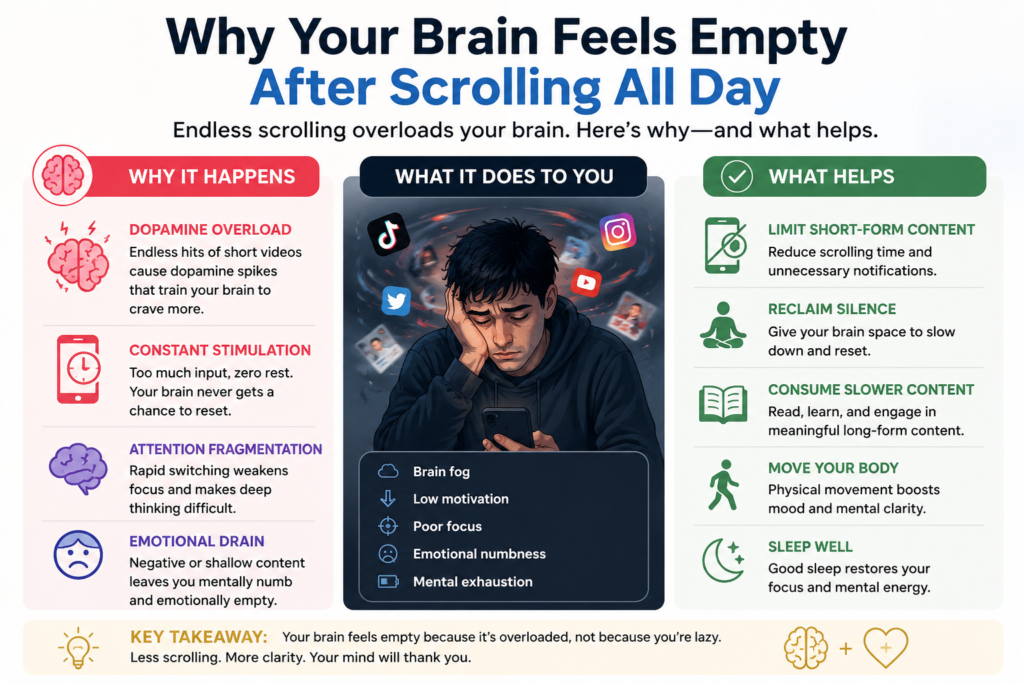
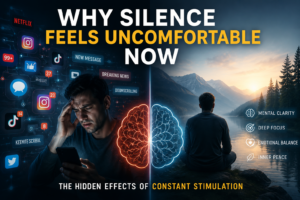
A clean infographic summarizing the psychological effects of endless scrolling, short-form content addiction, dopamine overload, and digital overstimulation. The image explains how social media fatigue contributes to brain fog, poor focus, emotional numbness, and mental exhaustion while offering practical solutions such as reducing screen time, improving sleep, consuming slower content, and creating quiet recovery time for the brain.
Final Thoughts
If your brain feels empty after scrolling all day, you are not lazy or broken.
Your nervous system is reacting to an environment designed to capture and overload your attention.
The real danger of endless scrolling is not just wasted time.
It’s the slow erosion of mental clarity, emotional depth, and the ability to feel present in real life.
The good news is that attention can recover.
But recovery usually begins the moment constant stimulation stops.
READ NEXT
Related Posts
Keep reading about doomscrolling, dopamine overload, focus problems, and digital fatigue.