Why Underdog Stories Affect Human Emotions So Deeply
The Hidden Psychology Behind Why We Always Root for the Underdog
People often think underdog stories are just “sports entertainment.”
But psychologically, they trigger something much deeper.
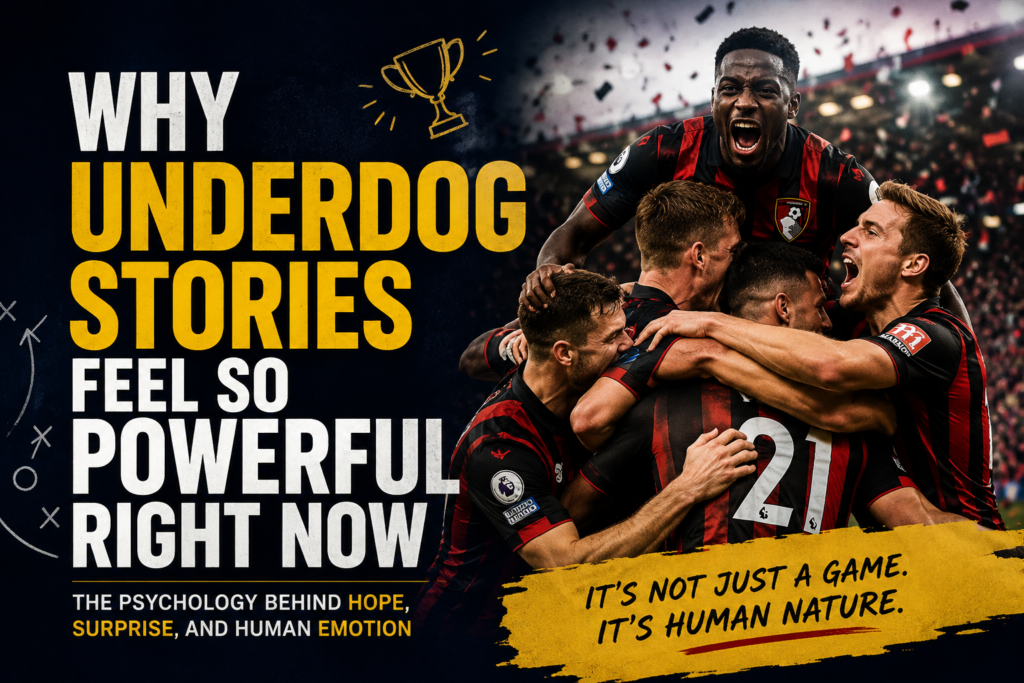
That’s why millions of people who normally don’t even watch football suddenly become emotionally invested when a smaller Premier League club defeats a giant team.
It’s not only about winning.
It’s about identity, hope, emotional survival, and the human need to believe that effort still matters.
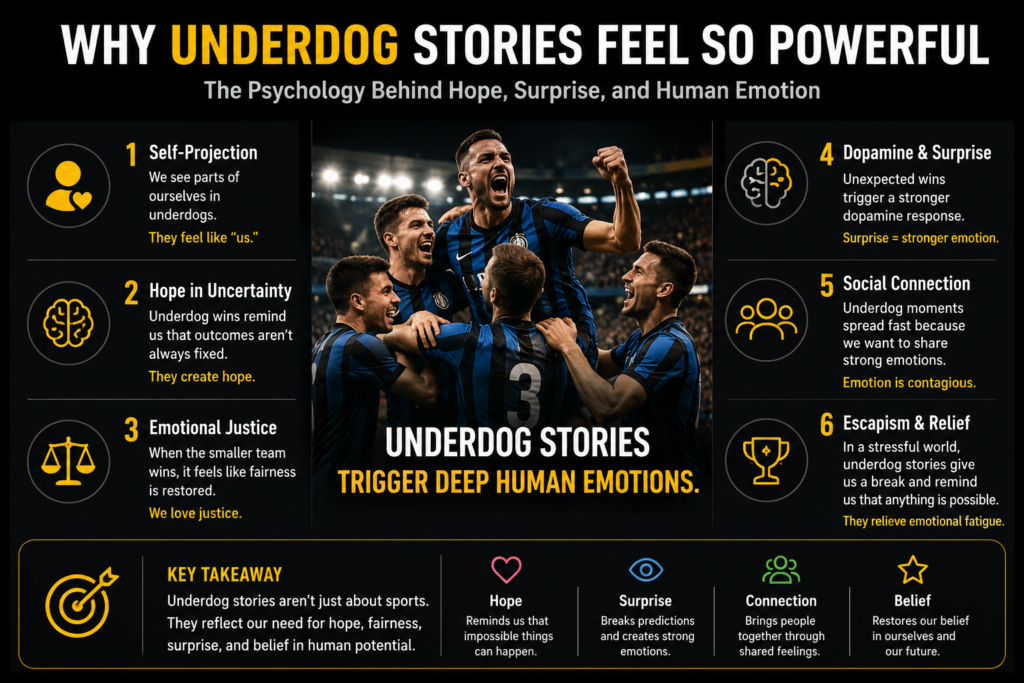
One of the strongest psychological effects behind underdog stories is called self-projection.
People unconsciously see parts of themselves in underdogs.
Think about modern life for a moment:
rising living costs
burnout
unstable careers
competition everywhere
AI replacing skills
social comparison through social media
Many people quietly feel overwhelmed.
Even if they never say it out loud.
So when they watch a smaller team fighting against overwhelming odds, something emotional happens internally:
“That feels like me.”
The underdog becomes symbolic.
Not just in football — but in life itself.
Why Dominant Teams Often Feel Emotionally Distant
Interestingly, psychologists found that people tend to emotionally disconnect from groups perceived as “too powerful.”
Why?
Because humans naturally empathize more with struggle than dominance.
A billionaire succeeding again doesn’t create much emotional tension.
But someone disadvantaged overcoming impossible odds creates emotional uncertainty.
And uncertainty is what captures attention.
That’s why underdog stories feel dramatically more emotional than predictable victories.
The Brain Loves Uncertainty More Than Certainty
Neuroscience explains this even further.
Research on dopamine systems suggests that unexpected rewards create stronger emotional reactions than guaranteed outcomes.
This is called reward prediction error.
In simple terms:
When something surprising happens, the brain releases a stronger emotional signal.
That’s why:
last-minute goals
shocking comebacks
upset victories
feel unforgettable.
Your brain becomes hyper-engaged because the outcome violated expectations.
Underdogs Trigger Hope in a Cynical Era
Modern society has become deeply optimized.
Algorithms predict behavior. Corporations dominate markets. Social media rewards status and influence.
Over time, people start feeling like outcomes are already predetermined.
That creates emotional fatigue.
Underdog stories interrupt that feeling.
They temporarily restore the idea that:
effort matters
unpredictability exists
systems are not completely closed
Psychologically, this creates relief.
Even if only for a moment.
Why Premier League Underdog Stories Spread So Fast Online
There’s also a social reason.
Underdog victories are emotionally “shareable.”
People don’t usually send friends clips of expected outcomes.
But shocking moments? They spread instantly.
Why?
Because emotionally surprising events activate stronger memory encoding.
People want others to experience the same emotional shock they just felt.
That’s why:
upset victories
emotional celebrations
impossible comeback moments
spread explosively across TikTok, YouTube, Reddit, and X.
The “Emotional Justice” Effect
Another powerful factor is fairness psychology.
Humans strongly dislike situations that feel unfairly imbalanced.
When a smaller club defeats a financially dominant giant, people subconsciously experience a form of emotional justice.
Even neutral viewers may feel satisfied because:
power was challenged
hierarchy was disrupted
imbalance temporarily collapsed
This emotional reaction becomes even stronger during periods of economic inequality.
Which is exactly why underdog narratives feel unusually powerful right now.
Why Young Generations Especially Love Underdog Stories
Younger audiences today often feel:
economically delayed
mentally exhausted
uncertain about the future
Many feel they are competing against systems larger than themselves.
That’s why underdog narratives resonate strongly with Gen Z and Millennials.
The emotional connection is not really about football.
It’s about survival in modern society.
The underdog becomes a psychological mirror.
My Own Realization Watching Premier League Matches
A while ago, I noticed something strange while watching football highlights.
I barely reacted when dominant clubs won exactly as expected.
But when a smaller club shocked everyone, I instantly became emotionally invested.
Even when I had no connection to the team.
That reaction surprised me.
Because I realized I wasn’t watching for technical perfection anymore.
I was watching for emotional unpredictability.
I wanted proof that impossible things could still happen.
And honestly, I think many people feel the same way right now.
Why Underdog Stories Matter More Than Ever
Underdog stories are not just sports narratives.
They are emotional resistance against a world that increasingly feels:
automated
optimized
unequal
emotionally exhausting
That’s why these stories continue spreading far beyond football.
They remind people of something psychologically important:
Outcomes are not always fixed.
And sometimes, people need that reminder more than they realize.
Read Next: Related Articles on Solveyourday
If you want to understand why underdog stories feel so emotional, these related articles explain the same psychology behind attention, motivation, burnout, and modern mental fatigue.