The hidden psychology behind why Costco feels emotionally comforting during uncertain economic times.
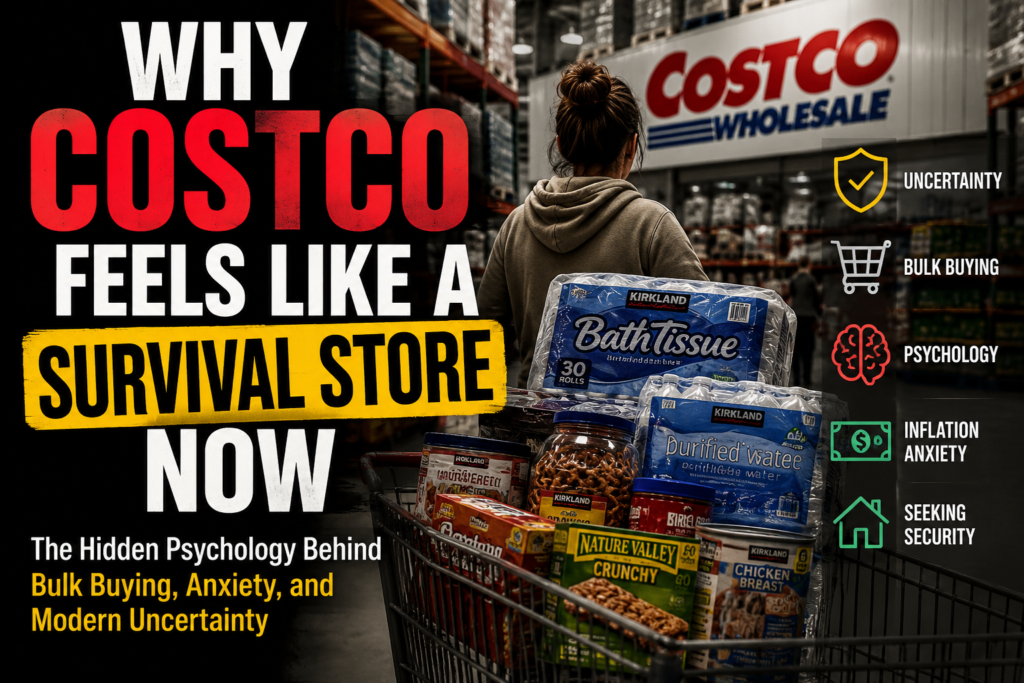
Why Costco Feels Like a Survival Store Now
The Hidden Psychology Behind Bulk Buying, Anxiety, and Modern Uncertainty
A few years ago, Costco mostly felt like a place people visited to save money.
Now it feels different.
Walk into a Costco in 2026 and you’ll notice something strange almost immediately:
People are not shopping casually anymore.
They’re buying giant packs of water, oversized food containers, emergency supplies, bulk paper products, frozen meals, vitamins, batteries, and household essentials like they’re preparing for something bigger than a normal week.
And honestly, many people are.
Not necessarily for a disaster.
But for uncertainty.
That’s why Costco no longer feels like just a warehouse store.
For many people, it feels psychologically closer to a “survival store.”
Why Costco Feels Emotionally Different Right Now
The shift is not just economic.
It’s emotional.
Modern consumers increasingly live under constant low-level stress:
inflation anxiety
rising living costs
job insecurity
AI replacing jobs
political instability
housing pressure
social exhaustion
Even people with stable incomes often feel psychologically uncertain about the future.
And when humans feel uncertainty, they naturally seek control.
Psychologists sometimes call this compensatory control behavior — people try to restore emotional stability by creating environments that feel predictable and safe.
Bulk buying creates exactly that feeling.
The Psychology Behind Bulk Buying
Research during multiple global crises — including the COVID-19 pandemic — showed that consumers often purchase large quantities of essential goods when they experience uncertainty or loss of control.
Interestingly, studies found that people weren’t only reacting to actual shortages.
They were reacting to the fear of instability.
That distinction matters.
Because even after supply chains improved, the emotional behavior remained.
People still buy in bulk because preparedness itself feels emotionally comforting.
A fully stocked pantry creates psychological relief.
Costco Sells More Than Products — It Sells Reassurance
This is where Costco becomes fascinating from a behavioral psychology perspective.
Most retailers sell convenience.
Costco sells emotional security.
The massive carts. The oversized packaging. The industrial shelves. The warehouse atmosphere.
All of it subtly communicates abundance and preparedness.
And in uncertain times, abundance feels calming.
A behavioral economics professor once described stockpiling behavior as:
“The emotional illusion of future stability.”
That line explains Costco perfectly.
Why Younger Generations Are Drawn to Costco
This trend becomes even more noticeable among Millennials and Gen Z.
Many younger adults grew up during:
economic recessions
student debt crises
pandemic disruptions
inflation spikes
AI-related career anxiety
As a result, financial uncertainty became psychologically normalized.
That changes shopping behavior.
People no longer only ask:
“What do I need today?”
They ask:
“What will make me feel safer tomorrow?”
That emotional shift is one reason Costco content has exploded across TikTok, Reddit, and YouTube recently.
People are not just showing products.
They’re showing emotional preparedness.
Why Costco Shopping Feels Weirdly Satisfying
There’s also a dopamine component.
Neuroscience research repeatedly suggests that the human brain responds positively to signals of preparedness and resource accumulation.
Modern brains still react to those signals emotionally.
That’s why buying 40 bottles of water can create a strangely satisfying feeling — even if you realistically don’t need them immediately.
The brain interprets preparedness as safety.
And safety reduces stress.
“The Costco Effect” and Modern Anxiety
I noticed this personally a few months ago.
I walked into Costco planning to buy coffee and paper towels.
Two hours later, I somehow had:
frozen food
vitamins
bulk snacks
emergency batteries
giant containers of rice
Driving home, I realized something strange:
I didn’t actually buy those things because I urgently needed them.
I bought them because they made me feel more prepared for life.
That feeling surprised me.
Because I think many people today quietly feel emotionally unprepared for the future.
Costco temporarily relieves that feeling.
Why Costco Became a Cultural Symbol
Costco is no longer just a retailer.
It has become a symbol of modern survival psychology.
That’s why people online joke about:
“Costco runs”
emotional support rotisserie chickens
bulk-buy therapy
apocalypse shopping
The humor works because there’s truth behind it.
People are emotionally exhausted.
And oddly enough, warehouse shopping creates temporary emotional stability.
The Rise of “Preparedness Culture”
Books like The Psychology of Money by Morgan Housel discuss how financial behavior is often emotional before it is logical.
That idea connects directly to Costco culture today.
People increasingly prioritize:
stability
preparedness
resilience
long-term security
over short-term luxury.
That’s why bulk buying no longer feels irrational to many consumers.
It feels responsible.
Even comforting.
Why This Trend Will Probably Continue
As AI disruption, economic pressure, and digital fatigue continue increasing, people will likely continue searching for environments that feel physically real, abundant, and stable.
Costco offers all three.
Ironically, in a world increasingly dominated by digital experiences, algorithms, subscriptions, and uncertainty, giant shelves full of physical products feel psychologically grounding.
That may be the real reason Costco feels so different right now.
Not because people suddenly love bulk paper towels.
But because modern life increasingly makes people crave reassurance.
Final Thoughts
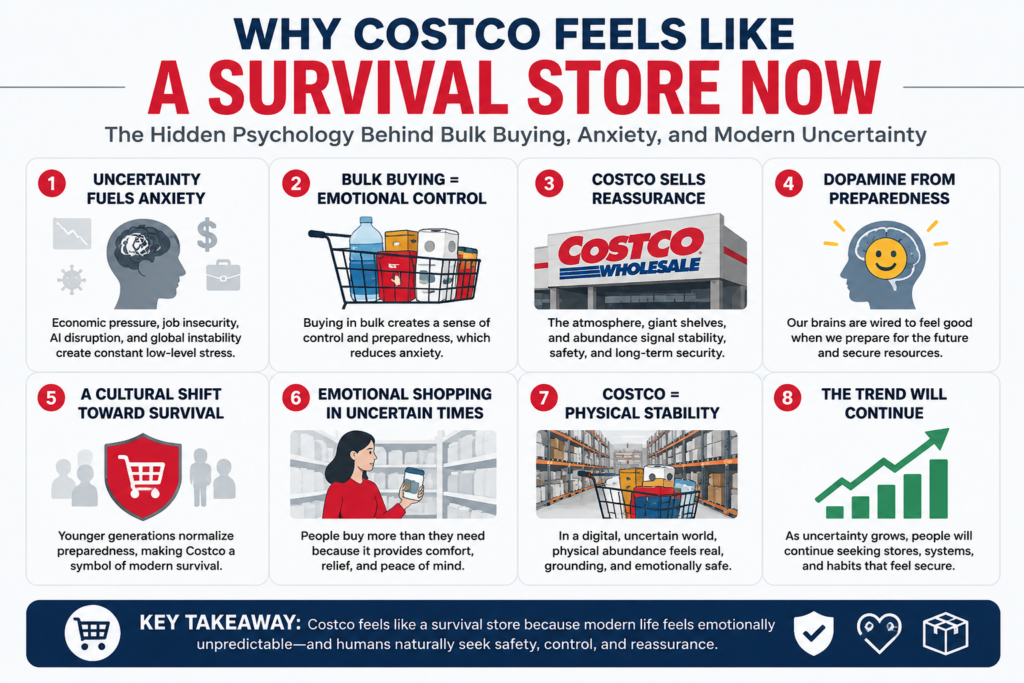
Costco feels like a survival store because modern life increasingly feels emotionally unpredictable.
And when people feel uncertain, they instinctively seek signals of safety, stability, and preparedness.
Sometimes that shows up as emotional shopping. Sometimes it shows up as bulk buying. And sometimes it looks like a giant cart filled with things you didn’t originally plan to buy.
But underneath all of it is the same human desire:
To feel ready for whatever comes next.
Read Next: Related Articles on Solveyourday
If Costco feels like more than just a store now, these related articles explain the deeper psychology behind modern anxiety, mental fatigue, emotional shopping, and the need for stability.