The hidden psychology behind why Memorial Day feels heavier, more nostalgic, and more emotional in modern life.
Why Memorial Day Feels More Emotional Than Ever
The Hidden Psychology Behind Nostalgia, Loss, and Why Modern Holidays Feel Heavier Now
Memorial Day used to feel simpler.
For many Americans, it was associated with:
backyard barbecues
long weekends
summer sales
family road trips
But recently, something feels different.
Even people who normally don’t think deeply about Memorial Day say the holiday feels strangely emotional now.
Heavier.
More reflective.
Almost nostalgic in a way that’s difficult to explain.
And psychologically, there’s a reason for that.
Why Holidays Feel Emotionally Different in 2026
Modern life has changed the emotional meaning of holidays.
Over the last several years, people have collectively experienced:
pandemic isolation
economic uncertainty
political division
digital exhaustion
loneliness
AI-related anxiety
constant information overload
As a result, holidays no longer feel like simple “breaks.”
They feel like emotional checkpoints.
Moments where people suddenly stop moving long enough to realize how mentally exhausted they’ve become.
That emotional pause often hits harder than expected.
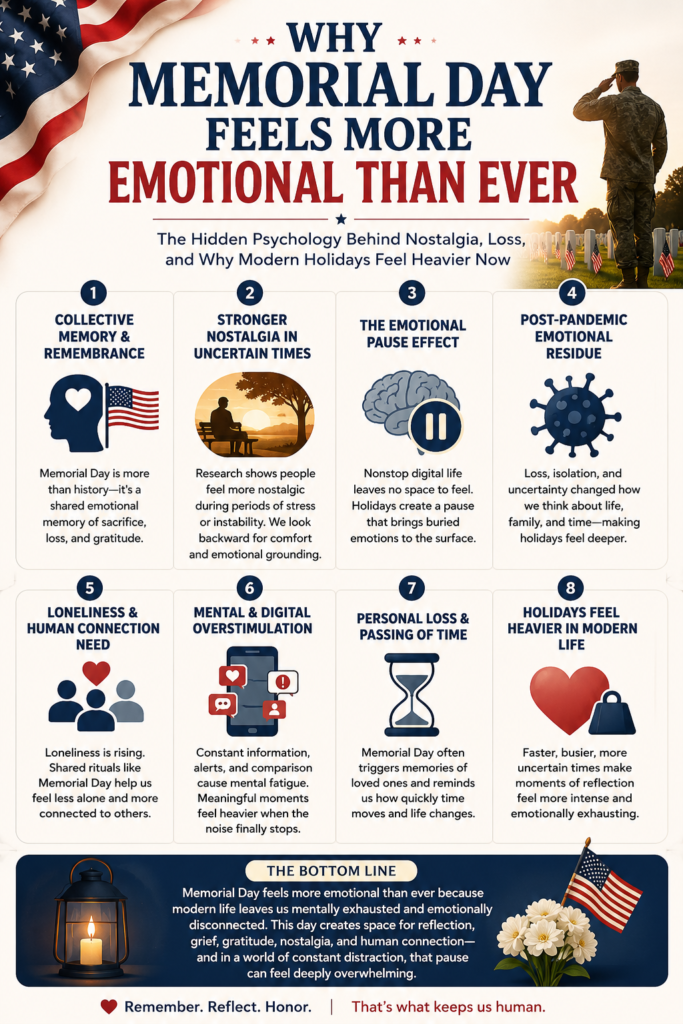
Memorial Day Is Deeply Connected to Collective Memory
Psychologists often describe Memorial Day as a form of collective remembrance.
It’s not only about military history.
It’s about shared emotional memory.
Humans naturally create rituals around grief, sacrifice, and reflection because rituals help people emotionally process uncertainty and loss.
That’s one reason Memorial Day feels unusually powerful compared to ordinary holidays.
It asks people to slow down and remember.
And in today’s nonstop digital culture, remembering itself has become emotional.
Why Nostalgia Feels Stronger Than Ever Right Now
Researchers studying nostalgia found something fascinating:
People experience nostalgia more intensely during periods of instability or uncertainty.
In other words:
When life feels emotionally overwhelming, humans instinctively look backward for emotional grounding.
That’s why Memorial Day can suddenly trigger:
childhood memories
old family gatherings
memories of relatives
feelings of time passing
emotional reflection about life itself
Sometimes the emotion is not even directly about the holiday.
It’s about what people feel they’ve lost over time.
The “Emotional Pause” Effect
Modern society rarely allows people to stop emotionally.
Phones never stop vibrating. News never stops updating. Algorithms constantly demand attention.
But Memorial Day creates a temporary emotional interruption.
And once people slow down, suppressed emotions often surface.
Psychologists sometimes call this an emotional decompression effect.
The brain finally has space to process feelings that were previously buried under routine and distraction.
That’s why holidays can unexpectedly make people emotional — even when nothing “bad” happened.
Why Memorial Day Feels More Personal After the Pandemic Era
The pandemic changed how many people think about:
mortality
family
time
absence
connection
Even years later, many people still carry unresolved emotional fatigue from that period.
That emotional residue quietly changes how holidays feel.
Memorial Day now reminds many people not only of military sacrifice — but also of personal loss, social change, and how fragile normal life can suddenly become.
That emotional overlap makes the holiday feel deeper than before.
The Psychology of Shared Grief and National Reflection
Sociologists have long argued that collective rituals help societies maintain emotional cohesion.
In simpler terms:
Shared remembrance helps people feel less alone.
That matters because modern loneliness has become a major issue.
Studies from organizations like the U.S. Surgeon General’s office increasingly describe loneliness as a public health concern.
That’s why Memorial Day gatherings, ceremonies, flags, and moments of silence still emotionally affect people — even those who aren’t directly connected to military families.
Humans psychologically need shared meaning.
Especially during uncertain periods.
Why Even “Normal” People Feel Emotional on Memorial Day
I noticed this personally last year.
I wasn’t attending a ceremony. I wasn’t thinking deeply about history.
But while driving past rows of American flags outside a small local memorial site, I suddenly felt unexpectedly emotional.
Not dramatic sadness.
Just a strange awareness of time, sacrifice, and how quickly life moves.
That feeling stayed with me the rest of the day.
And honestly, I think many people quietly experience similar moments now.
Especially in a world that constantly pushes people to stay distracted.
Why Modern Holidays Feel Heavier Than They Used To
There’s another reason Memorial Day feels more emotional now:
People are mentally exhausted.
Books like The Anxious Generation and research on digital overstimulation increasingly suggest that constant online life weakens emotional recovery.
As a result, meaningful pauses feel psychologically stronger.
Memorial Day interrupts the noise.
And when the noise briefly stops, people often reconnect with emotions they didn’t realize they were carrying.
Why This Emotional Trend Will Probably Continue
As modern life becomes:
faster
more digital
more algorithmic
more uncertain
people will likely continue craving emotionally meaningful rituals.
That’s why holidays tied to reflection, memory, and human connection may feel increasingly powerful over time.
Not because people suddenly became more sentimental.
But because emotionally grounded moments are becoming rarer.
Final Thoughts
Memorial Day feels more emotional than ever because modern life increasingly leaves people mentally overstimulated but emotionally disconnected.
The holiday temporarily interrupts that cycle.
It creates space for:
reflection
grief
gratitude
nostalgia
emotional reconnection
And sometimes, in a culture built around constant distraction, simply feeling something deeply again can be surprisingly overwhelming.
Maybe that’s why Memorial Day feels different now.
Not because the holiday changed.
But because people did.
Read Next: Related Articles on Solveyourday
If Memorial Day feels unusually emotional this year, these related articles explain the deeper psychology behind nostalgia, mental fatigue, overstimulation, and why modern life makes ordinary moments feel heavier.