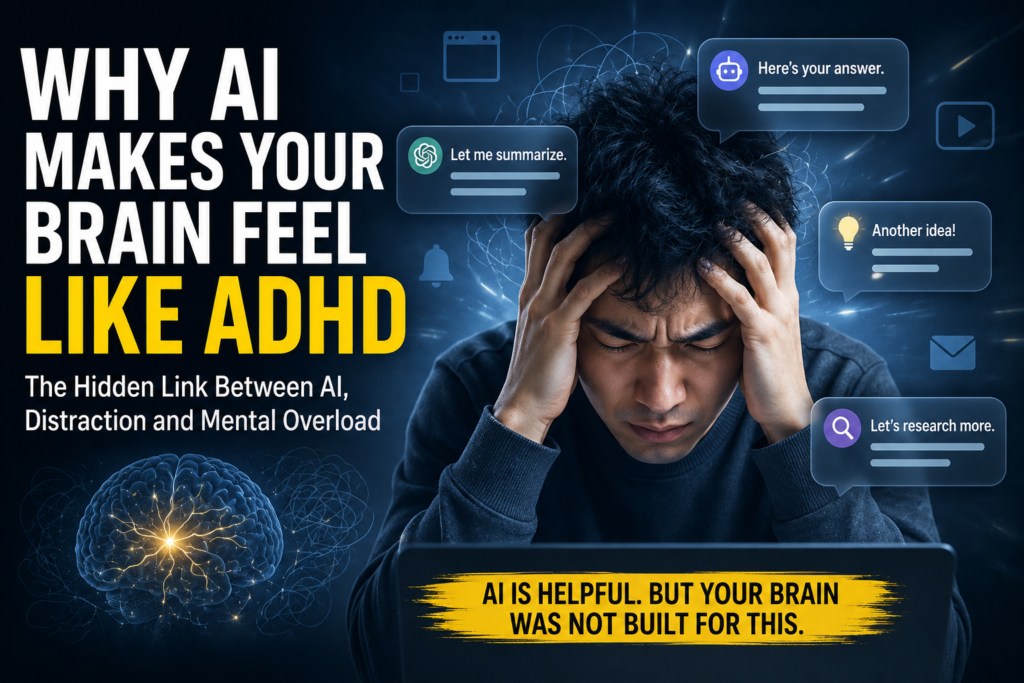
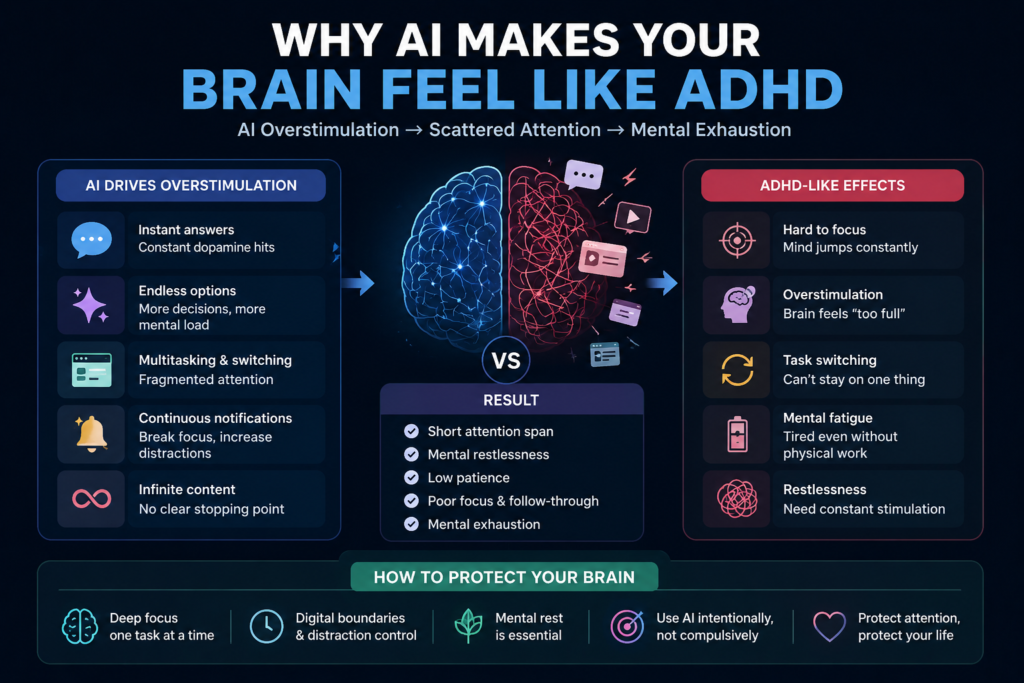
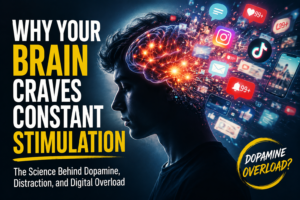
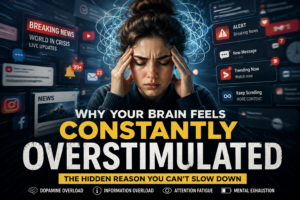
AI tools may quietly overstimulate attention, increase mental fragmentation, and create ADHD-like focus patterns through nonstop digital stimulation.
Why AI Makes Your Brain Feel Like ADHD
Artificial intelligence was designed to save time.
Instead, many people are starting to feel mentally scattered, overstimulated, and unable to focus for long periods of time.
You open ChatGPT for one task. Ten minutes later, you are switching between tabs, rewriting prompts, checking notifications, comparing answers, and forgetting what you originally planned to do.
For many people, modern AI tools create a strange psychological feeling:
“My brain feels like it has ADHD.”
That does not mean AI causes ADHD medically.
But the way AI changes attention, stimulation, decision-making, and cognitive habits can feel surprisingly similar to ADHD-like attention patterns.
And researchers are starting to pay closer attention to the psychological effects of constant digital stimulation.
Why AI Feels So Mentally Stimulating
The human brain is highly sensitive to novelty.
Every time AI generates:
A new answer
A faster shortcut
A better idea
A personalized response
An instant solution
the brain receives a small psychological reward.
This reward system is heavily connected to dopamine, the neurotransmitter associated with motivation, anticipation, and novelty-seeking behavior.
Psychologists have studied similar patterns for years in:
Social media
Short-form video platforms
Mobile notifications
Infinite scrolling systems
AI may intensify this effect because the interaction feels personalized and intellectually stimulating at the same time.
Unlike passive scrolling, AI constantly responds to you directly.
That makes the stimulation harder to disengage from.
The Brain Was Never Designed for Constant Input
Modern AI tools dramatically increase cognitive input.
At any moment, users can generate:
More ideas
More summaries
More options
More content
More decisions
This creates a state researchers often describe as cognitive overload.
The brain struggles when too much information arrives too quickly without sufficient recovery time.
In The Shallows, author Nicholas Carr argued that digital technology gradually changes how humans process information, making sustained concentration more difficult over time.
AI systems may accelerate that trend.
Instead of deeply processing information, users increasingly skim, switch, compare, and optimize continuously.
Why AI Encourages Constant Task Switching
One major similarity between AI overstimulation and ADHD-like attention patterns is frequent context switching.
AI workflows often encourage users to:
Jump between tasks
Rewrite prompts repeatedly
Compare outputs constantly
Open multiple tools simultaneously
Search for “better” answers endlessly
Research from the University of California Irvine found that repeated task switching reduces focus and increases mental fatigue significantly.
Every interruption creates a small cognitive cost.
Over time, the brain struggles to fully settle into deep concentration.
This creates the feeling that attention is constantly fragmented.
Instant Answers Change Attention Patterns
AI reduces friction everywhere.
You no longer need to:
Search manually
Wait for information
Struggle through uncertainty
Think through every problem slowly
At first, this feels incredibly productive.
But psychologists have long warned that instant gratification changes behavioral expectations.
When the brain becomes accustomed to immediate answers, patience for slower cognitive processes often decreases.
This is one reason many people now struggle with:
Long-form reading
Deep focus
Boredom tolerance
Delayed gratification
Complex problem-solving
The brain gradually adapts to faster stimulation cycles.
Why AI Can Feel Addictive
AI tools create a powerful psychological loop:
Curiosity
Instant answer
Dopamine reward
More questions
More stimulation
The cycle repeats continuously.
Behavioral scientists often describe this pattern as variable reward reinforcement — the same psychological mechanism that makes social media, notifications, and gambling systems highly engaging.
The brain never fully knows what useful insight or exciting answer might appear next.
That uncertainty keeps attention locked in.
The Rise of “AI Brain”
Some online communities have started casually using phrases like:
“AI brain”
“ChatGPT brain”
“TikTok brain for productivity”
These phrases reflect a growing feeling that constant AI interaction may be changing attention patterns.
Infinite digital stimulation changes reward sensitivity
AI may amplify all of these simultaneously because it combines:
Instant gratification
Personalized interaction
Endless novelty
Continuous cognitive stimulation
This makes AI psychologically different from older digital tools.
Why High Performers May Be Most Vulnerable
Ironically, highly productive people may experience AI overstimulation more intensely than others.
Why?
Because ambitious people often try to optimize everything.
AI tools create the illusion that:
More output is always possible
Faster productivity is always achievable
Better optimization always exists
This creates a dangerous cycle of nonstop cognitive engagement.
Instead of simplifying life, AI sometimes traps users inside endless optimization loops.
The result is mental exhaustion disguised as productivity.
The Attention Economy Is Evolving Again
Social media companies competed for human attention.
AI systems may compete for human cognition itself.
That distinction matters.
AI is not just capturing time.
It increasingly influences:
Thinking patterns
Decision-making habits
Attention allocation
Cognitive behavior
This is why some experts believe AI could reshape human psychology more deeply than previous digital technologies.
Why Mental Recovery Is Becoming Harder
The human brain requires downtime to recover properly.
Periods of:
Silence
Reflection
Boredom
Slow thinking
Unstructured attention
are essential for mental clarity.
But AI systems make constant stimulation incredibly accessible.
Many people no longer experience true cognitive rest because the brain remains continuously engaged.
This may explain why so many users describe feeling:
Mentally tired
Restless
Overstimulated
Unable to focus
Constantly distracted
even after relatively short periods of AI use.
The Hidden Danger of Endless Optimization
Perhaps the biggest hidden risk is not AI itself.
It is the belief that humans should always operate at machine speed.
AI tools encourage constant optimization:
Faster thinking
Faster writing
Faster responses
Faster workflows
But human cognition still has limits.
The brain cannot remain in continuous stimulation mode forever without consequences.
Ignoring those limits may eventually create widespread attention fatigue and chronic mental exhaustion.
Constant AI stimulation may fragment attention, increase mental fatigue, and create ADHD-like focus patterns through nonstop cognitive overload.
Final Thoughts
AI is not inherently harmful.
In many cases, it genuinely improves productivity, learning, and creativity.
But the psychological effects of nonstop digital stimulation are becoming harder to ignore.
The more AI systems reduce friction and increase cognitive speed, the more important mental recovery becomes.
Because the future challenge may not be whether AI can think faster than humans.
It may be whether humans can protect their attention long enough to think clearly at all.
AI OVERSTIMULATION & ATTENTION
Recommended Reading
Explore more articles about AI burnout, attention fatigue, cognitive overload, digital overstimulation, and how modern technology changes the way the brain focuses.
National Institute of Mental Health: ADHD
— Medical overview of ADHD symptoms and attention-related behavior. Useful for clearly separating clinical ADHD from ADHD-like digital overstimulation.