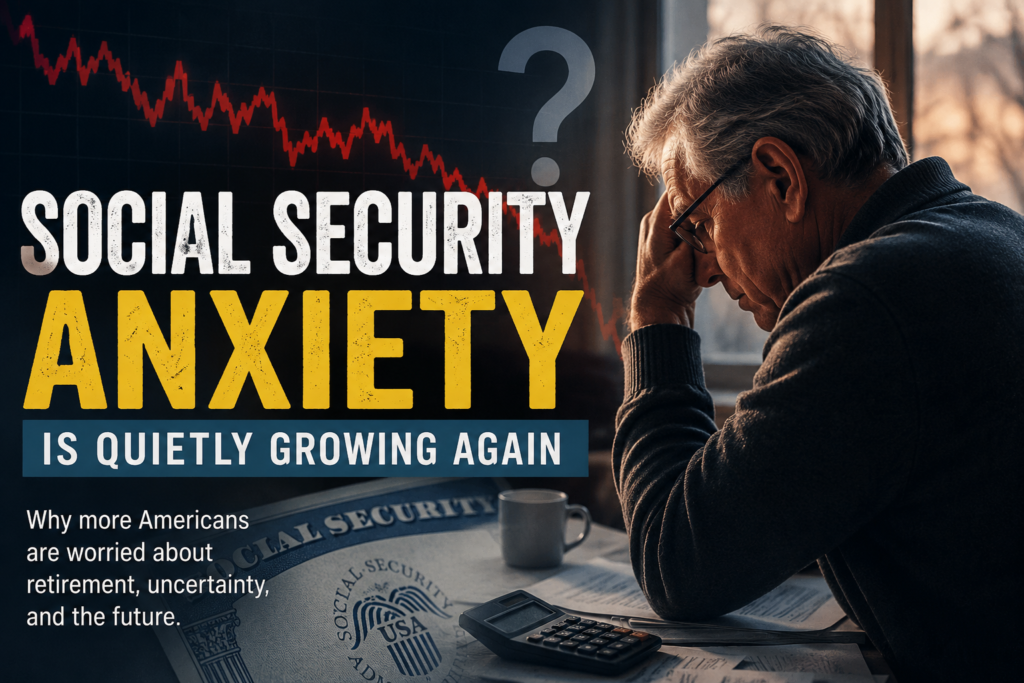
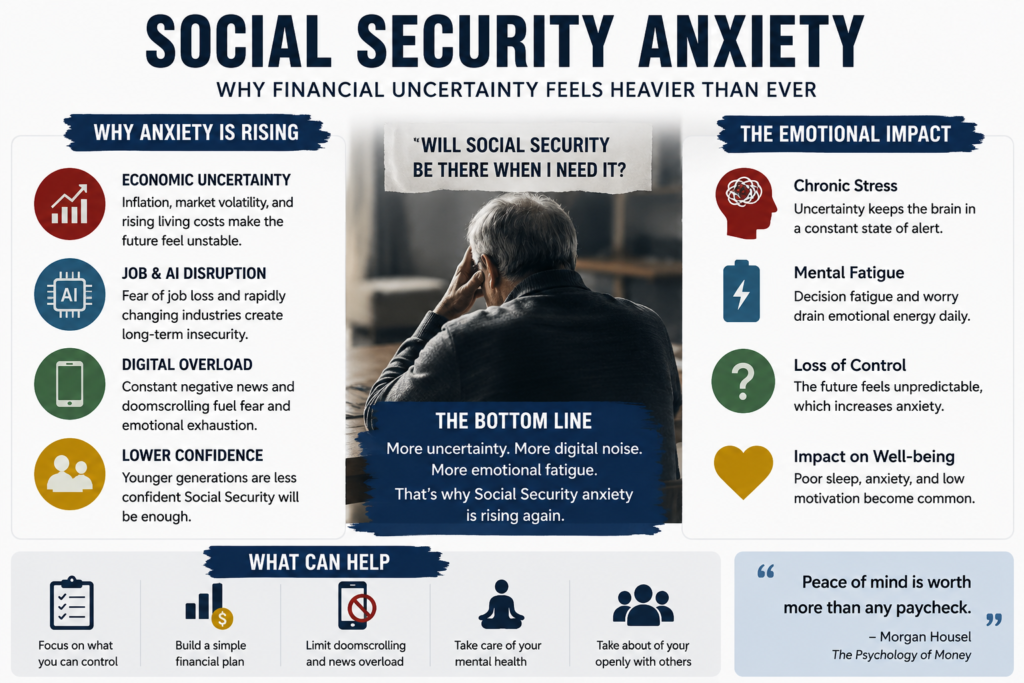
Financial uncertainty, retirement fears, and economic anxiety are becoming emotionally heavier for many Americans in the digital age.
Why Social Security Anxiety Is Rising Again
Last winter, I caught myself doing something my parents used to do.
I woke up at 2:17 AM, grabbed my phone, and searched:
“Will Social Security run out?”
Not because retirement was close for me.
Honestly, it wasn’t even about retirement.
It was the feeling underneath the question.
The feeling that modern life suddenly feels less stable than it used to.
And lately, I’ve noticed more people quietly carrying that same anxiety.
At grocery stores. In Reddit threads. On YouTube finance channels. In exhausted conversations about work, inflation, AI, and whether the future still feels dependable anymore.
That’s probably why searches related to Social Security, retirement fears, and long-term financial anxiety have quietly started rising again.
And psychologically, it makes perfect sense.
Why Social Security Anxiety Feels Different Now
Financial stress has always existed.
But today’s version feels heavier.
Not just because of money itself.
Because uncertainty became constant.
A few years ago, people worried about:
recessions
layoffs
retirement savings
Now the anxiety feels more personal and nonstop.
People scroll through:
inflation headlines
AI replacing jobs
retirement warnings
housing panic
market crashes
“you’ll never retire” videos
before they even finish breakfast.
At some point, financial awareness quietly turns into emotional exhaustion.
And I don’t think most people even realize it’s happening.
The Future Suddenly Feels Harder To Picture
One thing I’ve noticed recently is that people talk about the future differently now.
Even financially responsible people sound emotionally tired.
A friend told me a few months ago:
“I’m saving money, but somehow I still don’t feel safe.”
That sentence stuck with me.
Because modern anxiety often isn’t logical anymore.
It’s ambient.
It sits quietly in the background all day:
rising costs
unstable careers
constant bad news
digital overload
fear of falling behind
And eventually the nervous system starts treating uncertainty itself like a permanent threat.
Social Media Made Financial Fear Feel Personal
This is probably one of the biggest reasons Social Security anxiety feels stronger now.
Fear became algorithmic.
Platforms constantly push:
alarming headlines
recession predictions
retirement panic
emotional financial content
because fear keeps people scrolling.
Calm financial planning rarely goes viral.
Panic does.
A study discussed by researchers from Pew Research Center found that younger generations increasingly feel uncertain about long-term financial stability and institutional trust.
And honestly, that uncertainty shows up everywhere online now.
You can almost feel it in the tone of conversations.
I Started Noticing My Own Financial Doomscrolling
A few months ago, I realized I had developed a strange habit.
Every night before sleeping, I checked:
economic news
stock market headlines
AI job discussions
inflation updates
Not because I needed immediate information.
Because my brain kept looking for reassurance.
But reassurance never really came.
One article led to another. Then another. Then another.
Forty minutes disappeared.
And afterward, I didn’t feel more prepared for the future.
I just felt mentally heavier.
That’s when I realized modern financial anxiety behaves a lot like doomscrolling.
The brain keeps searching for certainty in an environment designed to continuously produce uncertainty.
Why Uncertainty Feels So Emotionally Exhausting
Psychologists have studied uncertainty-related stress for years.
One consistent finding appears repeatedly:
Humans struggle deeply when the future feels unpredictable.
In many cases, uncertainty creates more chronic stress than known hardship.
Because the brain constantly asks:
“Will things eventually be okay?”
When the answer stays unclear for too long, emotional fatigue builds quietly in the background.
Author Morgan Housel wrote that money is never purely mathematical. It’s emotional. Personal. Psychological.
And today, financial fear increasingly feels emotional before it feels rational.
AI Anxiety Quietly Changed Retirement Psychology Too
There’s another layer people don’t always talk about openly.
AI changed how many workers emotionally imagine the future.
Even people with stable jobs now wonder:
Will my industry still exist?
Will salaries fall?
Will my skills matter in ten years?
Will retirement become harder?
That uncertainty changes long-term thinking dramatically.
Because retirement planning depends heavily on one emotional belief:
“The future will probably stay somewhat understandable.”
Right now, many people no longer feel that confidence.
And I think that emotional instability is one of the biggest hidden reasons Social Security anxiety feels larger now.
Why Younger Generations Feel Especially Uneasy
For many younger adults, retirement almost feels abstract now.
Housing feels expensive. Living costs keep rising. Career paths feel unstable. Everything changes quickly.
So long-term financial planning sometimes feels emotionally disconnected from reality.
Some people react by obsessively consuming finance content.
Others avoid thinking about money entirely.
But both reactions often come from the same place:
Mental exhaustion.
Modern Life Made “Feeling Safe” Harder
One thing I keep noticing is that people no longer only want financial success.
They want emotional stability.
That’s different.
Years ago, retirement conversations sounded hopeful.
Now they often sound anxious.
People talk more about:
burnout
exhaustion
instability
survival
uncertainty
than freedom or peace.
And honestly, I think that says something bigger about modern life itself.
The real fear may not be poverty.
It may be never feeling mentally secure again.
The Internet Turned Financial Anxiety Into A Daily Emotion
The human brain was never designed to process economic fear 24 hours a day.
But smartphones quietly changed that.
Now financial stress arrives through:
notifications
TikTok clips
Reddit threads
YouTube warnings
Twitter panic
constant comparison
The nervous system never fully rests.
And after enough exposure, even ordinary financial discussions start feeling emotionally overwhelming.
I think many people are carrying more invisible financial stress than they realize right now.
Modern financial anxiety is becoming emotionally heavier as inflation, AI uncertainty, doomscrolling, and economic instability reshape how people think about retirement and long-term security.
Final Thoughts
Social Security anxiety is rising again because modern uncertainty feels emotionally nonstop.
Inflation amplified fear. AI amplified unpredictability. Social media amplified panic. And digital life amplified emotional exhaustion.
The result is a generation of people who increasingly struggle to feel psychologically safe about the future — even when they’re trying to plan responsibly.
And maybe that’s the deeper issue behind all of this.
The problem isn’t only money.
It’s that modern life quietly made stability itself feel harder to trust.
Related Reading: Financial Anxiety, AI Uncertainty, and Modern Stress
If Social Security anxiety feels heavier than before, these related articles explore how money worries, AI disruption, digital overload, and uncertainty affect the modern mind.