Modern life rarely gives the brain silence anymore.
And many people are starting to feel the consequences.
Tasks that once felt simple now feel strangely heavy.
Replying to messages feels draining.
Making decisions feels exhausting.
Even relaxing sometimes feels like work.
More people are quietly asking the same question:
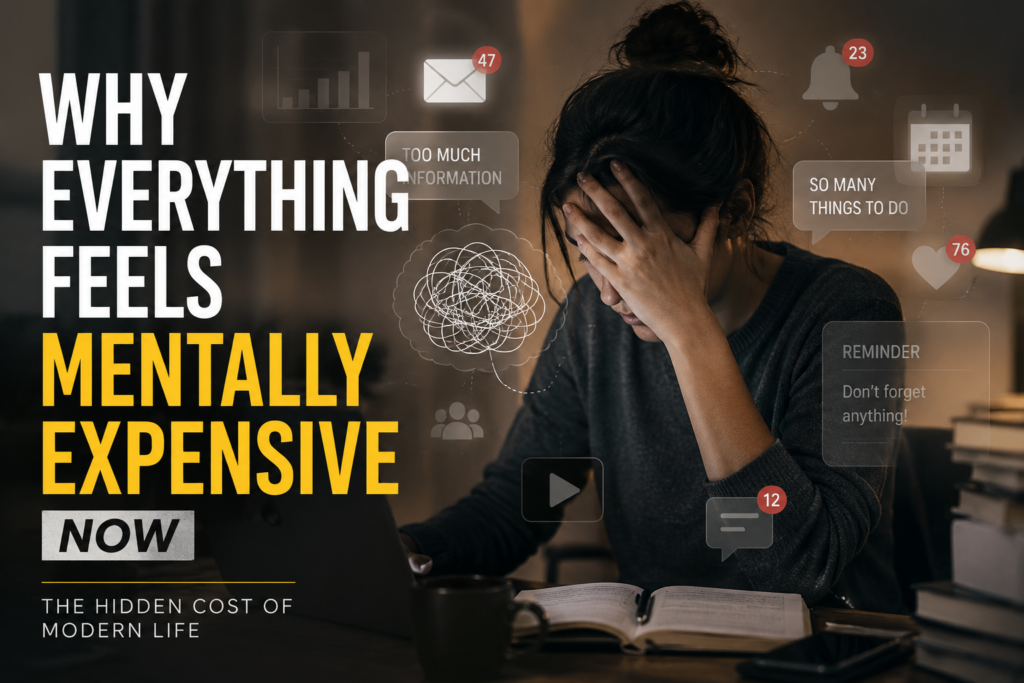
Why does everything feel mentally expensive now?
The answer is bigger than stress.
It is connected to how modern technology, digital environments, constant stimulation, and cognitive overload are reshaping the human brain.
The Human Brain Is Facing an Unnatural Level of Stimulation
Human beings evolved in environments with limited information.
For thousands of years, most people only needed to focus on immediate survival:
food, shelter, weather, danger, community.
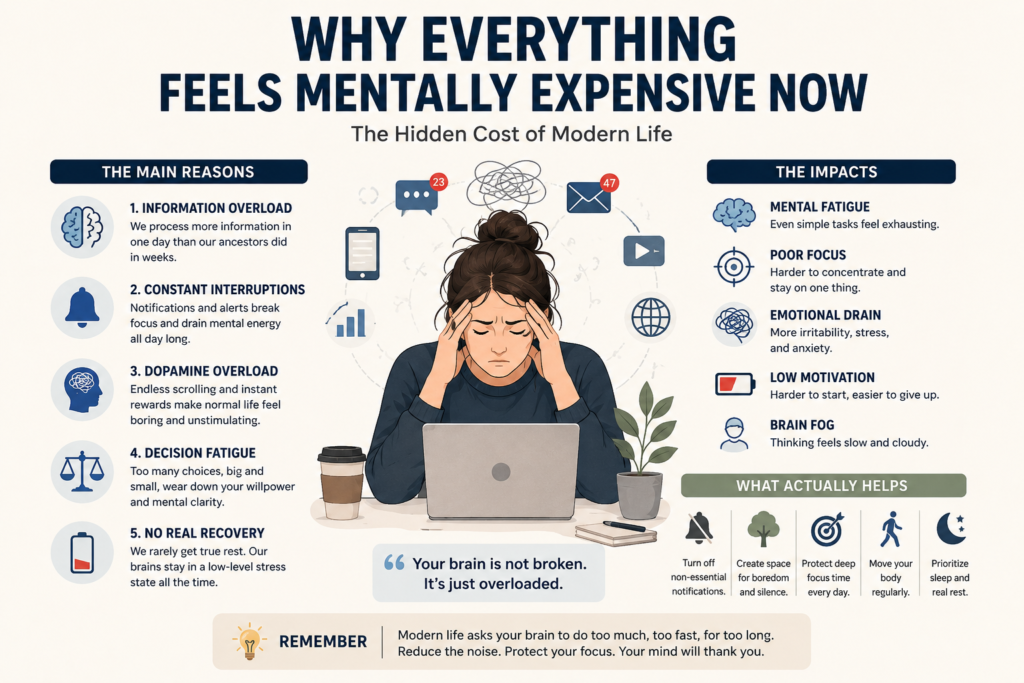
Today, the average person consumes more information in a single day than previous generations encountered in weeks.
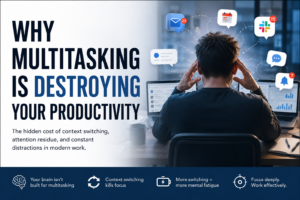
According to researchers at the University of California, Irvine, workplace interruptions significantly increase stress, frustration, and mental fatigue.
Every notification forces the brain to switch attention.
And attention switching is expensive.
Neuroscientists often refer to this as “task-switching cost.”
Even brief distractions leave behind what psychologists call attention residue — part of your mental focus remains attached to the previous task.
This means many people never experience true concentration anymore.
Their attention becomes fragmented all day long.
And fragmented attention creates mental exhaustion.
Why Your Brain Feels Tired Even When You Did “Nothing”
One of the strangest parts of modern burnout is this:
people often feel exhausted without accomplishing much.
That experience is real.
Because mental fatigue is not only caused by hard work.
It is also caused by constant low-level cognitive processing.
Consider a normal day:
You check Instagram for a few minutes.
Then answer Slack messages.
Then read the news.
Then switch to email.
Then watch short videos.
Then return to unfinished work.
The brain continuously reorients itself between emotional states, contexts, and priorities.
That constant recalibration consumes energy.
A Microsoft study on attention spans and digital behavior found that modern workers are interrupted or switch tasks incredibly frequently during the workday.
Many people no longer work in long periods of focus.
They exist in permanent partial attention.
And the brain was never designed for that.
The Attention Economy Profits From Your Mental Exhaustion
Modern platforms are carefully engineered to capture attention.
Not occasionally.
Continuously.
Social media companies, streaming services, online news platforms, and short-form video apps compete in what many experts call the “attention economy.”
The longer you stay engaged, the more profitable you become.
Former Google design ethicist Tristan Harris has repeatedly warned that many digital systems intentionally exploit psychological vulnerabilities.
A report from the American Psychological Association linked excessive digital engagement to higher stress levels, sleep problems, reduced concentration, and emotional fatigue.
This does not mean technology itself is bad.
But it does mean modern digital environments are far more psychologically aggressive than most people realize.
Dopamine Overload Is Changing Everyday Motivation
Many people today struggle to enjoy slower activities.
Reading feels harder.
Deep work feels uncomfortable.
Long conversations feel less stimulating.
Silence feels almost unnatural.
Part of this shift may be connected to dopamine overstimulation.
Dopamine is not simply the “pleasure chemical.”
It plays a major role in motivation, anticipation, novelty-seeking, and reward prediction.
Short-form content platforms create rapid cycles of novelty:
new video, new image, new headline, new emotional trigger.
Over time, the brain adapts to high-speed stimulation.
As a result, ordinary life can start feeling emotionally underwhelming by comparison.
This helps explain why many people:
procrastinate more easily,
lose focus quickly,
struggle with boredom,
and constantly seek stimulation without feeling satisfied.
Researchers studying digital behavior and reward systems have increasingly connected excessive stimulation to attention difficulties and impulsive behavior patterns.
The issue is not weakness.
The issue is neurological overload.
Why Decision Fatigue Is Quietly Destroying Mental Energy
Modern life contains an overwhelming number of invisible decisions.
What should I reply to first?
Should I answer now or later?
Should I optimize this?
Which content should I consume?
What if I am missing something important?
Psychologist Barry Schwartz described this phenomenon as “the paradox of choice.”
Too many options increase mental strain rather than freedom.
Even small decisions accumulate cognitive cost throughout the day.
This is called decision fatigue.
Some high-performing executives intentionally reduce unnecessary decisions.
Steve Jobs famously wore similar outfits daily.
Barack Obama discussed limiting minor choices to preserve mental energy for more important decisions.
The reason is simple:
the brain has limited cognitive resources.
And modern environments constantly demand them.
Why Social Media Makes Mental Exhaustion Worse
Social media does not only consume attention.
It also amplifies emotional comparison.
People constantly encounter:
curated success,
productivity culture,
financial achievement,
beauty standards,
self-improvement pressure.
Even passive scrolling can trigger subconscious stress responses.
Researchers have linked heavy social media usage to anxiety, depression, lower self-esteem, and emotional exhaustion — especially among younger adults.
The problem is not only comparison itself.
It is the feeling of continuous psychological exposure.
The human nervous system rarely gets time to emotionally disengage anymore.
The Pandemic Changed How People Experience Recovery
Many people underestimate how deeply the pandemic changed mental recovery patterns.
Remote work blurred the line between personal life and professional life.
Home stopped feeling like rest.
Laptops remained open late into the evening.
Notifications never truly stopped.
Even after lockdowns ended, burnout rates remained elevated across multiple industries.
According to surveys from major workplace studies, employees increasingly report emotional exhaustion, cognitive fatigue, and difficulty disconnecting from work.
For many people, the nervous system never fully returned to baseline.
Why So Many People Feel Constantly Overwhelmed
Mental exhaustion today is often cumulative.
Not dramatic.
Not obvious.
Just constant.
Small cognitive pressures build all day long:
notifications, unfinished tasks, financial anxiety, information overload, social pressure, digital noise.
Eventually, the brain reaches saturation.
And when cognitive load remains high for too long, people begin experiencing:
brain fog,
irritability,
low motivation,
poor focus,
emotional numbness,
chronic procrastination.
Many people assume this means they are lazy or undisciplined.
But often, the real issue is cognitive overload.
How To Make Life Feel Less Mentally Expensive
The solution is not escaping technology completely.
That is unrealistic.
The real goal is reducing unnecessary mental friction.
Small changes matter more than people think.
Turn off non-essential notifications.
Stop consuming information immediately after waking up.
Create periods of uninterrupted focus.
Reduce multitasking.
Take walks without constant input.
Allow your brain to experience boredom again.
Research consistently shows that deep focus, proper recovery, physical movement, and reduced digital overstimulation improve cognitive performance and emotional well-being.
The modern brain desperately needs recovery space.
Final Thoughts
Many people secretly believe they are becoming weaker.
Less disciplined.
Less motivated.
Less focused.
But modern life places enormous psychological demands on the human brain.
Never-ending stimulation, constant information, algorithmic attention competition, and cognitive overload have fundamentally changed how people experience everyday life.
That is why simple things now feel mentally expensive.
Your brain is not failing.
It is overloaded.
And sometimes the healthiest thing you can do is create enough silence for your mind to recover.
SEO FAQ Section
Why does everything feel mentally exhausting lately?
Modern life exposes people to constant stimulation, digital overload, decision fatigue, and fragmented attention. Research suggests excessive cognitive input increases mental fatigue and emotional exhaustion.
What is cognitive overload?
Cognitive overload happens when the brain processes more information than it can effectively manage, leading to stress, reduced focus, fatigue, and poor decision-making.
Can social media cause mental exhaustion?
Research increasingly links excessive social media usage to emotional fatigue, anxiety, attention problems, and overstimulation due to continuous comparison and rapid dopamine-driven content consumption.
How do I reduce mental fatigue?
Reducing notifications, improving sleep, limiting multitasking, taking breaks from constant stimulation, and protecting focused work periods can significantly improve mental recovery and cognitive performance.
MENTAL OVERLOAD & MODERN LIFE
Recommended Reading
Explore more articles about decision fatigue, digital overload, mental exhaustion, productivity pressure, and why modern life increasingly feels cognitively expensive.
Information Overload
— Research overview explaining how excessive information reduces decision quality, increases stress, and overwhelms cognitive processing capacity.
Decision Fatigue Explained
— Psychological research describing how repeated daily choices gradually deplete mental energy and self-control.
Digital Overload & Cognitive Fatigue
— Analysis of how nonstop notifications, meetings, multitasking, and digital fragmentation create “brain fog” and mental exhaustion in modern work environments.
The Science Behind Decision Fatigue
— Mental health experts explain why even small daily choices eventually make life feel mentally overwhelming and emotionally expensive.